StatCounter

Friday, November 03, 2023

Typologies – enough said?

 Money Laundering Bulletin, 18 March 2023

Knowing exactly how the launderers operate surely assists in frustrating their designs but then in detailing methods publicly there's a risk of educating other bad actors: at least, that's the logic – does it stand up? Paul Cochrane investigates.

Should all anti-money laundering typologies be made public? AML experts argue it depends on the circumstances, but as criminals are usually ahead of the curve, there probably won't be much new for them to learn other, perhaps, than if the nitty-gritty of a case is revealed.

There is no shortage of money laundering and terrorist financing typologies that highlight the various methods and schemes criminals use to conceal and move illicit funds.

The Financial Action Task Force (FATF) lists some 43 typology reports and trends published between 2006 and 2021. (1) Similar material is issued by FATF-style regional bodies, and regulators, with national risk assessments (NRAs) signed off at the central government level.

Nothing new

Moreover, said Tristram Hicks, a former New Scotland Yard detective superintendent, and an AML and criminal justice expert in the UK, so many ML typologies are already in the public arena, criminals might do well simply to watch popular crime dramas: “Screenplay writers have gotten the importance of money laundering as a pivotal piece of the plot, and they write typologies and broadcast them. I don’t think FATF or other publishers of typologies can add much to them,” said Hicks.

Papers in academic journals, media reports and training courses for anti-money laundering (AML) professionals also detail ML typologies. The Journal of Money Laundering and Control, for instance, has a paper on ‘Twelve methods of money laundering,’ which discusses “how feasible it is for intelligent criminals to circumvent existing AML mechanisms” based on interviews with launderers and AML specialists. (2) And the Journal of Financial Crime writes on Bitcoin money laundering. (3) The Association of Certified Financial Crime Specialists (ACFCS) has an article on how to launder US$1 million “easily, quickly and quietly”. (4)

With academic papers widely available on searchable databases such as Google Scholar, “honestly, if you want to know how to do money laundering the academic literature gives you a pretty good idea, and what law enforcement is looking out for. I don’t think it’s very secret, and I don’t think that criminals study the typologies to know what to do; they adopt the techniques of more experienced people,” added Hicks.

Legislation is certainly read by professional criminals: “After the Proceeds of Crime Act 2002 was published in the UK, the police found a copy of the Act in the bedside drawer of a well-known drug dealer - that is very diligent of that particular criminal!” recalled Hicks.

FATF 'guidance'

FATF’s mutual evaluation reports (MER) on how a jurisdiction is fairing in its efforts to combat money laundering and terrorism financing can also be abused by criminals, noted Ross Delston, an American lawyer, AML expert witness and former US banking regulator: “Every time there’s an announcement by law enforcement that they’ve shut down a money laundering operation in a particular country, that’s a message to launderers everywhere that this jurisdiction is an attractive place. But the counter argument is that criminals already knew that, and there is a list of offshore financial centres of which some are rigorous, and others are outliers. It is easy to find the outliers. In fact, FATF’s MER system will tell a financial criminal where to look,” he said.

“Typologies are not that helpful as they’ve been generalised, redacted and sanitised to be applicable to more than one case,” said Delston.

There is a grey zone though, with judgement calls difficult to make. In general, “there is probably very little straight citizens can tell criminals, especially criminal who specialise in financial crime, about how to launder money. But one never knows what one might be revealing,” said Delston. He recalled that objections have been raised in the past about the hosting of financial crime conferences that discuss weaknesses in the regulatory system and at financial institutions. “They can be fodder for financial criminals, yet issues also need to be discussed,” he said.

Discretion in some cases

Finding the balance between what to reveal or not is a fine one. Delston was hesitant to discuss the typologies revealed during legal cases in which he has appeared as an expert witness. “I’ve seen things shared behind closed doors that were never made public as a typology or red flag, yet I thought they were of great interest. The reluctance is that maybe there’s something helpful to the criminal element, such as revealing the sources and methods,” he said.

“Another concern is that some particular person at a financial institution will be fingered and therefore in jeopardy. There are lots of reasons to not be too specific,” said Delston. “As is the case with suspicious activity reports (SARs), one of the primary goals in AML/CFT reporting of any type, including typologies, is that particular financial institutions and the identities of employees need to have their identity masked. And that would include any clues as to which component of a particular financial institution, which function, which position, and which person played a part in the story that led to the creation of the typology. An overly specific typology could actually put employees of an financial institution in danger if the institution named and jurisdiction isn’t properly hidden. There are some folks out there who would not take kindly to having a spotlight on their criminal activities and would be only too happy to retaliate against the financial institution or its employees.”

Controlled circulation

The lack of detail, however, acts as a break on law enforcement and AML practitioners' ability to fight financial crime. “There really needs to be a research arm of every financial intelligence unit (FIU) that would be charged with putting together longer, more detailed typologies that can be used on a restricted basis,” said Delston. “There are some typologies that are so straightforward that by releasing details to the public criminals and terrorists would have the ability to change their modus operandi in a way that would not raise red flags. Hence, restricting access to certain typologies would be advisable, for example, only to the FIUs themselves – it’s bad enough that criminals are early adopters of technology, including crypto, without giving them a blueprint on how to avoid unwanted attention.”

Determining factors

Ursula M’Crystal, a former South African police officer who has also worked in financial intelligence units in Africa, said how much of a typology should be revealed depends on the jurisdiction and whether the crime combatting apparatus is robust, as well as the levels of corruption. "For high profile law enforcement operations, like an ongoing narcotics project or tracking ISIS financiers, the typologies used by them will usually be kept quite close to the chest. If there are situations where support is needed in relation to financial aspects of these investigations, typology sharing would probably happen through trusted relationships and public-private partnerships,” she said.

M’Crystal said there are times when typologies can and should be shared so that the public sector and law enforcement at large are better informed. She cited the example of the take-down of a catalytic converter theft ring by the US authorities in November 2022. Criminals were stealing the converters, an anti-pollution car part that contains precious metals platinum, palladium and rhodium, which can sell for US$1,000 each on the black market. (5) There was consequential money laundering and publicising the modus operandi (MO) could have an impact on future policy around precious metal trading, she said. “This is a typology that the public needs to know about as it has created problems in many countries, and it also makes us consider that scrapyards are not under the banner of AML requirements in many countries, so if people were selling catalytic converters, those could be treated as scrap metal and not as stolen goods or the proceeds of crime,” said M’Crystal.

Undercover imitation

While legal cases and public policy discussions may require aspects of a criminal’s modus operandi or how law enforcement’s methods to not be revealed, undercover operations may not require such secrecy around typologies.

Former undercover agents Chris Mathers, a Canadian law enforcement veteran (ex-Royal Canadian Mounted Police) and AML expert, and John Cassara, a former US Treasury Special Agent and AML expert, said there was nothing secretive about the money laundering techniques that were used as part of the stings they were involved in.

“We were all doing the same thing as the criminals, there was nothing novel about it. We were pretending to launder money and our goal was to gather evidence. There was just some trade craft that we didn’t want out there,” said Mathers.

Cassara said from a law enforcement perspective, the first priority is safety. “We would never put something out that would jeopardise an undercover agent’s physical safety. Law enforcement continues to use the same methodologies, and the criminals know we do. Undercover investigations have been fairly successful for us, but it is fraught with difficulties, and there are some corrupt agents,” he said.

Known and untraceable

That said, he argued there was far less need to keep typologies under-wraps than the need for more effective law enforcement to go after the money launderers.

Cassara cited the methodology known as the Black-Market Peso Exchange (BMPE). “We’ve known about it since the early 1970s, and how it is used to launder drug money. It is probably the longest running money laundering methodology in the Western hemisphere. We know about it, the criminals know we know, we have taken countermeasures, put out the methodology reports, and had Congressional hearings about it, but we are powerless to stop it,” he said. Chinese criminals are now using the BMPE and similar BMPE financial systems around the world. (6)

Trade-based money laundering (TBML) is another well-known methodology that is widely used.

“TBML is the largest, most pervasive money laundering methodology around the world but also the least known and enforced. We can write books and FATF can issue typology reports on what we need to do, but it is too pervasive,” said Cassara. “When you look at the metrics, law enforcement is doing a bad job in money laundering prosecutions and convictions, and measured by assets seizures and forfeitures.”

To Mathers, the different methods and typologies used “are just branches on one big tree. I haven’t seen anything that has made me go ‘wow’. The criminals are using the same old techniques.” He thinks the focus to stop money laundering and corruption should be on financial institutions knowing their customer (KYC). “All the frauds I deal with on a weekly basis start with someone opening an account at a bank with a false ID, they do a load of transfers, flip it to cryptocurrency, and are gone. It is all about a financial institution knowing their customer and not being corrupted by their clients,” said Mathers.

Notes

1) https://eurasiangroup.org/en/fatf-typology-reports

2) https://www.emerald.com/insight/content/doi/10.1108/JMLC-05-2016-0018/full/html

3) https://www.emerald.com/insight/content/doi/10.1108/JFC-11-2016-0067/full/html

4) https://www.acfcs.org/how-to-launder-1-million-easily-quickly-and-quietly-and-without-catching-the-attention-of-global-authorities-a-view-into-global-aml-vulnerabilities-through-the-eyes-of-the-infilt/

5) https://www.justice.gov/opa/pr/justice-department-announces-takedown-nationwide-catalytic-converter-theft-ring’

6) www.americanthinker.com/articles/2023/03/chinas_role_in_blackmarket_money_laundering_.html


Gold rush

Money Laundering Bulletin, 12 February 2023

Precious, fungible, transportable, accept everywhere – gold is made for laundering. Paul Cochrane, in Pietermaritzburg, considers the challenge for regulators and some attempts to meet it.

The precious metals and stones sector is increasingly under the spotlight for money laundering (ML) and terrorist financing (TF). Fungibility, complexity of supply chains and varying levels of oversight worldwide makes gold, especially, the precious metal of choice for launderers.

Ancient scarcity

Popular as a medium of exchange since antiquity, in part due to its scarcity, just 205,238 tonnes of gold has been mined throughout history, according to the World Gold Council (WGC). That is the equivalent of a 22 square metre cube – the size of a single car garage.

Around two-thirds of all gold has been mined since 1950, with 4,314 tonnes extracted over the past decade, of which 51% (2,215 tonnes) has been used to make jewellery, 26% (1,136 tonnes) for bars and coins, and 8% for technology (337 tonnes). (1)

Last year (2022), demand for gold surged by 18%, its highest in a decade, driven in part by central banks acquiring 1,136 tonnes, double that of 2021. Retail demand also rose, hitting a nine-year high at over 1,200 tonnes, with the rally driven by high inflation, the war in Ukraine spooking financial markets and diversification away from the US dollar, according to the Financial Times. (2) In the last quarter of 2022, the average value of gold trade at the London OTC precious metals markets, the oldest and biggest financial market for gold, hit US$228.88 billion according to the London Bullion Market Association (LBMA). (3)

“Gold is a safe haven mineral, so people tend to rely on it and continue to do so in times of economic turmoil,” said Lakshmi Kumar, policy director, at Washington DC-based Global Financial Integrity (GFI), a think tank.

Out on its own

“Gold is deserving of the attention it gets. Silver is not mined as widely or as profitable, and platinum needs a high level of expertise to process and is not as high risk,” said Marcena Hunter, thematic lead on extractives and illicit flows at the Switzerland-based Global Initiative Against Transnational Organised Crime. In the last quarter of 2022, the average weekly turnover in silver traded on the London OTC precious metals market was US$5.57 billion and palladium US$5.16 billion, according to the LBMA. (4)

“More work could be done on coloured gemstones, but due to the value of stones the sector doesn’t seem to pose the same risks as gold, and is not as fungible or easily exchanged. Diamonds are also not as fungible. In the mineral class, gold certainly poses the biggest vulnerabilities and risks by far,” she said.

Irresistible luster

For criminal activity, gold has long held its allure, with a high value to weight ratio: a Troy ounce (31.1 grams) was worth US$1,864 in February 2023, according to the World Gold Council (WGC) – gold is only sold as Troy ounces not by the regular ounce or 28.35 grams. It also offers near perfect obfuscation, being easy to melt down to remove all traceability.

“Gold is an inherently really difficult commodity to regulate due to the ease of hiding origins and ownership, how it continues to be easy to smuggle, and how it is used as a financial vehicle in exchange for value nearly everywhere in the world. There is a lot about gold that makes it attractive to criminals and illicit networks, and this has not changed (over time),” said Hunter. “As new actors in the compliance and regulatory space get more interested in gold and what is happening, the more they realise how complex it is and why gold is so difficult to regulate. The complexity of the sector really continues to be a challenge,” she said.

In the loupe

As a result, it is not surprising that gold has come increasingly under the AML/CFT spotlight over the last few years, driven in part by exposes by the media and civil society into “conflict gold”, smuggling, and illegal mining. The 'FinCEN Files' leak in 2020 revealed that a quarter of all suspicious transaction reports submitted to the UK financial intelligence unit (FIU), equivalent to US$514.9 billion, involved gold companies, according to the International Consortium of Investigative Journalists (ICIJ). (5)

There has also been impetus by international organisations, such as the United Nations Office on Drugs and Crime (UNODC), to include trafficking and the illegal mining of gold and precious metals as environmental crimes. In January (2023), the UNODC released guidance on Illegal Mining and Trafficking in Metals and Minerals, which recommends UN member states to “introduce offences related to the possession of and trafficking in metals and minerals of illicit origin”. (6)  

Law and regulation – some, finally

Some countries have already responded. In 2022, Switzerland introduced new legislation requiring due diligence and reporting obligations relating to conflict minerals (including gold), while the Monetary Authority of Singapore (the central bank) issued new AML rules for financial institutions involved with precious metals and stones. The United Arab Emirates (UAE) last year introduced new rules on responsible sourcing of gold imports.

Kumar commented: “All the years of reporting and exposing the issue is leading to legislation and governmental action to rectify the situation. These are positive steps we shouldn’t discount or ignore, such as by the UNODC. The UNODC is also looking at how gold moves through free trade zones. But we are now in a waiting period to see how these new measures take effect, and what it will look like. Will gold drop off the radar, and no longer be a shiny objective, like what happened with diamonds?” she asked.

Kumar is referring to the decline in concern about the illicit diamond trade - ‘conflict’ diamonds in particular - in the years since the Kimberly Process (2003) was inked to better regulate the sector. Indeed, the Financial Action Task Force ‘s (FATF) last guidance on diamonds was in 2013. (7)

More action is needed on gold. There has been work on reducing criminal engagement in the sector in sub-Saharan Africa, but developments have been slow, Kumar said. The US Treasury, in March 2022, sanctioned Belgian businessman Alain Goetz and his network of companies, accusing them of aiding the smuggling of gold from the Democratic Republic of Congo (DRC). Targets included the Goetz-operated African Gold Refinery, in Uganda.

“Some governments are still trying to figure out how gold is involved in money laundering, despite a lot of the techniques being known and understood. In the interim, some illicit gold-related activity will continue to flourish if there is not the political will to tackle it,” said Kumar.

Guidance still holds – FATF

Yet while there is more high-level discourse on gold and illicit finance, FATF has not issued any new guidance on ‘money laundering and terrorist financing risks and vulnerabilities associated with gold’ since 2015. (8) A FATF official told MLB: "The methods described are still relevant today. FATF hasn’t done any further research on these topics since then.”

Hunter said the FATF 2015 report still serves as a good primer on why gold is inherently attractive, but thinks an update would be valuable, to highlight more recent money laundering techniques.

Integration risks

One growing concern is the spread of the gold and narcotics nexus from Latin America, where there is a connection between mines, refineries and organised crime. Hunter said cases in Europe and Asia show this typology is spreading. Gold has also been used to evade sanctions, with risks that Russia may be exploiting the trade as part of its financial strategy for the war in Ukraine.

Concentrate

“If there are any ways to smuggle gold that are creative, and allows the movement of money, I’m sure criminals will find it, and we are starting to hear of gold concentrate as one of those methods,” said Hunter. An estimated 12 percent of global gold production stems from concentrates, according to precious metals consultancy Metals Focus, in which it is found mixed with other metals and minerals, and must be separated out. (9) There is scope to pass off a concentrate as some other mineral(s) depending on the percentage of gold present. “There has been less work done on gold concentrates and illicit crime, yet we are seeing large exports and it’s a US$50 billion industry. It is an area with a lot of opacity and secrecy,” said Kumar.

Africa to Dubai

As for major hubs for illicit gold sales, the UAE’s Dubai continues to be a major destination, notably for smuggled African gold, said Hunter. The UAE has been under scrutiny since being grey-listed by FATF in 2021, with its gold trade cited as a vulnerability. “Dubai is engaging more around the issue than it has in the past, whether because of FATF or increasing pressure with sanctions on Russia. It is giving the appearance they are taking the issue more seriously,” said Hunter.

Farai Maguwu, director of the Centre for Natural Resources Governance (CNRG) in Zimbabwe, said Dubai is the prime destination for smuggled gold and diamonds from the country, with an estimated 60 kilogrammes of gold flown from this southern African country to the Emirate every month. Zimbabwe plays host to 100 industrial gold mines, according to the International Crisis Group, and an unknown number of artisanal mines.

“Dubai’s policy is to take advantage of corrupt African regimes by getting their minerals and laundering them in Dubai and re-selling them. I don’t think they are sincere [in cleaning up] and are just pretending to be transparent,” Maguwu told MLB.

Zimbabwe's experience points to interconnected problems with gold and crime, corruption and weak governance. The country’s sole buyer and marketer of gold - Fidelity Printers and Refiners (FPR) – receives between 25 to 30 tonnes a year of locally mined gold, yet CNRG estimates around 100 tonnes a year is flowing out of the country, with the other gold either sourced locally from artisanal miners or smuggled from surrounding countries. (10)

“Zimbabwe is an easy country for smuggling minerals, being a transit route, as well as for drugs. We have a very big governance difficulty, with the country’s leadership involved in smuggling,” said Maguwu.

Artisans – left with no option?

The country is also illustrative of the challenges around regulating the gold supply chain. Heightened focus on the sector led the European Union following the adoption of Regulation 2017/821, effective January 2021, on supply chain due diligence on gold in line with the five steps of the OECD Due Diligence Guidance for Responsible Supply Chains of Minerals from Conflict-Affected and High-Risk Areas. (11) As a result, major gold refiners engaged derisked smaller, especially artisanal miners, said Hunter (12), but it has proved an “ineffective approach.”

Disengagement has merely increased criminal influence. “Gold is a livelihood issue, and when governments crackdown on mining, or give concessions to foreign-owned mining companies, this can disenfranchise the population as it undermines livelihoods (dependent on gold mining),” she said.

Pressure to clean up the gold trade is also coming from international traders: “We are seeing the likes of the London Bullion Market Association (LBMA) encourage banks and refineries to lean in and engage with the gold mining sector to improve practices rather than disengaging or stopping sourcing, which we saw in the past. It is a developmental issue. It is not just regulatory efforts that are needed to support the development of responsible sectors. We need some outside of the box thinking to bring in new innovative strategies and approaches,” said Hunter.

The LBMA told MLB: “Money laundering is a criminal offence and the responsibility for investigating allegations, and, as appropriate, preferring charges [sic], is in the hands of law enforcement agencies not LBMA. Clearly, however, any member of LBMA or any good delivery list (GDL) refiner, convicted of being involved with money laundering, will lose their LBMA membership or GDL accreditation.”

NOTES:

1) https://www.gold.org/about-gold/market-structure-and-flows 

2) https://www.ft.com/content/ef6ed550-422a-4540-a8af-41ff2ac30e67 

3) https://www.lbma.org.uk/prices-and-data/lbma-trade-data

4) https://www.lbma.org.uk/prices-and-data/lbma-trade-data

5) https://www.icij.org/investigations/fincen-files/fincen-files-investigations-into-the-gold-trade-from-around-the-world/and https://papers.ssrn.com/sol3/papers.cfm?abstract_id=3758442 

6) https://www.unodc.org/documents/organized-crime/tools_and_publications/Final_version_Illegal_Mining_and_Trafficking_in_Metals_and_Minerals_200123.pdf 

7) https://www.fatf-gafi.org/en/publications/methodsandtrends/documents/ml-tf-through-trade-in-diamonds.html 

8) https://www.fatf-gafi.org/en/publications/methodsandtrends/documents/ml-tf-risks-and-vulnerabilities-gold.html 

9) https://www.ausimm.com/bulletin/bulletin-articles/gold-concentrate-marketing-101/ 

10) Zimbabwe's disappearing gold. The case of Mazowe and Penhalonga. https://www.cnrgzim.org/_files/ugd/e33f9c_c5efdb731bef475fbab6c05672b37fdc.pdf?index=true 

11) https://www.oecd.org/corporate/mne/mining.htm

12) See report: Lessons learned on managing the interface between large-scale and artisanal and small-scale gold mininghttps://www.gold.org/esg/artisanal-and-small-scale-gold-mining

Egyptian companies forced to 'do illegal things to stay in business'

 Egypt's severe economic crisis push manufacturers to engage in illegal trade practices to remain afloat

Middle East Eye, 11 February 2023


A lack of foreign currency and tough banking requirements to finance imports is forcing many Egyptian manufacturers to engage in smuggling and illegal trade activity to stay afloat, manufacturers and analysts told Middle East Eye. With bogus export practices seemingly widespread, Egypt’s official trade figures may also be inflated. 

For Egyptian businesses dependent on importing raw materials and machinery to manufacture goods it has been a turbulent past year.

The currency has devalued three times against the US dollar since March, losing half its value, while inflation has surged, reaching 22 percent in December.

"Due to inflation and the depreciation, our buying power is over 50 percent less than the start of last year," Gamal*, a Cairo-based garment and textile manufacturer, told Middle East Eye, using a pseudonym.

"It is difficult and expensive to import raw materials and close to impossible to import machinery, even if you have the money."

The skies started to darken for manufacturers last February when Russia invaded Ukraine, which drove up the price of energy, caused delays in the supply chain, and created market uncertainty. Some $22bn was pulled out of the country’s debt market by foreign investors.

Then in March, Cairo depreciated the Egyptian pound to meet International Monetary Fund (IMF) requirements after Egypt sought a $3bn loan, its fourth in six years from the lender, to meet its growing debt obligations. The move drove up the cost of importation for businesses, particularly for firms that did not earn 50 percent or more of their earnings in foreign currencies from exports. 

In May, domestic regulations imposed an additional burden when the Central Bank of Egypt required businesses to use foreign currency for letters of credit (LC) – a bank-issued document that guarantees payment upon delivery of goods or services – instead of dealing directly with international suppliers. 

At the same time, the government increasingly restricted the amounts that foreign currency bureaus were allowed to exchange.

Dollar deposits at banks also started to dry up as account holders transferred their savings into Egyptian pounds to take advantage of local banks offering fixed-term savings certificates with interest rates of over 18 percent, and up to 25 percent as of January. 

"A lot of people exchanged US dollar deposits for Egyptian pounds and then bought the certificates, so this has vacuumed foreign currency out of the local banking system,” said an Egyptian official off the record.

To read the rest go to Middle East Eye 


Wednesday, January 19, 2022

AML, South Africa - Recovery Mode (Money Laundering Bulletin)

                            Cartoon courtesy of Stidy (copyright)


Money Laundering Bulletin: Already seeking to rebuild state institutions and public confidence after the Zuma era, South Africa's government now has an up-to-date mutual evaluation report from the Financial Action Task Force to guide its upgrade of the anti-money laundering regime. Paul Cochrane reports from Pietermaritzburg. 

South Africa has a lot to do to improve its regulatory oversight and more effectively tackle money laundering, which its Financial Intelligence Centre (FIC - the financial intelligence unit) readily admits as it reflects on the country's latest Financial Action Task Force (FATF) mutual evaluation report (MER), released in October (2021)

Thin blue line

The key findings are nothing new: law enforcement, for example, has been hollowed out over the past two decades, especially under former President Jacob Zuma, between 2009 to 2018, according to Open Secrets, a Cape Town-based non profit investigating economic crime linked to human rights violations.

FATF noted that the South Africa Police Service’s (SAPS) Directorate for Priority Crime Investment (DPCI, also known as the Hawks) currently has 3,000 vacancies in its notionally 5,000-strong special investigative team.

“The DPCI is a small unit within the police, and they have lost a lot of people. You see cops from 1994 that have never promoted while others are jumping through the hoops with no qualifications. There was a really good anti-narcotics police unit, and that whole branch of expertise has disappeared,” said a former law enforcement officer, now working as an anti-corruption advisor, who wanted to remain anonymous.

Open Secrets believes the lack of manpower in enforcement is undermining the fight against financial crime. SAPS has a headcount of 187,358 for a population of 58.8 million people despite having one of the highest crime rates in the world, according to the Global Initiative’s Global Organised Crime Index. South Africa's ratio is around 288 policemen per 100,000 citizens, against a global average of 340, according to the UN. “It is one of the most fundamental problems, with massive gaps in the system. Even when cases are identified they are not pursued,” said Michael Marchant, Open Secrets’ head of investigations.

The shortfall is readily admitted by the FIC. “The persons lost have been detrimental to the DPCI’s [work]. They have largely moved to the private sector for more lucrative pay. This has increased reliance on the private sector for work that should have been done by the government,” Christopher Malan, executive manager of the FIC's compliance and prevention division, told MLB.

The impact shows in the number of money laundering convictions: 333 between 2016 and 2021, according to the National Director of Public Prosecutors (NDPP) office. This represents an increase on the previous decade (1999-2009) when there were just 16. Out of the 83,869 reported cases of commercial crimes for the 2019/20 period, the NDPP secured 760 convictions; no figures were released on laundering convictions in the period.

“There is certainly a disconnect between the high number of cases and money laundering convictions. Every investigator should know that when investigating commercial crime, money laundering is standard [goal of the investigation], but that’s not the case,” said the former law enforcement officer.

Terrorist financing and hub status

The record on countering the financing of terrorism (CFT) is particularly woeful, with the FATF report noting that South Africa has only prosecuted one person since its last MER, in 2009.

Asked about the current terrorist financing caseload, Pieter Smit, executive manager of the FIC’s legal and policy division, said there were “more prosecutions than just one” underway. He said FATF’s conclusion that South Africa had a weak perception of its terrorist financing exposure was contentious. “We do believe we have a good understanding of that risk, and to what extent it is happening, but we were unsuccessful in convincing the FATF assessors on that point. A lot of the information is based on sensitive intelligence, so there’s a limit to what can be discussed in a public report. Maybe we made an impression that very little is happening,” Smit told MLB.

The truth is, said Marchant, that South Africa faces numerous financial crime risks, from organised crime to narcotics, to wildlife trafficking, fraud and corruption, with exposure to ML and TF intensified by the fact the country is a regional banking hub for Southern Africa.

“I don’t think there’s any doubt we are a hub for a lot of money in the region, given the developed financial system. The growth and inter-meshed nature of criminal networks and syndicates with the global drug trade and organised crime, and links to police corruption, is a massive problem,” said Marchant.

Smit acknowledged that the FATF report was “spot-on” about South Africa's need to bring “understanding risk into the policy process, the better shaping of future decisions, where policy should be going and [how] resources [are] allocated.” He added: “One specific factor is understanding South Africa’s position as a regional financial hub. That has not received adequate attention in the past, and what that means for cross border [financial] flows into the sub-Saharan region,” he said.

Karam Singh, Corruption Watch’s head of legal and investigations, in Cape Town, thinks law enforcement and regulators should be more active. “There’s clearly a lot of money that leaves the country, and is done through the facilitation of different financial intermediaries. It’s a very porous system. Dubai and Hong Kong would seem to be two of the big destinations,” he said.

Unenviable legacy

One of the top challenges South Africa faces is repairing damage done to state institutions by the Zuma government, which allowed private interests to profit from state capture and grand corruption. During Zuma’s second term in office (2014-18), the cost of state capture was estimated by South African news outlet the Daily Maverick at around ZAR1.5 trillion ($101 billion).

After Cyril Ramaphosa took over in February 2018, he launched numerous presidential Commissions of Inquiry, including the ongoing Zondo Commission into allegations of fraud, corruption and state capture, which is probing senior politicians (including Zuma), state-owned enterprises, and financial institutions.

The FATF report did not comment on the state capture cases, although clearly if embezzlement and corruption are proved in subsequent criminal trials, there will be proceeds of crime at issue - corruption is a predicate offence under South Africa's ML laws. “From looking at provided cases we observed a lack [of action] relating to the issue of state capture," an International Monetary Fund (IMF) official, who worked on the FATF report, told MLB, "which was surprising considering the alleged sums of money involved in some well publicised cases. This lack of focus had a material impact on our view of how effective the authorities were at pursuing complex money laundering cases and those involving larger sums being sent out of South Africa.”

Marchant questioned why SA financial institutions have yet to be investigated in relation to state capture. “You can pick out a whole host of case studies that shows banks were facilitating transactions that were outrageously irregular and suspicious, raising every red flag you could have. No bank has been called to account for larger state capture transactions – no fines, or criminal or civil action, or [questioning] at the Zondo Commission, to explain their role,” he said. 

Bankers' role

The FIC said South African banks could have raised more red flags over state capture.“We firmly believe banks could have done more but the context is very important,” said Malan. “The context now, importantly is about risk: we must push the entire regime towards a better understanding of risk.” Smit observed that “hindsight is always perfect,” and continued: “Maybe 10 years ago banks should have picked up on those transactions and should have reported them if they had the context we now have. Maybe if they did report them [at the time], the FIC didn’t have the context to understand what their suspicious transaction report (STR) meant when it landed in our IT system,” said Smit.

Marchant was blunter: “The banks went to the Zondo Commission, and said the African National Congress [ANC, the ruling party since 1994] tried to bully them, but on balance, those big banks enjoy a secure and powerful position, and could have done something. The banks waited until it became clear there would be catastrophic reputational cases, and one by one closed the accounts, and defended their position. It is quite clear they could have done that earlier,” he said.

Intelligence flow

There has, though, been no shortage of STRs filed. In 2020, 44,499 financial and non-financial institutions registered with the FIC submitted 394,709 STRs; banks were responsible for around 260,000. STR volumes have been high for years - in 2015/16 (under President Zuma), the FIC received 180,363 STRs. As with jurisdictions worldwide, South Africa has struggled to handle such numbers. “We have come to the realisation we cannot continue with the STRs system as we have for the last 10 years and expect better results in the next 10 years. We know how we want to take things forward in the future and respond quicker when alerts need to be going off and actions to be taken,” said Smit. “That change includes getting closer to the banking community and enriching their information with ours so that they can better report back to us.”

Indeed, by the end of 2019, the FIC had formed a partnership with the major banks, titled the South African Anti-Money Laundering Integrated Task Force (SAMLIT). “We hope that SAMLIT will be the bridge to truncate the time between reporting and converting the reports into intelligence,” said Malan.

Smit sounded a note of caution: "We need to recapacitate state organs that have been depleted or paralysed during the state capture period. The concern is that the rest of criminality goes on, with limited [enforcement] capacity if all the focus goes on state capture."

In the works

The government is expected to respond to issues raised in the latest FATF report through an amended Financial Intelligence Centre Act (FICA), already set to impose AML/CFT reporting requirements on traders in high value goods, from antiques to fine art and aircraft, as well as trust company service providers, said Marchant.

Beneficial ownership, meanwhile, is to be addressed as part of the Companies Amendments Act, introduced for comment in October 2021. Malan said a multi-tiered registry approach is to be adopted, rather than a national registry. 

The FATF findings are overall challenging for South Africa but “[W]e have a fully agreed action programme in place, that is acknowledged from the top, from the President, so serious action is underway,” said Smit.


Copyright Maritime Intelligence, a trading division of Informa UK Ltd.
 

Energy crisis: Qatar eyes opportunity to strengthen ties with UK

Middle East Eye: Qatar is considered Britain’s best bet to get out of its energy pickle. 

Natural gas prices have surged, some 20 British energy companies have gone bust this year alone, and the United Kingdom only has storage capacity to last a few days.

“The UK is not going to go to the Iranians or the Russians [which have the world’s largest proven gas reserves], but to Qatar, which is third globally,” Hugh Miles, founder of Arab Digest, told Middle East Eye.

n early November, the Financial Times reported that the UK was in talks with Doha for Qatar to be its liquefied natural gas (LNG) "supplier of last resort". Four Qatari LNG tankers were reportedly rerouted from Asia to the UK to help out. 

“This issue of ‘supplier of last resort’ is PR speak," said David Roberts, an academic based at King's College London's defence studies department.

"When the energy crisis started a few weeks ago, it was presumed Qatar would step in with more tankers. That has been the case to some degree, and it is not entirely surprising.” 

The UK government, however, has denied it is seeking LNG contracts with Qatar. 

“The UK government has not requested or secured any additional shipments from the Qatari government,” a government spokesperson stated in an email to Middle East Eye on 15 November. 

“Our gas supply remains secure, thanks to a diverse range of sources at home and abroad. We have more than enough delivery capacity to meet demand.”

'Up shit creek'

Despite the government's response, a long-term LNG deal with Qatar is not only likely, say analysts, but inevitable. 

“If the UK doesn’t do it now, they will sooner or later. They have to," said Naser Tamimi, a senior associate at the Italian Institute for International Political Studies (ISPI).

"The UK government doesn’t want to give the impression there is a crisis but if you see the figures, storage is low and everything else is low. They must be getting something from Qatar.” 

Meanwhile, the Qataris would be more than willing to do a deal with the British.

"Qatar would be absolutely thrilled to help, as they’d get good headlines and score points with the UK government and the [British] public," said Miles.

"It is also a life insurance policy - it is politics, Doha is not interested in just making money.”

Qatar has long been a key supplier of LNG to the UK, peaking in 2011 with 98 percent of imports. 

The UK then decided to diversify its suppliers of natural gas, with its over-reliance on the Gulf state summed up by Lord Howell in a secret recording on energy policy in 2012: “If it [Qatar] was to go into chaos we would be up shit creek, we really would.”

Continue reading - https://www.middleeasteye.net/news/qatar-uk-energy-crisis-opportunity-strengthen-ties


Saudi import ban spells more trouble for Lebanon's economy

Middle East Eye: Saudi Arabia’s recent decision to ban imports from Lebanon is the latest crushing blow to Beirut’s already battered economy, set to lose out on $250m in revenues if ties are not mended over a diplomatic spat that broke out last week. 

The move is in retaliation against Lebanese Information Minister George Kordahi’s ​​​​remarks calling the Saudi-led military intervention in Yemen “absurd”, which Riyadh described as “insulting”.

The kingdom’s decision to punish Lebanon both diplomatically and financially marks the fourth hit to the Lebanese economy in the past two years, already reeling from a financial crisis that has led the Lebanese lira to depreciate by more than 90 percent, the Beirut port blast that devastated the capital in August 2020, and the Covid-19 pandemic.

If other Gulf Cooperation Council (GCC) countries follow Riyadh’s lead - Bahrain, Kuwait and the United Arab Emirates have already recalled their ambassadors and taken other punitive steps - Lebanon could lose over $1bn a year at a time when it cannot afford another setback.

Continue reading -  https://www.middleeasteye.net/news/lebanon-saudi-import-ban-economy-crisis

Pandora Papers: How London became a financial hub for Gulf rulers and the super-rich

Middle East Eye: Since leaving the European Union, the British government has looked to boost its image at home and abroad with a series of public relations exercises, including the "Britain is Great" advertising campaign, designed to "promote British creativity and innovation to foreign investors".

What goes unsaid is the great talent the United Kingdom has developed since the end of World War Two, of serving as a money laundering hub, tax haven and facilitator of global finance.

It is a position that Britain and its satelites have consolidated since the country's decline following the messy retreat from empire. 

The foundations of the structures used by political elites and the super-rich in the Pandora Papers to evade taxes and scrutiny were however formed much earlier, during the British empire itself, and involved the Middle East.

In 1876, British courts ruled that a company should be taxed only in the country where the company is controlled, enabling a distinction between a company’s registration and where it operates.

This was the start of dual-taxation agreements, where a company essentially chose where it is taxed, which was invariably where tax was lower.

It was a case involving the Egyptian Delta Land and Investment Company that first used this loophole, which some have argued “made Britain a tax haven”. In 1929, a court ruled that the company, which was registered in the UK and had moved its board to Egypt, would not pay tax in the UK.

Britain’s own form of banking secrecy was also developed during empire - the trust fund, where the beneficial owner (the actual owner of an asset) is not publicly declared.

“Trusts are legacies of British colonialism, existing in many forms in former colonies, either enacted during imperial rule or after, when the UK had influence in how legislation and laws were developed,” says Rachel Etter-Phoya, senior researcher at the UK-based Tax Justice Network (TJN).

Continue reading - https://www.middleeasteye.net/news/pandora-papers-london-money-hub-gulf-rulers-super-rich


Green hydrogen: The Gulf's next big fuel - or a load of hot air?

Middle East Eye: Qatar is the world’s second largest helium producer and traditionally exports much of its production overland via Saudi Arabia. But in July 2017, Riyadh and other Gulf Cooperation Council (GCC) governments imposed a blockade amid alleged ties with terrorism.

The move was not unexpected. Forced into crisis mode, Doha shut its two production plants and fell back on contingency plans to offset the expected economic hit.

“The first industry that emerged was hydrogen, so they came up with contracts to get it to market,” recalls Theodore Karasik, a senior adviser at consultancy Gulf State Analytics in Washington, DC.

Moving nimbly, Qatar reconfigured its export market, switching 25 percent of exports from GCC member UAE to East Asia, including China, Singapore and South Korea. In doing so, it became the world’s fifth largest hydrogen exporter, with sales of more than $520m by 2019.

Continue reading - https://www.middleeasteye.net/news/gulf-qatar-saudi-arabia-uae-hydrogen-green-next-fuel

Friday, April 16, 2021

Dubai, the business capital of Africa

Growing numbers of Africa-focused companies are basing themselves in the emirate


                             Sheikh Zayed Road, Dubai (Paul Cochrane)


Middle East Eye: For hundreds of years, the business capitals of Africa were in Europe - in London, Paris, Berlin and Lisbon.

Despite decolonisation, money still flows from Africa to European financial hubs, but over the past decade business headquarters have geographically shifted. Not back to Africa, but to another former British colony: Dubai.

There are now more than 21,000 African companies in Dubai, which is part of the United Arab Emirates (UAE). It's a number that has increased by over a quarter since 2017, according to Dubai Chamber of Commerce and Industry figures.     

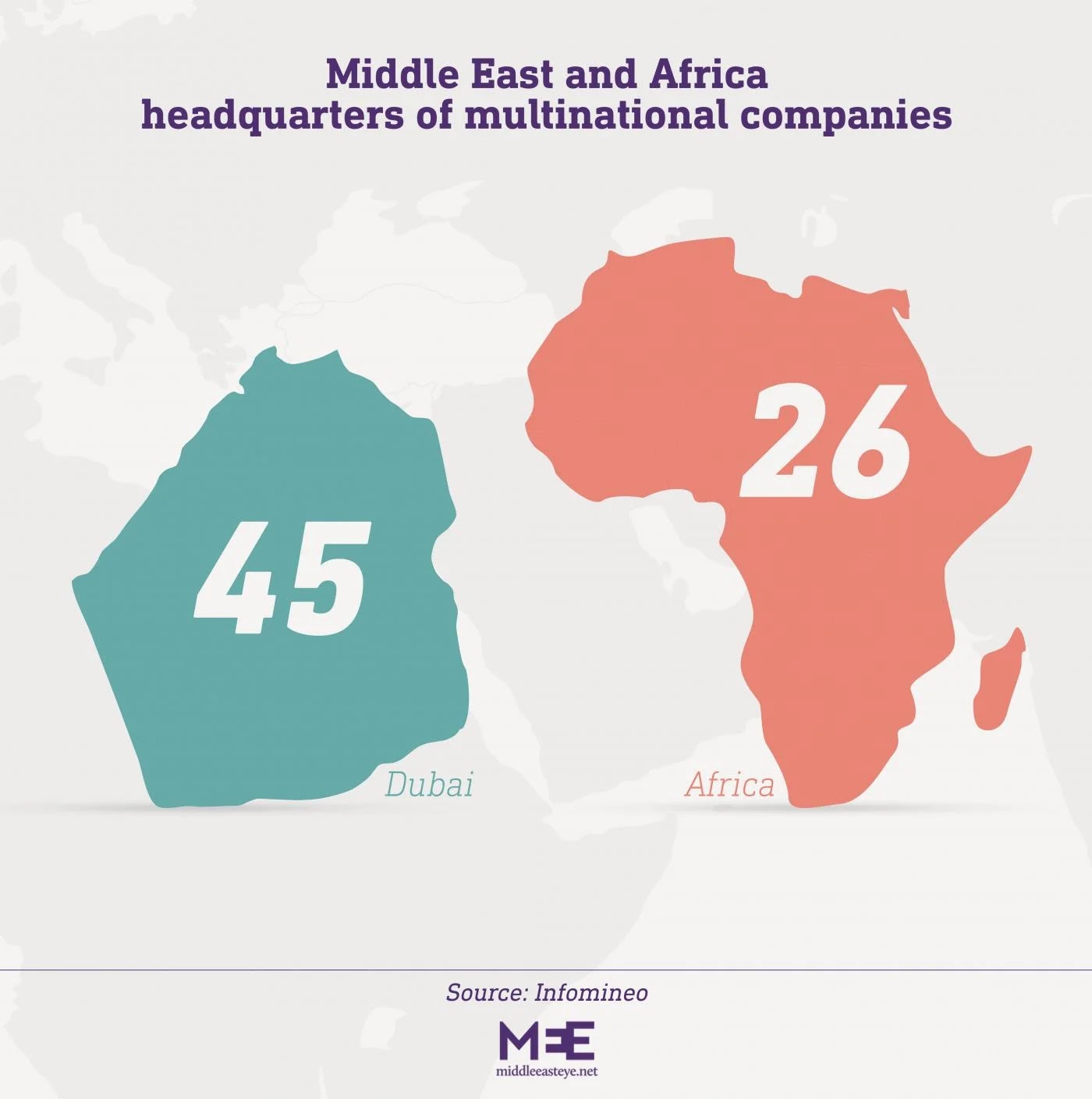
The emirate has also attracted 45 Middle East and Africa headquarters of multinational companies - compared to just 26 in Africa, according to a 2018 report by Infomineo, a data and research outsourcing provider specialising in Africa and the Middle East.


 To read the rest go to: https://www.middleeasteye.net/news/uae-dubai-africa-business-capital

Monday, March 08, 2021

Saudi Arabia’s ‘Programme HQ’: Can Riyadh rival Dubai as a business hub?

 Plans to make access to mega-project contracts conditional on companies establishing regional headquarters in the kingdom are ambitious but ambiguous


Middle East Eye: In the pre-pandemic days of globalisation, countries competing in emerging markets were often engaged in a "race to the bottom" to attract multinational companies, which typically involved offering them incentives such as tax breaks and favourable labour laws.

More recently, governments with large enough economies have opted for the stick-over-the-carrot approach in allowing companies to set up shop, often for political objectives.

Last year, for instance, Turkey passed a law requiring any social media platform based abroad with over one million daily Turkish users to set up a representative office in the country.

Saudi Arabia is taking a leaf from the same playbook as it grapples with the economic fallout of the Covid-19 pandemic and embarks on its ambitious Vision 2030 plans.

In mid-February, Minister of Investment Khalid al-Falih announced that any company seeking contracts with the government, state-owned firms and the Public Investment Fund (PIF, the sovereign wealth fund) will have to base its regional headquarters in the kingdom by 2024.

Saudi Arabia is hoping that the allure of being the Middle East’s biggest economy, with hundreds of billions of dollars earmarked for mega-projects over the coming decades, will force companies to comply.

“There was surprise at the announcement, and there are some merchant families that will not be happy,” said Theodore Karasik, a senior adviser to Gulf State Analytics, a Washington-based consultancy.

“But at the same time, others will see the benefit of such a regulation, and in how the city states of the Arabian peninsula interact with each other for recovery purposes. Because of Covid-19, they are rebooting and restructuring their economies."

The requirement, called “Programme HQ”, is still at the discussion phase, with “as many questions as answers. It is a reminder of the intense competition for investment within the Gulf Cooperation Council,” said Rachel Ziemba, a non-resident fellow at the Gulf International Forum, a Washington-based institute.

To read the rest go to: https://www.middleeasteye.net/news/saudi-arabia-uae-dubai-programme-hq-rival-business-hub


Red Sea cables: How UK and US spy agencies listen to the Middle East

 An expanding network of undersea fibre optic cables from the Mediterranean to the Gulf has made surveillance of regional communications easier than ever


The Mediterranean viewed from the Troodos Mountains, Cyprus (Paul Cochrane)


Middle East Eye: The growth of Middle Eastern fibre optic cable networks has given Western signals intelligence agencies unprecedented access to the region’s data and communications traffic.

“There is no question that, in the broadest sense, from Port Said [in Egypt] to Oman is one of the greatest areas for telecommunications traffic and therefore surveillance. Everything about the Middle East goes through that region except for the odd link through Turkey,” said Duncan Campbell, an investigative journalist specialising in surveillance since 1975.

The Five Eyes, a signals intelligence (SIGINT) alliance of the US, the UK, Canada, Australia and New Zealand, has been snooping on the Middle East since the network was formed during the Second World War.

The key players are the US’s National Security Agency (NSA), and the UK’s Government Communications Headquarters (GCHQ), utilising both known and secret facilities in the region to collect data.

The Middle East is a hotbed of surveillance for obvious reasons: its strategic political-economic importance, the Arab-Israeli conflict, and political divisions between the allies of the Five Eyes and their adversaries, from militant groups to countries such as Iran and Syria.

While all conventional forms of surveillance are carried out, from airspace surveillance to tapping phone lines, the region is a strategic asset for mass surveillance due to the current routes of fibre optic cables.

“The importance of cables is still largely unknown by the average person. They think smartphones are wireless and it goes through the air but they don’t realise it is through cables,” said Alan Mauldin, research director at telecommunications research firm TeleGeography in Washington.

Spy agencies have tapped into fibre optic cables to intercept vast volumes of data, from phone calls to the content of emails, to web browsing history and metadata. Financial, military and government data also passes through cables.

To read the rest go to: https://www.middleeasteye.net/news/red-sea-cables-how-us-uk-spy-agencies-listen-middle-east


'Digital Suez': How the internet flows through Egypt - and why Google could change the Middle East

Most web traffic between Europe and Asia passes through fibre optic cables crossing Egypt. Could a proposed new route through Israel and Saudi Arabia break the 'Red Sea bottleneck'?
 

Most internet traffic between Europe, the Middle East and Asia passes through Egypt (MEE/Illustration by Mohamad Elaasar)


Middle East Eye: There are only a few historically strategic transit points around the Mediterranean Sea: the Strait of Gibraltar, the Bosphorus, and the Suez Canal.

While the Suez Canal has been a jewel in Egypt’s crown since 1869, netting the country some $5.6bn in revenues in 2020, it accounts for just eight percent of world cargo shipments.

But Egypt’s location as a fibre optic cable hub, linking Europe, Africa, the Middle East and Asia, means up to 30 percent of the global population’s internet connectivity transits through the country.

“If you want to route cables between Europe and the Middle East to India, where’s the easiest way to go? It is via Egypt, as there’s the least amount of land to cross,” says Alan Mauldin, research director at telecommunications research firm TeleGeography in Washington DC.

Egypt, through its state-owned monopoly Telecom Egypt (TE), has successfully capitalised on its position to entice cable operators to transit the country.

“It is one of Egypt’s trump cards, like the Pyramids, which never goes out of fashion. They are used to making business out of transit and tourism, but now they’re doing it with data. It is a digital Suez canal, which trades on its geopolitical position,” Hugh Miles, founder of Arab Digest, in Cairo, told Middle East Eye.

There are 10 cable landing stations on Egypt’s Mediterranean and Red Sea coastlines, and some 15 terrestrial crossing routes across the country, of which 10 are operated by the Egyptian telecom giant, spanning a region stretching from the Mediterranean as far as Singapore, according to TE.


To read the rest go to:  https://www.middleeasteye.net/news/google-egypt-suez-digital-internet-flow-change-middle-east


Thursday, January 07, 2021

Dubai, Switzerland, London: How the UAE became a smuggling hub for 'blood gold'

Emirates urged to clean up their act amid numerous reports about role in dirty gold trading


                                         Credit: Stevebidmead/Wikicommons


Middle East Eye: There are no mines under Dubai's sands with artisanal miners or children toiling away trying to strike gold. But there is the Dubai Gold Souk and refineries that vie with the largest global operations as the United Arab Emirates (UAE) strives to expand its position as a major gold hub. 

In recent years, the UAE, with Dubai in particular, has established itself as one the largest and fastest-growing marketplaces for the precious metal, with imports rising by 58 percent per annum to more than $27bn in 2018, according to data collated by the Observatory for Economic Complexity.  

With no local gold to tap, unlike neighbouring Saudi Arabia, the UAE has to import gold from wherever it can, whether it be legitimately, smuggled with no questions asked, sourced from conflict zones, or linked to organised crime.

Gold has become so important to Dubai's economy that it is the emirate's highest value external trade item, ahead of mobile phones, jewellery, petroleum products and diamonds, according to Dubai Customs.

And it is the UAE's largest export after oil, exporting $17.7bn in 2019. Gold's importance has only increased as Dubai's oil reserves have dwindled and the UAE has tried to diversify its economy.

To read the rest go to: https://www.middleeasteye.net/news/dubai-switzerland-london-how-uae-became-smuggling-hub-blood-gold


Wednesday, December 16, 2020

In 2020 as more of life went online, we ask: What are the limits to Virtual Islam?

Salaam Gateway: In 2020, more of life went online than ever before, including religious activities. Prayers and lectures were streamed over platforms like Zoom, and Ramadan virtual iftars became commonplace.

Will this become the 'new normal', as believers accept the shift to a virtual religious life amid COVID-19, possible future pandemics, and looming challenges like climate change, which may affect the very way hajj is carried out? Is Virtual Islam on the horizon?

“It is a transformative moment in some respects because the traditional religious establishment within Islam is having to rapidly adapt to modernity in its fullest sense, not just because of COVID-19, but of where human society is,” said Adnan A. Zulfiqar, Associate Professor of Law at Rutgers Law School, USA.

A NEW DIMENSION

As religious life went online with earnest earlier in the year, especially in the lead up to Ramadan and during the holy month itself, certain questions were raised about religious obligations and practices. Religious leaders, for instance, were careful to virtually present lectures instead of actual sermons as they were not physically in mosques with their congregation.

“Another dimension has been opened up: to what extent is ritual practice and worship able to be conducted through technology? There has been a real struggle over this,” said Zulfiqar, who has researched Islamic legal responses to COVID-19, including congregational prayers and funeral rights.

“The idea of conducting your Friday prayers via Zoom, where people are in various locations and the prayer leader in another - is that permissible? There has been, frankly, a lot of resistance to that, as if you open up the space of ritual practice, essentially you are giving everybody a marketplace in which they can choose. If you say this is just for COVID-19, to what extent can you later on put the genie back in the bottle?”

A technological shift was already underway before the pandemic confined people to their homes, and apps were launched to book prayer slots at mosques once stay-at-home restrictions eased.

Zulfiqar noted that fatwas have been increasingly issued verbally or through visuals on social media platforms rather than via the printed word. “Islam is much less written than it was before. Traditionally speaking, there is a really formal way that fatwas are written, but I often couldn’t find them written down. People have become comfortable with the (fatwa's) presentation by video as its the primary medium out there,” said Zulfiqar.

The generational gap over technological adoption, and acceptance, has also become more pronounced. “The physical sacred space is historically, and for the human psyche, so important that it will be difficult for the virtual to completely take over, but we will see. You already have in a lot of the Muslim diaspora third-way movements that are essentially 'un-mosqued', of young people gathering virtually but also organising virtually and meeting outside of the mosque or masjid,” said Zulfiqar.

To read the rest go to: https://www.salaamgateway.com/story/in-2020-as-more-of-life-went-online-we-started-asking-what-are-the-limits-to-virtual-islam


One month until ‘Brexit’: Is the UK looking to seal a Gulf free trade deal?

With talks with the EU still deadlocked, London is looking to forge closer trading ties with the GCC


Middle East Eye: The British government has been scouting the world to drum up business with the clock ticking down as it prepares to finally exit the European Union at the end of the year.

And while discussions over the UK’s critical future trade relationship with its erstwhile EU trading partners still appear deadlocked, London has its eyes set on securing a free trade agreement (FTA) with the Gulf Cooperation Council (GCC) countries.

Inking an FTA would be a big headline grabber for Downing Street, with bilateral trade worth $60.1bn in 2019, more than with India and Canada combined.

Some analysts suggest that the British government could attempt to package its lucrative arms dealings with the Gulf states into an agreement, even with weapons sales to Saudi Arabia the subject of a continuing legal battle focused on allegations of war crimes carried out by Saudi-led forces in Yemen.

But is an FTA likely to actually materialise, given the GCC’s current internal divisions – over Qatar – and its weak track record in actually ratifying such agreements? Furthermore, what benefits are there for both parties?


To read the rest go to: https://www.middleeasteye.net/news/brexit-uk-gulf-free-trade-deal-seal


The US's long financial war on Hezbollah - and Lebanon

The United States has piled sanctions on the Lebanese movement, but to what effect?


The Lebanese and Hezbollah flags fly above Bayt Al Ankabout - The Spider's Web - a Hezbollah exhibition about the 2006 War in Beirut's southern suburbs. (Paul Cochrane)


Middle East Eye: Over the past two decades, Lebanon has been under close scrutiny from the US Treasury for potential money laundering or financing of US-designated terrorist organisations.

This has led to two banks shutting their doors, bans on the use of Paypal and other payment operators, headaches for ordinary Lebanese to make transfers, and lots of pressure on banks to comply with international standards.

The reason for such scrutiny is straightforward. 

“Lebanon is always under the spotlight because Hezbollah is in Lebanon,” said Wissam Fattouh, the secretary-general of the Union of Arab Banks to the UK publication Money Laundering Bulletin.

This month, the United States, which considers Hezbollah a terrorist organisation, sanctioned more Hezbollah members and allegedly connected businesses.

But in a first for the US Treasury, which has focused more on curbing Hezbollah’s financial operations over the years than going after corrupt Lebanese politicians, it sanctioned Gebran Bassil, former foreign minister and head of Free Patriotic Movement, which holds the biggest bloc in parliament, for corruption earlier in November.

The move has been widely considered as linked to Bassil’s ties to Hezbollah.

Such moves come amid the heightened use of sanctions by the US government against governments and political parties it opposes, from plans to intensify sanctions on Iran until President Donald Trump leaves office in January 2021, to sanctions against Syria, Venezuela, North Korea and China.

The US currently has two pieces of legislation targeting Hezbollah – the Hezbollah International Financing Prevention Act (HIFPA) of 2015, and the Hezbollah International Financing Prevention Amendment Act (HIFPA 2) of 2018.

A new bill was proposed in September, the Hezbollah Money Laundering Prevention Act of 2020, “to stop the Iranian backed terrorist organization Hezbollah’s money laundering activities across the world, especially in Lebanon and Latin America.”


To read the rest go to: https://www.middleeasteye.net/news/lebanon-us-hezbollah-financial-war-sanctions