StatCounter

Tuesday, July 01, 2014

FATCA, China and the World 美國《外國帳戶稅務遵守法案》與中國及世界


International Link - Hong Kong
http://www.internationallinkmagazine.com.hk/news/editorialjuly2014


A US-enacted law that is to go into force in July appears set to have a major impact on the global financial sector as well as potentially usher in a new era of tax sharing initiatives. China, so far, is standing on the sidelines of the Foreign Account Tax Compliance Act (FATCA), but it will be dragged into the regulation's net one way or another.
According to some commentators, the Act will have an adverse effects on the US economy – the dumping of Treasury Bonds (TBs), the weakening of the dollar, lower foreign direct investment (FDI) – and will be a contributing factor in hastening indebted America's decline as a financial superpower.
To others, FATCA will lead to greater global tax enforcement by curbing banking secrecy and offshore tax havens - where an estimated $32 trillion is stashed away from the tax man - with “sons of FATCA” laws being mulled by the OECD and the G20 countries to share tax information and go after tax evaders.
So what is this new law that has such global reach, yet few outside of financial circles are aware of, that is slated to go live on 1 July? Enacted in 2010, FATCA is aimed at curbing tax evasion by American citizens with accounts above $50,000. Under the law foreign financial institutions (FFIs) around the world will have to screen all their account holders to verify whether clients are US citizens or not. Such an extra territorial law puts the onus on FFIs to act, essentially, as unpaid agents of the US' Internal Revenue System (IRS), or face a 30 percent withholding tax on US account holders. Further motivation to comply is the possibility of being cut-off from the US financial system and not being able to deal with FATCA compliant institutions.
“The withholding of 30 percent is the big stick the US is using to try and force any recalcitrant banks or countries to sign up to FATCA. That is a hefty fine, and it is going to make FFIs reconsider doing business with US, but can they really leave the US market? The bet is that no one will and if so, will only cause a small ripple, but we'll just have to see it how plays out,” said Andrew Salzman, Senior Associate at law firm Dezan Shira & Associates, which has offices throughout China and South East Asia.
Given such an ultimatum, FFIs – primarily banks – are getting ready to report by 1 July to central banks or directly to the IRS, depending on what governments have decided – a Model 1 intergovernmental agreement (IGA) whereby the FFI reports directly to their central bank/regulator, which then reports to the IRS, or the FFIs report directly to the IRS themselves, known as Model 2, which only seven jurisdictions have opted for, including Hong Kong.


Slow uptake


The uptake of FATCA can be best described as lacklustre in the first years since being enacted. Britain was the first to sign up, in 2012, followed by Denmark, Switzerland and Japan; by the end of 2013, only 13 jurisdictions had signed IGAs. As a result, along with the complexities of wading through 500 pages of legislation, later expanded by a further 500 pages – that was not translated from the English – the FATCA go-live date was delayed multiple times and the US Treasury went on a global offensive to get more countries on-board.
Only this year as the go-live date looms have more countries signed up to FATCA, bringing the total to 34 countries with Model 1 and Model 2 IGAs, while 36 countries have, in the words of the IRS, “reached agreements in substance” to comply – that means that while no IGA has been ratified, the US will treat such jurisdictions as being compliant. Nonetheless, as of June, 123 countries (out of a total of 193 jurisdictions the US recognises worldwide) including China and Russia, have not signed an IGA or reached an agreement in substance. Furthermore, while some 77,000 FFIs have signed up, an estimated 200,000 FFIs have not.
The lack of agreements is raising question marks about how effective the law will be once in force. “I don't know how they will be able to go live on 1 July with so few IGAs signed. I am not saying they should delay again, but is the market ready? Where's Russia? China?” said Camille Barkho, Chief Compliance Officer at the Lebanon and Gulf Bank in Beirut.
The reluctance to sign IGAs has not been, in most cases, due to overtly political reasons but more so to do with issues of sovereignty and the regulatory changes required for FFIs to report to a foreign jurisdiction. Under Chinese banking and tax laws for instance institutions are not allowed to comply with a law such as FATCA. In other jurisdictions privacy laws have had to be overhauled, and in some cases, even changes to the constitution required.
The costs attached to being compliant with FATCA is another factor, with FFIs having to spend anywhere from $25,000, at smaller institutions, up to $1 million for large banks. Indeed, in the IRS’ 2013 Annual Report to Congress, it notes that the Congressional Joint Committee on Taxation estimates that while FATCA “will generate additional tax revenue of approximately $8.7 billion over the next 10 years,” private sector implementation costs could “equal or exceed” the amount FATCA may raise.
Jurisdictions have also taken issue with the law being unilaterally imposed by the US, as have investors. “I am on the record as saying that this is the most arrogant legislation ever penned, as the US is effectively trying to regulate other banks and jurisdictions. It only has teeth as the US is at the centre of the global financial system,” said Simon Black, founder of Sovereignman.com, one of the most popular asset protection websites in the world.
The issue is that while global tax sharing agreements are being mulled, FATCA is essentially a one-way street, of FFIs providing information to the US but getting nothing in return. The US has indicated it is willing to be reciprocal, but whether Washington can in fact do this is a legal gray area. “Are these IGAs even legal? They are not mentioned in the law, they are not passed by Congress, or going through the proper treaty method. And can the US Treasury bind US institutions to be reciprocal when no one has said where the information will come from?” said Salzman.


Resistance


The threat of the withholding tax and not being able to do business with FATCA-compliant FFIs has spurred countries to sign up to FATCA this year as well as for FFIs to optionally report directly to the IRS. Even Syria, which is under US and EU sanctions, is requiring its banks to be compliant.
But certain jurisdictions clearly will not be playing ball. Iran, which is under the heaviest financial sanctions in modern history, and international pariah North Korea are obvious cases. It is Russia that has taken the strongest stance against FATCA, but only following the Ukraine face-off between Moscow and the West. Within weeks of sanctions being imposed on Russia, Moscow came out to say that Russian banks complying with FATCA would be subject to penalties from the domestic regulator. Indeed, Deputy Finance Minister Alexei Moiseyev told the press in May that Russia will not become “tax agents for the Americans, that will not happen under any circumstances.”
As for China, while Beijing has not signed up, Hong Kong has (Model 2, “in substance”), with commentators speculating it is to see how FATCA plays out in the SAR, and so that FFIs in China do at least have a door to the US market and correspondent banks. A further factor was to retain Hong Kong's financial hub status. “I think a big issue was that Singapore signed up, and there is rivalry between the two as Eastern Asia financial centres. If Hong Kong had not signed US business would use Singapore instead and Hong Kong would get squeezed,” said Salzman.
Beijing has made it clear that while it supports tax sharing initiatives - and is reportedly mulling its own form of FATCA – it wants this done multilaterally not unilaterally. As Liu Xiangmin, deputy director general of legal affairs at the People’s Bank of China, told the press in 2013, “I agree that countering tax evasion is an important policy bill but an uncoordinated extraterritorial measure such as FATCA is unlikely to generate broadly accepted solutions with full consideration of the effects on global financial systems and the conflicts involved...A more co-ordinated multilateral approach should eventually replace the unilateral approach of FATCA.”
While China will not face the issues of some banking centres that have a lot of US citizens on their books, Chinese FFIs will encounter issues dealing with the US and other counterparts as they will not be FATCA compliant. According to the Association of Certified Financial Crime Specialists, only 210 institutions from China and 513 from Russia have registered – compared to 14,835 FFIs in the Cayman Islands and 4,000 in Switzerland.
“Signing the FATCA agreement provides almost all downside and no upside, quid bono FATCA, and China doesn't benefit. Beijing realises that. So they may wait, which is tantamount to financial warfare if China holds out as after July all FFIs will have to gang up on China as not compliant. Would it force the Chinese to sell treasury bills and so on? This is a possibility,” said Black.

The unknown unknowns
This is the unknown factor about what will happen when FATCA goes live. Will there be a slump in business transactions as some 200,000 recalcitrant FFIs will not be able to deal with compliant FFIs? “What happens July 1? There is no line in the sand. There are huge direct costs (of implementing FATCA). As for indirect costs, there will be a loss of business, and it will close the doors on swathes of customers for years or even decades to come,” said Black.
Analysts expect a two-tier financial system to possibly develop: compliant and non-compliant FFIs, with institutions effectively policing one another for compliance. Non-compliant FFIs will clearly deal with one another; compliant FFIs will not, or charge an extra fee.
“Let's assume small and medium sized FIs are not ready, this could have a cascading effect on larger ones, creating a ripple effect,” said Ranjith Kumar, Director at Keypoint, a financial services consulting firm in Bahrain. “But what I believe may happen is that the cost attached to not participating may result in a higher cost of service for financial services, or costs for maintaining the relationship with an FFI. It is unlikely that an FFI will totally stop dealing with them, although there will be a lot of pressure to participate. Some FFIs not critical (to a compliant FFI) for business may be asked to stop doing business.”
A further factor is what may happen with US Treasuries, with overseas institutions holding $5.9 trillion, or 48.5 percent of TBs, more than double the amount held in January 2008, according to the US Federal Reserve.
“What happens when we start shorting payments on our TBs by 30 percent? A sovereign holder is not subject to withholding, but for a private institution, what if the interest payment is done through SWIFT to a commercial bank that has not signed an IGA? Treasury will take the interest,” said Jim Jatras, Manager of RepealFATCA.com, which is lobbying against the law in Washington. “This is the kind of thing that could promote dumping TBs, and affect interest rates and the dollar as a global currency, which are issues nobody has thought out.”
FATCA has arguably already had an effect on US Treasury bills. In March, Russia sold $26 billion, or 20 percent, of its holdings in Treasuries. To offset the sale of TBs by Moscow, Belgium stepped in, becoming the third largest foreign holder of treasuries, although it is not clear if it was Brussels acting independently or through coercion.
“Russia is selling off treasuries – why? Two things came together at once, one FATCA and the other the new advance in Ukraine, as the Russians couldn't anticipate the US response, so sold TBs to be insulated from sanctions,” said Jim Rickards, a veteran Wall Street investor and author of current New York Times bestseller The Death of Money. “Look at the enormous surge in buying TBs through Belgium, it could be (clearinghouse) Euroclear or a third party, or the European Central Bank (ECB) using dollar proceeds from Fed Swaps. Or is it holders in places like the Cayman Islands moving accounts to Belgium to avoid FATCA? It is a good question, and I speculate that FATCA has something to do with it. Russia is dumping, China is not, but they are not buying more and Belgium is, so put all together and we are shuffling deck chairs around on the Titanic.”
It would be ironic if FATCA backfires on the US, as a primary motivation for the Act, and the OECD and G20 mulling multilateral legislation, is that governments are scrambling for tax revenues following the 2008 bailouts of banks due to the financial crisis. Indeed, governments are in debt to the tune of $100 trillion worldwide, with that figure having surged 30 percent since the 2008, according to Bloomberg. What is clear is that FATCA's go live date is bad timing, given the Russia-West standoff, Russia and China strengthening financial ties, and fears in the market of another financial crisis.
“I think we are heading for another financial collapse, and the next one will be bigger than central banks can keep a lid on. Central banks could barely subdue the last crisis and used trillions of dollars to do that, but at this point there's not much left to deal with another crisis, which would be bigger. The only clean balance sheet is the International Monetary Fund's, so it would have to bail out the EU and US,” said Rickards.
Whether another financial crisis is on the cards requires a crystal ball, albeit the fundamentals are pointing in that direction. In any case, there seems to be a global rebalancing in financial power, as the West is in debt and the Asian markets are in much better fiscal health.
“I think we are rapidly seeing more signs of Asian banks becoming increasingly powerful and developing their own financial infrastructure, and places like Hong Kong, Singapore and Shanghai will become more powerful financial centres and the US a secondary system,” said Black. “This creates the conditions for rebalancing as capital goes where it is treated best, and the West goes out of its way to treat savers as poorly as possible. If all the savings are in Asia, and debt and consumption in West, where will power reside?”


China's stance


Beijing has not made its official position on FATCA crystal clear, other than in not signing an IGA. What is clear is that Beijing is in favour of a multilateral approach to tax sharing initiatives. Furthermore, in January, Beijing introduced new legislation that requires wealthy Chinese citizens to declare their overseas assets – the “Foreign Asset Reporting Requirements” (FARRs). It is similar to the US forerunner of FATCA, Foreign Bank Account Reports (FBAR) – which has a lower reporting threshold of $10,000 – in that the FARR has no requirements for FFIs to file on Chinese account-holders.
The US providing information on Chinese account holders would be of clear benefit to Beijing for tax enforcement purposes, but the US is highly unlikely to do so, even if China signed an IGA. As noted earlier, the legality of reciprocity is a gray area and has essentially been used as a fig leaf by the IRS to coerce jurisdictions into signing up. Additionally, reciprocity on the US side could lead to the loss of significant funds that are parked in US banks, especially in tax havens, which is a reason why US financial institutions are opposed to multilateral tax sharing initiatives (see below).
For China to comply with FATCA, domestic regulations will need to be changed – such as bankruptcy protection rules - which will be onerous and with minimal benefit to the state or Chinese financial institutions. A further factor is that FATCA could affect Beijing's financial dealings with countries under US sanctions, such as Iran and Sudan, with which China has significant trade relations, especially for hydrocarbons, while US dollar transactions for these countries are often transferred via China.
In international politics, China not playing ball with the US over FATCA would have far reaching affects by being a major global player that will not bend to US diktats, and on the flip side could potentially benefit from inflows of cash from investors avoiding the American market and resultantly aiding further in China's financial rise.
China is in a position to help derail FATCA altogether by not complying. In Beijing not doing so, it would set a strong precedent that could be followed by other countries pulling out, especially if they had minimal business with the US. Indicative is that few of the countries in China's immediate sphere of influence in South East Asia have signed up with the US – Thailand, Malaysia, Cambodia, Vietnam, Myanmar and Laos, as well as US allies the Philippines and Taiwan. Neither has Macau.
Further afield, a region where China has made significant economic inroads is Africa, where only a handful of countries have signed up to FATCA. China could benefit from this in having African funds that had previously gone to the US destined instead for Chinese financial institutions, as well as making amenable African states stay out of FATCA and join the “not FATCA compliant club”.
In other words, China certainly has international leverage, as if it signs, others would too, and by not doing so it will put the breaks on FATCA's global effectiveness, regardless of the fact that Hong Kong has signed an IGA “in substance”. China should press this advantage with the US in its discussions over taxation, fiscal and other economic issues.
However, a financial war is not necessarily in either sides interest, but in the case of FATCA, it was initiated on the US side, and how Washington will respond to China being recalcitrant is not overly clear.
In any case, China has time to see how effective global FATCA-compliance will be before having to make a firm decision either way, as the IRS has deemed 2014 and 2015 a period of transition, with jurisdictions that have to adapt domestic laws to comply with FATCA not to be issued penalties for delays.


Tax Haven Hypocrisy


Overall the roll out and implementation of FATCA has not been well handled by the US. The IRS has implied that it will only gradually enforce FATCA, and will provide FFIs with a degree of flexibility in the first year and a half, with for instance the onerous requirement for banks to sift through all their clients to check for US citizen indicia part of the second phase.
While FATCA is expected to generate $800 million a year for the IRS in tax revenues, commentators suggest the US should look closer to home. “The US is the number one tax haven in the world, yet goes around and terrorizes all these places (through FATCA); the biggest culprit in this charade is the US. If they want to solve the problem, why not make the tax code more attractive?” said Black. “And the funny thing is that most of the money sitting offshore is from the big companies, the Fortune 500, and offshore is permissible under the US tax code.”
Indeed, there is a degree of hypocrisy by the US on clamping down on US tax evaders globally, and requiring FFIs to do so, while still letting it happen within the US and for anyone globally to do so on US territory, such as in Delaware, the top tax haven on the planet. This is preventing the US from being reciprocal when it comes to tax sharing with other countries and, moreover, undermines initiatives for a global move to tackle tax evasion.
“Delaware is highly protected by political lobbies in the US. A huge number of Fortune 500 companies use Delaware, and that is why it will be so hard to push through reciprocity in Congress,” said John Christensen, director of the Tax Justice Network in London. “Perhaps some of the most extraordinary discussions I've had have been in (the state of) Wyoming, where service companies and trust companies seem to compete with one another on being devastatingly secret and illegal. It is real Wild West territory and beyond the federal government. In terms of scale it is not like Delaware but tends to be attracting low life activities, not the Fortune 500, so a bottom feeder.”
To Christensen, FATCA is a good move, and if handled right will push forward initiatives at the G20 and OECD for greater tax sharing initiatives. Indeed, the days of tax havens are limited it seems, although the loopholes need to be stopped. “There is definitely a movement by the OECD for a global tax system and the impediment has been tax havens, Swiss banks and so on, but one by one those dissenters have been knocked out,” said Rickards.
China is for such a global tax sharing initiative, as the People’s Bank of China has stated, while at the 18th Party Congress there was agreement for giving priority to greater political transparency and the rule of law.
For a global tax initiative to work, major economies need to be on-board and especially emerging economies, which have more often than not been the victims of capital flight and tax evasion by the political and economic elites. Done well, a global tax initiative would circumvent concerns about sovereignty, which Christensen regards as “a great rhetorical device.”
“My view is that any country that is unable to tax its own citizens as they are using offshore accounts and tax havens have long since lost sovereignty in tax matters, and need tax measures, including FATCA. For me the sovereignty argument is bogus,” he said.
Some analysts have suggested that FATCA should be delayed to take into account G20 and OECD initiatives. “If FATCA was delayed a final time and its launch coincides with OECD tax initiatives it would make sense, as a tax exchange system would be more powerful and global. I bet China would join, and no one would say this is just from the USA, it would be a worldwide trend to be ethical,” said Barkho.
What the OECD tax regime looks like has been kept under wraps, but there appears to be a move towards a new era that will not tolerate tax evasion. “On the positive side, the OECD is going ahead with proposals. I don't know what they will look like, and I've had long discussions with OECD officials, so we can certainly see a window for moving forward. That is progress,” said Christensen. “Will it achieve political support? It's very hard to say. What is clear is that the fiscal crisis facing many countries is not receding, and governments are under pressure on tax policies because they are increasingly seen as regressive.”
As for the impact of FATCA on the global financial system, the US markets and non-compliant institutions, as well as on future tax sharing initiatives, we will have to wait and see. “There are certainly some people opposed to FATCA and want it to fail – US overreach, impact on the dollar, and predicting doom and gloom. With this being so open-ended and not knowing how it will go, people choose their own narrative,” said Salzman.


Photo from http://www.iexpats.com/china-sign-fatca/

Monday, June 23, 2014

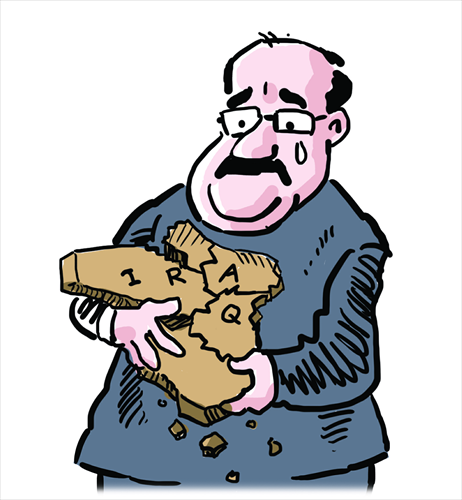
US has left region wracked by sectarian splits

http://www.globaltimes.cn/content/866903.shtml 

Illustration: Liu Rui/GT


Earlier in the year, I was a guest on an Iraqi TV channel to discuss the advances that the Islamic State in Iraq and Syria (ISIS) has made in Iraq.

In January, the group of hard-line Sunni Islamists had taken the city of Fallujah and were gaining in strength in Anbar province. The weakness of the Iraqi army was apparent, as was the leadership of Prime Minister Nouri al-Maliki in its failure to stop the advance of this Al Qaeda-esque group.

While the ISIS advance made news in the Arab world, the world's media lens was focused elsewhere, on the conflict in neighboring Syria, but it was obvious that ISIS posed a clear and present danger to Iraq's stability.

This was all discussed on the program, but the channel's Shia Muslim leanings and Iranian backing made it hard to address the malign role of Maliki and the US backing of Shia groups. The region's media is now just as sectarian as its politics.

The world started to take notice recently that the conflict in Iraq did not end when the US left, and that the Pandora's box the US had opened when it invaded in 2003 has not been firmly closed.

Some 1,000 ISIS fighters overran two Iraqi army divisions of 30,000 soldiers in Mosul, the country's second largest city, and have made further territorial gains.

This mess falls squarely in the court of the US and Britain, which beat the drums for war against the Saddam Hussein regime, ostensibly over weapons of mass destruction but also touting the spurious claim that Iraq was connected to Al Qaeda and therefore linked to the September 11 attacks.

There was no Al Qaeda or militant Islamic extremism in Iraq prior to 2003, but the overthrow of Hussein, the deliberate disintegration of the Iraqi army by the US, the use of sectarian death squads to further divide and rule, and a new constitution drafted under US auspices that shifted the sectarian balance away from the Sunnis, provided the fuel for a fire that is still burning.

Under a resurgent Shia government, which has led the country since 2005, the Sunnis felt marginalized and unrepresented, resulting in resentment.

This explains why ISIS has support in areas it occupies, not overly because people support the group's aims of an Islamic state, but to counter Shiite dominance and the failure of imposed federalism.

The US war on terror has created more terror, and in the broken and destroyed Iraq that Washington left behind, has created fertile territory for extremism and violence to flourish.

Counter-terrorism can only work if it addresses core grievances and issues, both political and economic.

But while the US war on Iraq cost anywhere from $800 billion to $3 trillion, depending on the estimates, just $60 billion was spent on reconstruction and aid.

Iraq is struggling to get back on its feet economically, with the second National Development Plan for 2013-17 requiring $357 billion to improve critical infrastructure.

ISIS' advance will scupper such plans, and the Maliki government is under tremendous pressure. There are only hard choices left.

Maliki will have to create alliances with nationalist Sunnis to regain the north. The Iraqi army did not retake Fallujah earlier in the year, as tribal leaders convinced Maliki to not destroy the city.

While critics opposed this move, it could have further sidelined already disgruntled Sunnis. They face the same quandary now, if the Iraqi army brutally retakes Mosul and other ISIS-held areas.

Only through addressing core sectarian gripes and through a collaborative military made up of different sects can Baghdad avoid being seen as overly pro-Shia and ready to crush the Sunnis.

If that does not happen, fuel will be added to the fire of a sectarian war in the Middle East that is bubbling dangerously close to boiling point.

Friday, June 13, 2014

Flawed narratives cloud truth of Syrian vote


Illustration: Liu Rui/GT

http://www.globaltimes.cn/content/865419.shtml
By Paul Cochrane
Global Times Published: 2014-6-12


There were huge traffic jams in and around Beirut recently as tens of thousands of Syrians went to their embassy to vote in the presidential elections.

Such a turnout, with the elections extended for an extra day, confounded many observers, particularly in the anti-Syrian regime camp. How could people vote for a president, Bashar al-Assad, during a conflict that has killed over 160,000 people, and a man that has ruled Syria since 2000, and his father before him since 1971?

People must have been intimidated and forced to do so, fearing for their lives if they did not vote, went some accusations in the press. Others stated that people were paid to turn up.

That an estimated 10 million Syrians voted in Lebanon, Jordan and Syria appeared antithetical to the anti-Assad narrative in the mainstream media since the uprising started in 2011; the narrative that Syrians were overwhelmingly against dictatorship and were fighting for freedom and democracy.

As is so often the case, such observation and analysis overlooks the fact that the price of achieving such goals comes at a high cost for people and the country. Stability and security are preferable to chaos.

Indeed, Syrians had looked on with horror at what happened in Iraq following the US-led invasion in 2003, and how the country splintered apart amid brutal sectarian warfare and terrorist attacks.

Syrians also looked at neighboring Lebanon, from which Syria withdrew in 2005 after a 29-year military presence, and did not want the Lebanese-style "democracy" of corrupt political dynasties and sectarian parties either.

The Assad government naturally capitalized on such sentiments and made it part of their narrative of the conflict, that terrorist insurgents, primarily Sunni extremists, were bent on destroying the country and were aided externally by the Persian Gulf states of Saudi Arabia, Qatar and Kuwait, alongside the West. It is a narrative that has clearly worked, with 88.7 percent of people voting for Assad and a 73.4 percent voter turnout.

That the election was not overly transparent, that millions were not able to vote in or outside of the country - such as in opposition-held areas - and that no members of the opposition itself were on the ballot naturally raises questions about its credibility. Yet at the same time, those criticizing the Syrian elections as a farce were not as quick to say the same about Egypt's presidential elections that happened at the same time, with Abdel Fattah al-Sisi getting 96.7 percent of the vote while only 47.5 percent reportedly voted.

Indeed, in Egypt, voting was extended for an extra day not because of overwhelming turnout, but because not enough people had voted. But Egypt is pro-West and pro-Gulf whereas Syria is not, so the narrative has to be different.

Yet this is not to imply that there is no strong opposition to Assad. There is, whether from Islamic groups or others, while many Syrians do not feel represented by the divided opposition itself.

Syrians did protest against the "blood elections." A recent poll by the Arab Center for Research and Policy Studies found that 78 percent of Syrian respondents inside and outside of refugee camps viewed the presidential elections as illegitimate, and 64 percent held the opinion that the ideal solution to the crisis would be through a change in the current regime.

So what next, now that Assad is in for a third term as president? The regime has clearly been given a popularity boost from the public, and will go on to try to cement that position. Damascus has political and military support from Iran, and at the international level from Russia and China.

Getting to that stage will be the big challenge. In the meantime, the conflict is set to get even more polarized. Government forces will try to retake opposition controlled areas, primarily in the north and east.

Conversely, there is a renewed push by the rebels from the southern front in Jordan with the backing of US, British and Gulf intelligence agencies, and also from the Turkish border, with the aforementioned agencies along with the Turks meeting in late May to shift the balance of power in favor of the rebels. US President Barack Obama has called on Congress for a $5 billion Counterterrorism Partnership Fund "to train, build capacity, and facilitate partner countries on the front lines," which includes the Syria conflict.

The US and Europe have made it clear that Assad has to go, and have denounced the election. The scene is set for the three-year-old conflict to rage on, eerily reminiscent of the situation in Iraq a decade after the overthrow of Saddam Hussein.

Wednesday, June 04, 2014

Lebanon’s financial sector braces for FATCA

Executive magazine
http://www.executive-magazine.com/business-finance/finance/lebanon-financial-sector-braces-for-fatca


The Lebanese Canadian Bank fiasco is fresh on the minds of Lebanese bankers racing to fully comply with FATCA.


The countdown is on, with just a month to go before the United States’ Foreign Account Tax Compliance Act (FATCA) goes live on July 1. Aimed at curbing tax evasion by American citizens, an estimated 26,000 foreign financial institutions (FFIs) around the world will have to be FATCA compliant or be shut out of the US financial system. As a result, FFIs — primarily banks — are scrambling to be ready to report to central banks or directly to the US’s International Revenue Service (IRS), depending on governmental agreements.

In the MENA region, Lebanon is considered by local bankers to be ahead of the pack, followed by Jordan, Saudi Arabia and other Gulf countries. “We’re really well prepared to meet FATCA, and I think with all modesty, the most prepared in the MENA today, because we started at the beginning — some three years ago — and have carried out intensive training,” said Makram Sader, secretary general of the Association of Banks in Lebanon (ABL). “But very few FFIs will be on time in MENA.”

The Lebanese banking sector has been preparing for FATCA like the teacher’s pet not because it is a major advocate of reining in tax havens — Lebanese law explicitly allows companies set up with offshore tax status — or greater taxation transparency and new tax laws in the country. Rather, the sector is exceedingly wary of international regulators, specifically of falling foul of the US Treasury. This is due to Lebanon’s immense exposure to American leverage: some 70 percent of local deposits are held in US dollars; banks need to keep good relations with correspondent banks in the US and elsewhere; and no one wants a repeat of the 2011 Lebanese Canadian Bank fiasco, when the bank was accused by the US of money laundering and subsequently closed its doors. 

“Banks want to avoid the danger of having another [Lebanese Canadian Bank] right now, as it would affect the sector as a whole, so all banks are being careful that FATCA will be properly applied,” said Malek Costa, head of compliance at BLOM Bank. “In substance, the threat is to be cut off from the US financial system.”

Compliance has become a major concern for the sector, pushed by the central bank, Banque du Liban (BDL), which issued two circulars — 126 and 128 — in 2012 and 2013 for banks to abide by international regulations and establish compliance departments, respectively. Indeed, compliance with anti-money laundering and counterterrorism financing regulations — with FATCA the latest such addition — is being taken so seriously that Sader conceded that he has spent about 20 percent of his time over the past two years on compliance issues alone. 

That said, Sader claimed Lebanon is well positioned to capitalize on providing financial services related to FATCA. “Maybe we can prepare other MENA countries to implement FATCA by exporting that skill. For example, we are supporting the Association of Iraqi Banks, as there are 11 Lebanese banks there, by educating our bank partners and supporting the Central Bank of Iraq,” he said.

Legal issues

However, that the banking sector has prepared for FATCA so early can be read as a further indication of the country’s inability to defy US demands. Indeed, as one compliance officer put it off the record, “It is ridiculous that it takes a foreigner to come here and say you have to apply regulations, and we do it, but not because we are afraid of the Lebanese regulator.” 

FATCA has been a problematic law to apply globally, with governments having to amend domestic legislation — in Lebanon’s case to allow for US clients to waive banking secrecy. Moreover, the act was met with political resistance and a lackluster uptake by many jurisdictions, so much so that the IRS had to delay FATCA’s rollout multiple times. Adding to the law’s problems, none of the rising BRICs (Brazil, Russia, India or China) have signed up yet. However, there has been a flurry of jurisdictions signing intergovernmental agreements (IGAs) with the US just in the past few months as the IRS went on a global push, fearing that FATCA’s effectiveness could be undermined before it even started.

Another potential reason for the push was to end the current period in which Americans can renounce their citizenship without paying back taxes. “There are around 3,000 renunciations a year of US citizenship and there is growing interest, but they don’t say if it’s because of FATCA or a travel risk element, but certainly FATCA has an impact because of the complexity of banking in this world,” claimed Armand Arton, president and CEO of global financial advisory business Arton Capital.

Loss of business?

BDL opted to not go for an IGA with Washington but rather for banks to report directly to the IRS, concerned that if it signed an IGA there would be the remote possibility of the US freezing BDL money in the event of non-compliance. “It was a political reason, to not be an agent of the IRS,” said a senior source at BDL speaking on the condition of anonymity.

Yet while many jurisdictions have not yet signed up to FATCA, and some are unlikely to at all — Russia is a prime example — and certain MENA countries lag behind, the Lebanese banks are more than ready. “We are working as if FATCA already exists,” said Abdul Razzak Achour, chair and general manager of Fenicia Bank. “We are contacting all FFIs that we do business with and checking if [they are] FATCA compliant; if not, we will act accordingly.”

But herein lies the primary problem with the law. How will FATCA compliant Lebanese banks deal with what the IRS calls “recalcitrant” FFIs? And does the sector stand to lose business by not dealing with non-participating FFIs in say West Africa, Algeria or China? No one interviewed by Executive could give a clear answer.

“I’m not sure if we’ll lose business. Even the worst country in Africa has clean businesses and wants to do business with good banks,” said Sader. “Yet in terms of business, [Lebanese banks are] in 30 different countries, and maybe five, six or seven countries will not comply [with FATCA].”

Practical short game, long term worries

Joseph El Fadl, a managing partner at Deloitte, which was contracted to draw up a FATCA implementation manual for the ABL, believes the IRS will initially be pragmatic once FATCA goes live. “The IRS acknowledges it’s not going to be a piece of cake and indicates it is not going to be difficult with FFIs in the early stages,” he said. “We’ve seen that international banks want compliant FFIs, but what will be the reaction? We may have two layers, big banks refraining from doing business with non-participating FFIs, and medium banks applying withholding tax, but we don’t know yet.”

Initially, FATCA will be implemented in two phases. “The first is to screen all existing accounts with a threshold of over $1 million, so not a big task [in Lebanon] as that’s not more than 2 to 4 percent of customer deposits. Then it will move to thresholds of $50,000 and above, and about documentation and questions, with a short list of who could fall under FATCA,” said El Fadl.
This second stage will prove the most trying, as banks will have to sift through all bank accounts for possible US indicia — citizenship, residency, addresses, etc. — with Sader estimating there could be as many as three million accounts to go through.

Elsewhere in the region this may be more challenging. For example, Syria is requiring banks to be FATCA compliant, including Lebanese banks operating in the country. “There’s a large number of displaced Syrians, so it will be a challenge as a number of clients are outside the country, and there may be a mismatch between addresses on record and current addresses because of the security situation,” said Chahdan Jebeyli, who wears several hats as chief legal and compliance officer at Bank Audi, chairman of the ABL’s anti-money laundering committee, and the Union of Arab Banks’ head of compliance.

If clients are not cooperative, banks will have to decide whether to close an account or withhold 30 percent of interest returns in tax, as stipulated by FATCA. “The main issue banks will face is confronting pre-existing customers to make them fill out the necessary documents,” said Costa. “For example, if a client having US indicia showing in the core banking system or customer file says, ‘No, I am not a US citizen,’ we’ll say, ‘Prove it within 90 days or we’ll close the account, or withhold.’”

What is expected is that the financial sector will essentially police itself by dealing with only compliant FFIs. “You will see banks across the world asking other banks if [they are] FATCA compliant, asking about the Global Intermediary Identification Number [GIIN — to be registered with the IRS] and it will be a main factor in evaluating the continuing relationship,” said Jebeyli. “I don’t believe any Lebanese bank will not be compliant, and if there are mistakes, it will be in the details not the general direction.”

Tuesday, May 06, 2014

Safe bet – the risk in online gambling

Money Laundering Bulletin
http://www.moneylaunderingbulletin.com/industries/casinos/safe-bet--the-risk-in-online-gambling-98144.htm

Odds are better, overheads low, customers plentiful – online gaming has struck lucky, but is the wise money on the criminal or AML compliance to win? Paul Cochrane checks the state of play.


Online gambling is big business – worth US$30 billion a year - and is forecast to grow exponentially: UK-based Juniper Research estimates that betting on mobile devices will reach US$100 billion worldwide by 2017. Where legal, the sector is generally tightly regulated – but, even so, it is widely perceived to be a target for money launderers. Some analysts, as we will see below, suggest, however, that the risks are over-hyped, with too little data to evidence the threat.

Law around e-commerce and the internet is, in general, still in its infancy and weak in most jurisdictions, struggling to keep up with technological change. Similarly, anti-money laundering (AML) authorities are only now beginning to seriously address the nefarious potential of online gambling, e-gaming and related alternative e-currencies.
The Financial Action Task Force (FATF), for instance, only issued specific guidance on application of a risk based approach for casinos in 2008, warning then that illicit funds could be channelled through remotely-accessed (online) games and accounts. The Council of Europe's Moneyval committee issued its first report on e-gambling in 2013, but its risk assessment was qualified due to lack of data; and there has been scant progress since.
“When we did the report, very few financial intelligence units (FIUs) had received suspicious transaction reports (STRs) [relating to e-gambling], and as typologies are generally based on STRs, when it came to analysis already done by the FIUs, we found very little information, so it was hard to understand the extent of the problem,” said a member of Moneyval’s secretariat who requested anonymity. “We thought the problem was maybe due to us looking at a specific geographic region, but the EU [European Union] in its 2012 report faced the same problems,” he said, referring to the September 2012 European Commission Communication (policy paper) “Towards a comprehensive European framework for online gambling.”

When Moneyval conducted its study, said the official, “we thought it was early days, but some time has passed and there is still limited information on the phenomenon of online gambling.” He is uneasy about this, noting: “You could argue that this is a vulnerability in itself, as very few FIUs and enforcement authorities have any information to base analysis on and conduct risk assessments…” Meanwhile, the debate continues, with some experts concluding “that this sector doesn't pose significant or specific risks.”
In the EU, the proposed Fourth Money Laundering Directive(4MLD) recommends extension of AML/CTF controls to e-gambling activities. Even assuming the proposal becomes law, significant political hurdles would remain to be overcome not least as, to date, any common approach to regulation in the area by member states has been notable only for its absence: “There has been no move towards harmonisation at the EU level as many states are very protective with regard to gambling, and why it is outside EU regulations, even not in online regulations, as members states don't want it to be. So it looks like it will be left to domestic regulators,” said Clive Hawkswood, chief executive of the UK-based Remote Gambling Association (RGA).
“Who knows what happens in unregulated markets,” added Hawkswood. “Apparently, there are huge sums going through un-licensed sports bookies in India and elsewhere. But in regulated and licensed markets [in the EU], we have a good record so far.”


Non-EU


Complicating matters outside of Europe are the highly diverse approaches to gambling, with, for example all forms banned in mainland China and much of the Middle East. “Given the extent that gambling and e-gambling is illegal in many places, then with AML legislation, it makes all gambling money laundering, but that's not a helpful way of thinking about it. You need to know if people are trying to launder money,” said Michael Levi, professor of criminology at Cardiff University, Wales and author of the 2009 report 'Money Laundering Risks and E-Gaming: A European Overview and Assessment.'


US contradictions

In the US, e-gambling is only allowed in Nevada, New Jersey and Delaware. In theory it is illegal to engage in games of chance online in other states – but with notable exceptions: Native American tribes operate 460 gaming facilities in 28 states, according to the AGA. “The American position on e-gambling seems to be born more from the puritanical roots of the country rather than any particular money laundering concern,” said Mark Methenitis, vice chair of the International Bar Association's (IBA) electronic entertainment and online gaming subcommittee in the US. “However, as we're seeing the beginnings of a shift in the stance, with online gambling legal or soon to be legal in a handful of US states, money laundering may become a more major focus if the legalisation continues to spread.”

Risk assessment

So, what, exactly, are the money laundering risks of e-gambling? Mike Levi holds that, in the EU, they are “comparatively modest due to the high traceability of e-gaming transactions and the customer identification controls in the regulated sector.” Indeed, licensed e-gambling companies have chosen to comply with the existing Third EU AML Directive (3MLD) and adopted codes of conduct issued by the RGA and the European Gaming and Betting Association. Furthermore, the Fourth EU ML Directive proposes a threshold of Euro EUR2,000 (USS2,728) on e-gambling, above which enhanced due diligence needs to be carried out by the website or e-gambling company, which would also be required to file suspicious transaction reports.  

Nevertheless risks remain related to micro-laundering and the anonymity that the web can provide: fake identities could potentially be used to open e-gambling accounts. “Remote gaming is a method often used by launderers to move money from one payment gateway to another. The money launderer may not reveal his identity to the gaming firm as multiple accounts using stolen identities can be used to collect his 'winnings', for example, in poker tournaments by ‘chip dumping’ [intentionally losing to another player] - and the multiple accounts often skim beneath regulatory identification reporting thresholds,” said Seona Devaney, director of the consultancy Frisk Online Limited, in the UK. She said the vulnerability arises where e-wallets receive winnings from multiple accounts linked to false identities. Person-to-person transfers are allowed by such systems, and money can be channelled to a central individual (who may actually exist) and who commands a high value transaction limit for collecting payments within an e-wallet: “The main collector may act as an unlicensed e-money exchanger, withdrawing the proceeds of crime, and routing funds elsewhere on request of the launderer,” she said.
Which said, Brendan O'Connor, founder of Malice Afterthought Inc, a US-based security consultancy, believes the risks of e-gambling as a money laundering tool are overstated, although also, he concedes, difficult to control. “In general, attempting to place restrictions on things like e-gambling only prevents law-abiding citizens from gambling, while it doesn't restrict criminal organisations at all. Even if the EU placed a ceiling of EUR5.00 (USD6.82) per day [on bets], the ability to create a near infinite number of accounts - something not stopped by any identification law, no matter how draconian - would enable criminal organisations to launder money despite the restrictions,” said O'Connor.
Jean-Loup Richet, information systems service manager at Orange and Research Fellow at the ESSEC Business School in France, has observed that online gaming is a way to avoid basic AML monitoring, but thinks there is greater potential for money laundering in e-gaming systems that use online currencies. “Laundering money into an online game currency is an obfuscation technique, like creating shell companies and corporate vehicles. It reduces global traceability, and it's cheaper and easier - one doesn't need a lawyer that can give him up, doesn't need straw men and so on.” Moreover, it is less regulated than e-gambling per se, said Richet. 

Photo credit: Jamie Adams, Wikimedia Commons 

Sunday, May 04, 2014

US can ditch chemical weapons too

Op-Ed Global Times http://www.globaltimes.cn/content/858093.shtml#.U2XR5nn6giE

 
Over the past year there has been a lot of hand-wringing about Syria's chemical weapons, as to whether the weapons were used by the regime or the rebels in the conflict. Allegations reached a peak last summer over one particular incident, when the US said a "red line" had been crossed in Syria and there was a strong possibility of a US-led military intervention. 
At the last hour, Russia pushed through a compromise, that Syria would willingly hand over its chemical weapons to the Organization for the Prohibition of Chemical Weapons (OPCW) for destruction. Military intervention was called off. A self-imposed deadline by Syria to hand over all chemical weapons was set for April 27 this year, and the weapons to be destroyed by June 30. 
As of April 22, 86.5 percent of weapons had been handed over. By April 24, 92.5 percent had been relinquished, according to the OPCW. This is extraordinary progress considering the obstacles faced, including extracting and transporting the weapons in the mid of a conflict, and getting them to US navy vessel Cape Ray to be taken from Syrian shores for destruction. 
Indicative of the complexities is that, according to an AFP report, the last chemical weapon stockpile is near the Syrian capital but cannot be accessed for security reasons. It is no surprise then that Damascus did not meet April 27's deadline, which is a concern, but it was perhaps wishful thinking for the deadline to be met in a relatively short time frame. 
Moreover, with the removal of chemical stockpiles still underway, it gives Damascus more time to stave off international pressure, particularly as UN Security Council members are calling for a new investigation into alleged gas attacks.
Yet while recriminations and fingers are being pointed at Damascus for having missed the deadline, Syria's actions since last summer are worthy of emulation. 
Indeed, the removal of the chemical weapons is one of the few positive developments since the conflict started in 2011.The removal of weapons in trying circumstances is a further positive sign, and one that should send a signal to other countries possessing chemical weapons to get rid of them too. 
Syria's example means there is no excuse for Angola, Egypt, Israel, Myanmar, North Korea and South Sudan not to sign up to the 1993 Chemical Weapons Convention (CWC). 
More crucially, given the US wagging its finger at Syria over chemical weapons, and Russia having suggested disarmament in the first place, the two countries should re-bolster their efforts to eradicate their own stockpiles. 
The US in particular sounds hypocritical when it forces Syria to disarm, and given the sordid saga of Iraq's alleged weapons of mass destruction that provided the casus belli for the US invasion of Iraq in 2003. 
Furthermore, Iraq signed the CWC in 2009, and has a supply of chemical weapons from before the 1991 Gulf War, yet the US did not destroy these caches when occupying the country, or in the years since. 
The big issue is that under the CWC, participating countries were given a decade to destroy stockpiles, with the possibility of a five year extension. By 2007, five countries had missed the deadline: the US, Russia, South Korea, India and Albania. In the years since, South Korea, Albania and India have lived up to their obligations. 
While 58,528 metric tons (MT), or 80.69 percent, of the world's declared stockpile of 72,531 MT of chemical agents have been destroyed, according to the OPCW, Russia and the US missed a second deadline, the supposed final one, in 2012. To date, Russia still has some 15,000 MT (38 percent of former stockpiles), and the US has some 2,800 MT (10 percent). 
Russia is slated to have destroyed its stockpile by 2015, although there are doubts this will happen before 2020. The US on the other hand is only likely to have destroyed its weapons by late 2023 - 26 years after the first deadline – and having spent $20 billion so far on the destruction process, and a further $40 billion to have been spent by 2023. 
The real issue here is that the USA in particular is in danger of renegading on the CWC, which states that “in no case” may the final deadline for destruction exceed 15 years.
We are approaching 100 years since chlorine gas was first used in modern warfare, in 1915, which left over 90,000 dead and 1 million injured. This should give further impetus to eradicating such horrific weapons. 

Photo: Wikicommons

Wednesday, April 30, 2014

FATCA – Middle East preparing for Uncle Sam

Forthcoming US rules loom large over Middle Eastern banking sectors

Paul Cochrane - Executive magazine

http://www.executive-magazine.com/business-finance/finance/fatca-answering-to-uncle-sam


The four-year build up to the Foreign Account Tax Compliance Act (FATCA) going live is nearly over, with just eight weeks left until financial institutions have to be compliant. But the act, which is intended to rein in tax evasion by United States citizens abroad with accounts above $50,000, involves such a complex reporting and withholding regime that much of the Middle East and North Africa (MENA) will likely not be ready by the July 1 deadline, experts believe.

Such an extraterritorial law puts the onus on foreign financial institutions (FFIs) to act, in essence, as unpaid agents for the US Internal Revenue System (IRS), or face a 30 percent withholding tax on US account holders. Further impetus to comply is the possibility of being cut-off from the US financial system and not being able to deal with FATCA compliant institutions. “If a country is not FATCA compliant it will be financially sanctioned in a new way, ‘the FATCA way’, and the readiness in the MENA is not sufficient in my opinion for a FATCA go-live situation,” said Camille Barkho, chief compliance officer at Lebanon and Gulf Bank.

The potential sanctioning of the Lebanese banking sector is a grave concern in Beirut, given the high degree of the economy’s reliance on banking. Fortunately, Lebanon is ahead of the regional curve in getting to grips with FATCA. “At a FATCA Q&A session at a conference in March, some of the questions asked were very basic. You still hear regional banks asking questions about FATCA that Lebanese banks dealt with two years ago,” added Barkho.

Understanding FATCA at an institutional level has been one of the main stumbling blocks to compliance. The initial FATCA document was over 500 pages long and a further 500 pages have been released since. The starting date for reporting had also been delayed multiple times – the last one gave a further six months, to July this year – which has sent mixed signals as to how serious the deadlines are, while implementation on the US side has been badly handled.

“There are not sufficient IRS platforms to assist FFIs in better understanding the regulations. Recently the IRS released the ‘Temporary and Final Regulations,’ but how to go live with something ‘temporary’? And the W8 form was released in March, and other documents released this month. How can you prepare for an exam if the teacher doesn’t provide enough course material?” said Barkho.

Two options

The biggest stumbling block is the lack of agreement between governments and Washington. To provide information to the IRS, inter governmental agreements (IGAs) are needed, or alternatively central banks can allow FFIs to file directly to the IRS, which is what Lebanon is doing.

Other MENA countries are considering the same reporting mechanism as Beirut. With the exception of Oman and Kuwait, the rest of the Gulf Cooperation Council (GCC) countries have indicated they will opt for an IGA, although with just over two months to go before FATCA goes live time is ticking. “In the UAE an IGA is getting close but institutions are not sure if it will be wrapped up in time,” said Ranjith Kumar, Director at Keypoint, a financial services consulting firm in Bahrain.

Elsewhere in the region it is a similar story, from Turkey to Morocco. “Egypt said it will participate without an IGA. Tunisia and Libya are considering IGAs, but they’ve not progressed significantly,” added Kumar. “Institutions could register directly, but with disclosure of customer information to a government outside their jurisdiction, they are looking to regulators for guidance to decide how to go ahead with disclosure. In Algeria for instance, some of the banks have highlighted that they would get ready but will register for FATCA only after regulatory guidance.”

In Iraq, no IGA has been signed, but the Central Bank of Iraq (CBI) is pushing banks to comply. “There will be a lot of teething problems about disclosure and transparency, and lots of Iraqis are dual nationals so it will have an affect,” said a source at the CBI who requested anonymity.

Curiously Syria, in the midst of a conflict and international sanctions, is considering playing ball with the US. “The central bank has formed a FATCA committee to decide what to do, but I’m not sure if they can sign an IGA due to [US] sanctions,” said Dr Paul Morcos, founder of the Justicia law firm and President of the Banking Commission at the Beirut Bar Association. In Iraq, no IGA has been signed, but the Central Bank of Iraq (CBI) is pushing banks to comply. “There will be a lot of teething problems about disclosure and transparency, and lots of Iraqis are dual nationals so it will have an affect,” said a source at the CBI who requested anonymity.

On a global level, the MENA is not lagging behind. Only 26 countries have signed IGAs, while 19 countries have in the words of the IRS “reached agreements in substance” with the US this year, of which Qatar is the only MENA country listed.

The lack of IGAs is raising question marks. “I don’t know how they will be able to go live on July 1, with so few IGAs signed. I am not saying they should delay again, but is the market ready? Where’s Russia? Where’s China, Europe and Australia?” asked Barkho.

Three areas of impact

The lack of assistance from the IRS is a major gripe of financial institutions, especially as implementing FATCA requires major initial investment within an institution, estimated at $25,000 for smaller institutions, to $100,000 to $500,000 for most institutions and $1 million for larger firms. While a boon for the financial consultancy and IT industry, it is an extra cost that institutions would rather not have. As such, FATCA may well have a knock-on effect on banks to cut costs elsewhere. “International challenges can lead to the restructuring of the banking sector. So FATCA poses a question – will we have to restructure the banking sector here?” said Morcos.

More pressing in the immediate term is the issue of privacy and the safety of American citizens. “One thing the Treasury has not thought about is how do you protect US citizens? In a country like Lebanon, with Hezbollah and other US designated terrorist organizations, banks will identify US citizens, which could put them at risk,” said the BDL source.

Dual citizenship is a related concern, as in many MENA countries it is not allowed. “It will be a challenge as some citizens are known to have US citizenship, but now they have to explicitly declare if they have US citizenship or not,” said Kumar. “How institutions use the information once clients waive their right of confidentiality could be an area of concern for customers.”
The regional and global impact of FATCA has also not been addressed. With so few IGAs signed and banks not ready or willing to file directly to the IRS, will they be cut off from the US financial system? There is the assumption that the IRS will have to be pragmatic in the first year to prevent major reporting issues. Indeed, the IRS reported 2.7 million filing errors – out of 60.5 million tax returns – in the US in 2011. “Imagine the number of errors by FFIs reporting to the IRS? Even the most compliant banks will have high levels of errors,” said Barkho.

How will banks implement the withholding of tax, and how will compliant FFIs deal with non-compliant FFIs? Answers are also not clear.

While FATCA is likely to go ahead, it is not a 100 percent given, with members of the Republican National Committee voicing concerns recently, and the possibility of the Democrats losing the Senate to the Republicans in the fall. More questions about the viability of FATCA will no doubt arise, such as the returns versus the outlays. Indeed, in the IRS’ 2013 Annual Report to Congress, it notes that the Congressional Joint Committee on Taxation estimates that FATCA “will generate additional tax revenue of approximately $8.7 billion over the next 10 years,” while private sector implementation costs could “equal or exceed” the amount FATCA may raise.

Further questions may arise if there is a dawning realization about negative economic impacts on the US itself. “What happens when we start shorting payments on our Treasury bonds (TBs) by 30 percent? A sovereign holder is not subject to withholding, but for a private institution, what if the interest payment is done through SWIFT to a commercial bank that has not signed an IGA? Treasury will take the interest,” said Jim Jatras, Manager of RepealFATCA.com, which is lobbying against the law in Washington. “This is the kind of thing that could promote dumping TBs, and affect interest rates and the dollar as a global currency, which are issues nobody has thought out.”


Monday, April 28, 2014

Better late than out - Turkey tackles terrorist finance


Money Laundering Bulletin
www.moneylaunderingbulletin.com

Financial Action Task Force patience was running on empty when Ankara finally passed terrorist financing legislation. One crisis averted, perhaps, but Paul Cochrane, in Beirut, finds that other deficiencies persist.

Since 2007, Turkey has been on the receiving end of repeated warnings from the Financial Action Task Force (FATF) to improve its regime to combat the financing of terror. While a anti-terrorism bill has now been passed, shortcomings still remain and new risks have emerged in Turkey's difficult neighbourhood. Ongoing political wrangling and a corruption scandal present further challenges, including the independence of the judiciary.

It was in February 2009 that the AML/CTF standard-setter gave Ankara to pass new laws on terrorist financing. This did not happen and in October 2012, Turkey was told it had three months to comply with the Recommendations on terror finance or face suspension from FATF. Specifically, Turkey is required to establish a “legal framework for identifying and freezing terrorist assets" meeting its guidance, notably Recommendation 6, and its Interpretive Note 6 on freezing, “without delay and without prior notice, the funds of other assets of designated person and entities.”

Not before time
 
In February 2013, at the eleventh hour, Ankara passed a domestically-controversial bill under which any individual or entity financially aiding terrorists, even if the money is not “used for an illegal activity,” faces five to 10 years in prison. The law authorizes the Finance Ministry’s Financial Crimes Investigation Board (MASAK) to freeze the assets of those involved in terrorist financing in Turkey or abroad without the need to first obtain a judicial ruling. 
 
“I think the FATF observation was valid, as we didn't have the legal framework to confiscate or freeze assets on international watch lists or the red flag mechanism for suspicious transaction reports (STRs),” said Atilla Yesilada, an Istanbul-based analyst at Global Source Partners Inc. “The final warning of FATF has strengthened the legislative framework but it is very clear that Turkey doesn't have a very tight supervision on AML and on CTF. We live in a country where impunity exists.”

Still to do
Indeed, despite the new CTF law, a FATF public statement, issued in February, 2014, stated, “certain concerns remain, and Turkey should take further steps to implement an adequate legal framework for identifying and freezing terrorist assets” under United Nations Security Council Resolutions (UNSCRs) 1267 and 1373.

Such shortcomings places Turkey alongside Yemen, Algeria and Syria in the Middle East and North Africa (MENA) in having what FATF terms “strategic AML and CTF deficiencies.” As such, Turkey is lagging behind many of its MENA peers. 
 
“On a comparative level, Turkey needs to update its regime to be in line with the rest of the region,” said Hossam M. Abd El-Rahman, Chairman and Managing Director of Allied Compliance Consultants in Dubai, which specializes in financial crime, consultancy and training in the MENA. “Turkey is falling behind in Recommendation 6, proper risk management, Recommendation 7, regarding financing of proliferation, and in others, such as Recommendations 11 and 12, on measures to be taken to prevent ML and TF. There are a lot of deficiencies, and all these gaps need to be filled up quickly.”

Taxing questions

A further issue to be addressed are the tax amnesties Ankara introduced to repatriate capital. In 2008 and 2009, tax amnesties attracted some US$27 billion in assets, according to government statistics. In 2013, a third amnesty was introduced, with Ankara wanting to attract US$130 billion in untaxed assets kept offshore by Turkish taxpayers. Controversially, the Finance Ministry stated there would be no tax investigation or retroactive tax assessments, although criminal investigations could be launched if there is suspicion of ML. 

“This wealth amnesty has completely undermined the system,” said Yesilada. “Part of the money brought in as being of “Turkish origin” may actually be borrowed or given to them by non-Turkish entities or cartels with no questions asked, and laundered in Turkey. These amnesties ask no questions and you just have to show a certificate of deposit that the money belongs to you, which is easy to get. It is a disgrace not to find out the source of that money, as there's no idea of its nature.”

Trouble at the top
Compounding regulatory and enforcement issues is the ongoing political wrangling between the ruling AKP party of Prime Minister Recep Erdogan, which has faced mass demonstrations over the past year, and the opposition. In December (2013), allegations of corruption among Erdogan's circle emerged following a police investigation, including a scandal that his son, Bilal, met with Saudi Arabian businessman Yasin Al-Qadi, whom the United States blacklisted via its Office of Foreign Assets Control (OFAC) as a "specially designated global terrorist," freezing his assets on 12 October 2001.  

Another high-profile case involves Iranian-Turkish national Reza Zerrab, who is alleged in another police investigation to have launder billions of dollars for Iranian businessmen in a “oil for gold deal,” with commissions paid out to the Economy Minister (an alleged US$49 million), the CEO of the partly state-owned bank Halbank (US$7.7 million), and people close to the AKP. Zerrab was arrested in December 2013, and faces money laundering, corruption and fraud charges. 

Political push and pull

Depending on how these cases turn out (and the government has made allegations that they are politically motivated), they could put pressure on Turkey's financial and business world to clean up its AML act. Abd El-Rahman said: “The corruption case will seriously affect the banks, and companies will have to do a lot of effort to boost compliance.”  

But political plays are in motion that could mean the opposite. The Speaker of Parliament, Cemil Cicek, for instance, said in January that there is no independent judicial review in Turkey, while a bill is being debated that would restructure the Supreme Board of Judges and Prosecutors (HSYK).
However, Professor Recep Pekdemir, a faculty member of the Istanbul Business School at Istanbul University, believes this issue will be sorted out. “The judiciary issue will be stabilised soon, it's only a fight between politicians. If the country is stabilised there can be more control over illicit activities, but right now the government is focused on internal matters rather than external matters,” he said.

Syria - unknown quantity
Externally, Ankara is having to deal with the changing political environment in the Middle East: the West's relations are warming with sanctioned Iran while the conflict in neighbouring Syria has seen hundreds of thousands of refugees flooded into the country since 2011. There are also allegations of Turkey supporting Islamic rebel movements in Syria.
“Ankara denies it but everyone knows that Ankara is sending arms and money to the Syrian Islamic Front and Jabhat Al Nusra, and there are millions of Syrian refugees in the country; who they are and what they are living on no one knows,” said Yesilada. “There may be blow back for Turkey, and Syrian groups are allied with (the blacklisted terrorist group) Kurdistan Workers' Party (PKK), which is bad news. How can smuggling be stopped?”

Turkey has many challenges ahead to bolster its AML regime in addition to curbing the country's role as a trans-shipment hub for drugs, human trafficking and smuggling. “Turkey has many neighbouring countries which have been having troubles with not only terrorism but also human trafficking, illicit crime and money laundering. As Turkey is uniquely positioned on two continents, it is difficult to solve such issues,” said Pekdemir.

Thursday, April 10, 2014

Home far off for flood of Syrian refugees

The Global Times
Op-Ed - http://www.globaltimes.cn/content/853547.shtml#.U0aNqI_PHVM
By Paul Cochrane

The Middle East is experiencing its worst refugee crisis since 1948 when the state of Israel was created, which led to the expulsion and dispossession of some 3.2 million Palestinians throughout the region. 

Recently the UN registered the millionth Syrian refugee in Lebanon. Every minute another refugee is registered, yet the number of Syrians in Lebanon is way higher than officially acknowledged, given the porous borders and the tens of thousands of Syrians that were already working in the country and could not go back.

The exodus of Syrians since the conflict broke out three years ago means roughly one in four people in Lebanon are now Syrian.

They are everywhere, from mountain villages to makeshift tents in the Bekaa Valley, to extended families sharing a single room in Beirut.

Lebanon is bearing the brunt of the refugee crisis, but there are a further 1.5 million refugees in Jordan, Turkey and Iraq's Kurdistan region, and 6 million internally displaced within Syria.

In addition to Syrian refugees, there are 500,000 Palestinian refugees that have been in Syria since 1948, and are being forced to become strangers in another land once again.

The same is true for Iraqis that fled to Syria following the US-led invasion in 2003, with the number of refugees reaching 1.2 million by 2007, and as of 2013, had dropped to 480,000 refugees, according to the UN High Commissioner for Refugees (UNHCR). Iraqi refugees are stuck between a rock and a hard place, with Syria a war zone and Iraq beset by terrorism and violence.

As for Lebanon, there are 280,000 Palestinian refugees living in 12 camps. Lebanon has become a home for the dispossessed, and it is taking its toll, with an estimated $7.5 billion in cumulative economic losses due to the Syrian conflict and mounting socioeconomic instability.

Lebanon is unwilling to allow refugee camps for the Syrians, unlike Jordan and Turkey, as it does not want a repeat of the Palestinian camps that have been here since 1948.

The Lebanese authorities are concerned that Syrians will settle in camps and not return home, even if the conflict ends.

This stance is driven by fear, and it overlooks the fact that Palestinian refugees cannot return home even if they wanted to, whereas at some point, Syrians will be able to. It's when they can go home that's the question, not whether.

More to the point, with Syrians dotted throughout the country, it is proving a logistical nightmare to get aid to refugees; aid that is needed to help alleviate the refugees' plight, while also lessening the socioeconomic impact on Lebanese society.

Refugee camps should be strongly considered as part of the solution, as the Lebanese government will have to adopt a more pragmatic approach to deal with a crisis that is expected to only worsen.

Some 30 percent of the UNHCR staff are now focused on Syria. But that is not enough, especially when pledged donor funds are not honored, nor are all the aid organizations and NGOs working to address the burgeoning humanitarian crisis.

The UNHCR is already making plans to handle potentially up to 2.5 million Syrian refugees in Lebanon.

"We need to know how to react if there is a further inflow of people if the situation in Syria deteriorates further, and what to do if the situation in Lebanon deteriorates," said Shaden Khallaf at the UNHCR in Beirut.

The situation is deteriorating in both countries, especially Syria, and the only real solution is an end to the conflict. But multilateral talks in Geneva have not proved successful, and the conflict has become a proxy war between global and regional players.

Conflicts with major external actors tend to last longer as they provide the materiel to keep the war going, while making it harder to get around the negotiation table.

Add in multiple internal actors, and an end to hostilities seems far off. In Syria's case, there are estimated to be as many as 1,000 armed opposition groups comprising some 100,000 fighters.

While a third round of talks in Geneva are planned, the region is bracing itself for whatever comes next.

And that means somehow dealing effectively with the multiple waves of refugees, Palestinian, Iraqi and Syrian, who seem a long way from returning home

Friday, March 07, 2014

Crime may thrive after Turkish crackdown on police


Commercial Crime International
http://www.icc-ccs.org/

Istanbul (Ben Morlok)
 
Law enforcement and the judiciary are under threat in Turkey amid political wrangling and corruption probes. Thousands of police officers have been reassigned, the deputy of a financial crime unit has been dismissed, and the independence of the judiciary has been brought into question. Crime, smuggling and corruption are all likely to increase unless the political situation improves. Paul Cochrane reports.

Turkey, like much of the Middle East, is experiencing political turbulence and uncertainty. In early 2013, massive demonstrations erupted in Istanbul, ostensibly over the redevelopment of Taksim Gezi Park into a shopping mall, but expanded into protests against the government of the ruling Justice & Development (AKP) Party, which has been headed by Prime Minister Recep Erdoğan for 11 years.
Following the Istanbul protests, the political temperature rose further in December, 2013, when police financial crime units arrested some 50 people for graft, including the sons of three cabinet ministers, the mayor of Istanbul's Fatih district, a construction mogul, the general manager of partly state- owned Halkbank, and Iranian- Turkish businessman Reza Zerrab.
All those arrested had links to the ruling party. Erdoğan claimed the crackdown was a “dirty operation” to smear his administration, and dismissed members of the police force, the head of Istanbul police, and the chiefs of the financial crimes, anti-smuggling, cybercrime and organised crime units. “Nearly 5,000 police officers of different ranks were assigned different duties, and police chiefs of big cities were replaced,” said a Turkish criminologist who wanted anonymity.
Critics accuse Erdoğan of taking advantage of legitimate investigations to install pro-AKP supporters in the police and judiciary. “The rule of law is under threat, and the separation of powers is under threat as the government wants to keep legislative power, especially, under its control,” added the source.
In January however, the Speaker of Parliament Cemil Çiçek claimed there was no independent judicial review of Turkish legislation, while the government passed a law restructuring the Supreme Board of Judges and Prosecutors (HSYK) in February. “Everything is on ice right now due to the current (fraud) controversy. Erdoğan is decimating the judiciary, and there is a lot of collateral damage, with many careers and businesses up-ended if they are suspected of being an ally [of the US-based opposition movement led by cleric Fethullah Gülen]. It's all about power and who runs the AKP and subsequently Turkey,” said Atilla Yesilada, an Istanbul-based analyst at Global Source Partners Inc.
Three elections are to take place over the next two years, starting with local elections in March, but the outcome for judicial independence does not look optimistic given the tensions on both sides of the political divide. “If the Gülen movement wins, many innocents will be put in prison because of corruption accusations, and if the AKP wins, the corruption cases will be dropped,” added Yesilada.

Crime on the rise

With an undermined police force and judiciary, crime looks set to increase. “It is difficult to estimate crime and the sources of new crime that we will come across in Turkey, but definitely it will increase, as will white collar crime and corruption,” said the criminologist.
Of particular concern is that the deputy of the Financial Crimes Investigation Board (Mali Suçları Araştırma Kurulu or MASAK) was replaced in December. “Normally people can inform MASAK of financial crimes but as the root of these financial corruption probes goes back to information provided to MASAK, which is supposed to be independent, this is now under threat with the government interfering in bureaucratic operations. Confidence within the police and public confidence in the police is decreasing,” said the criminologist.

Smuggling concerns

Such enforcement concerns could play into the hands of smugglers, with Turkey a major crossroads between Europe and Asia in the narcotics and human trafficking trades, as well as counterfeit goods, while the country has porous borders with conflict-riven Syria, a turbulent Iraq, and Iran, which remains under heavy international sanctions. Indeed, the Office of the US Trade Representative (USTR) in its 2013 annual review placed Turkey on its 'watch list' for ineffective and inadequate protection of intellectual property rights. “US rights holders continue to raise serious concerns regarding the export from, and trans-shipment through, Turkey of counterfeit and pirated products,” the report stated. Turkey has also regressed in Transparency International's Corruption Perceptions Index 2013, dropping from 49th position in 2012, to 53rd out of 177 jurisdictions. “The commercial crime that is most frequently investigated and therefore that occurs most frequently is bribery, followed by bid rigging, malversation and malfeasance,” said Ms Olgu Kama, a Partner at law firm ELIG in Istanbul.
To address such concerns, in July 2012, Turkey criminalised private- to-private bribery and broadened the scope of both domestic and foreign bribery offences in its legislation to abide by the OECD’s Convention on Combating Bribery of Foreign Public Officials in International Business Transactions.
However, the OECD's Phase 3 anti-bribery review of Turkey, which is to occur this month, may be affected by the ongoing corruption scandal. “The implications of these allegations may be reflected in the report, as Turkey is currently undergoing Phase 3 examinations,” added Kama.

Corporates take care

Away from the current fraud scandal, Kama said that multinational companies (MNCs) are “extremely careful” about their actions in Turkey, primarily due to the need to be compliant with multinational treaties such as the UK Bribery Act.
Assuming the independence of the judiciary and law enforcement survives the current political crisis, Kama said a key reform that would help legitimate businesses work in Turkey is protection for whistle-blowers. And companies can take steps themselves. “MNCs merely using global corporate compliance policy is not enough. Adaptation to the local context should be made. To that end, we advise companies to retain local counsels who are familiar with the Turkish culture,” she argued. Notably, any whistle- blower protection system lacking anonymity “may not work in Turkey, simply because other employees may regard the employee who blew the whistle as a snitch.” As a result, setting up anonymous telephone hotlines for whistleblowers “would be good idea,” said Kama.
However, whistleblowing and journalists investigating commercial crime could be thwarted by government interference in the media. Some 100 journalists have been fired or reassigned since December, while Erdoğan admitted in January that he had made a call to a media outlet to change headlines.
Furthermore, a draft internet bill has been proposed that critics say will censor journalism and social media. "This bill is all the more disturbing for seeming to be an integral component of a series of draconian statements and initiatives by the authorities in recent months,” said Reporters Without Borders in a January statement, while ranking Turkey 154 out of 179 jurisdictions in its Press Freedom Index 2013.

Tuesday, March 04, 2014

Syria’s Civil War Stagnates Oil Production

Oil tanks in the hotly contested city of Deir Ez Zour, with murals of President Bashar Assad (centre), his late brother Bassel Assad (left) and his father and former President Hafez Assad (right). Source: Richard Messenger


Petroleum Review

As peace talks finally got underway in Geneva, aimed at ending Syria’s bloody civil war, one economically devastating consequence is all too clear – Syria’s energy sector has come to a near standstill. The government has lost control of key oil producing areas to the rebels, international oil companies have left the country, and the regime has had to resort to roundabout methods to secure energy imports to offset production losses. Paul Cochrane reports.

In May 2013, Syrian Oil Minister Suleiman Abbas told the parliament that output was down 95% from the 380,000 b/d produced prior to the start of the uprising in March 2011, to 20,000 b/d, and that gas production had halved to 15mn cm. In November, Abbas gave the parliament worse figures for the
sector, with output at 772,540 tonnes (105,374 barrels) in 1Q2013, down 37.1% from 1,299,100 tonnes (177,197 barrels) in 4Q2012, according to a report in Syrian daily Tishreen. This would be a steep fall to just over 1,000 b/d for oil in government-controlled areas.
Natural gas output – which is still held largely in government hands – had declined from 2,020,800 cm to 1,558,760 cm during the same period, a drop of 22.9%. OPEC’s December 2013 monthly oil report was more upbeat, estimating Syria’s output to average 90,000 b/d in 2013. This almost certainly has to include rebel-controlled area production, although OPEC did not clarify this and added a health warning: ‘The lack of production data from Syria due to the ongoing political situation might bring a large revision once the numbers become available.’
Indeed, knowledge of what is happening inside Syria’s oil sector is scant. One prominent international energy consultancy firm turned down an inter-view with Petroleum Review, stating: ‘The situation is still unclear and it’s very difficult to assess the impact on oil and gas infrastructure. We do not provide speculative commentary.’
Estimating damages to infrastructure is clearly difficult to quantify, although the regime has estimated it at some $70mn. Damage to the country’s 6,000 km of pipeline has been minimal, how- ever. ‘There are clearly losses in terms of production, and determinate costs on what it will cost to re-start production, as to whether damage to facilities is due to the conflict or because it was not maintained or used. There is no idea what the scale is,’ says David Butter, Associate Fellow at the Middle East and North Africa Programme at Chatham House.

Losing oil control

What is clear is that Syria’s energy sector is in bad shape. Abbas stated to the Syrian parliament that 40,000 barrels of oil were being stolen every day from across the country, losing the industry $1.4bn directly and $17.7bn indirectly up to the end of 3Q2013. Meanwhile, $500mn was being spent monthly on imports of oil and derivatives to meet demand.
While the government of President Bashar al-Assad blames sanctions imposed on Syria in late 2011 by the US and the European Union (EU) for the loss of oil revenues, the reality is that the regime has lost control of the key oil producing areas. ‘While the regime is regaining important areas in the west and north-west of Syria, it has not achieved much in the desert close to the fields of eastern Syria, which has a large presence of the [rebel movement] Islamic State of Iraq and al-Sham (ISIS), some of the most capable fighters. I don’t think the regime will create a new front with ISIS to control the fields because it cannot concentrate on these areas for logistical constraints, as focusing on the east would compromise the western front, which is already fragile,’ comments Ayham Kamel, a senior Middle East analyst at the Eurasia Group. ‘So the oil sector will suffer for a prolonged period of time, mainly because fields are in areas under the control of rebels, and they’re unlikely to lose control for the foreseeable future,’ he adds.
With international oil companies having left Syria (Chinese companies pulled out in 2013) and oil sector workers having fled production areas, the rebels have been forced to extract oil as best they can, utilising very basic methods to refine the country’s heavy crude oil. According to a report in the regional Arabic-language daily Al-Hayat, in the area around Deir Ez Zour in the north-east, rebels are operating some 3,000 small-scale refineries. ‘Anecdotal evidence suggests small amounts are produced and exported to Turkey, and refined in a rudimentary way, probably tens of thousands of barrels a day only,’ says Butter.
Kamel, however, thinks production is just in the thousands of barrels per day, which has been a stumbling block to the April 2013 EU plan of lifting sanctions on oil exports from rebel-controlled areas to help bolster the opposition. ‘It’s been a big fiasco. The plan was unrealistic, to export some of that oil to outside markets and create a sustainable revenue stream for, at that time, the Syrian National Council. It was mainly a tool to boost morale among the opposition, as implementing it was very difficult – the regime has an air force and could attack significant deliveries, and the opposition was always divided. If the opposition had made a coherent front and controlled fields, they could have had volumes in the tens of thousands of barrels – but again, vulnerable to regime attacks,’ says Kamel. ‘Now, many opposition groups control the fields, follow no political authority and they have little or zero experience in operating the fields. It is hard for the fields to be monetised in any significant way, as such small volumes are for local use,’ he adds.

Offsetting losses

To offset domestic losses and keep its military machine running, the Syrian government has had to import fuel. According to Butter, prior to the conflict, Syria was consuming around 320,000 b/d, half of that figure being gas-oil and diesel, while half overall was imported.
‘It is obvious that total consumption is a lot less than it used to be, but there’s no real indication what it may be; perhaps around 150,000 to 200,000 b/d. There are a few indications as to how the regime is meeting its liquid requirements, which appears to be a mix of importing products and crude,’ he says. A key refinery at Homs city in western Syria has ceased operations, or at best is operating at 10% of capacity, notes Butter, leading to most refining happening at Baniyas on the regime- controlled coast, which has a capacity of around 130,000 b/d. International media reported in December 2013 that Syria is being supplied with crude from Iraq and Iran via private traders in Egypt and Lebanon, with shipments routed to Beirut and Baniyas. ‘My reading is Baniyas has four units – two for heavy crude from Iran, and two configured for lighter crudes for Iraqi crudes; but there’s no firm information on it,’ comments Butter.
Indicative of neighbouring Lebanon’s role, mineral (oil, gas and solid minerals) imports have surged, as have exports, going from $3.7bn imports in 2010 and exports of $56mn, to $4.6bn in 2013 and exports reaching $350mn, according to Lebanese customs data. ‘State-owned oil companies are not allowed to sell to Syrians [due to the sanctions], but private traders can,’ notes Lebanon Energy Analyst Roudi Baroudi.

A positive note

While the overall picture for Syria’s energy sector is grim, in December 2013 Damascus inked a 25-year, $100mn concession with Russian firm Soyuzneftegaz to explore for offshore oil and gas.
Although offshore exploration is likely to go ahead because there are no maritime security concerns in Syria, revival of the sector onshore will have to wait for the end of hostilities – assuming the peace talks have any success. ‘The oil industry should be the most important thing to come back on track, as a major aspect of GDP, so it should be up and running very fast [once peace is secured]. It all depends on the EU and US lifting sanctions,’ concludes Baroudi.