StatCounter

Monday, May 25, 2009

The Funding Methods of Bangladeshi Terrorist Groups

Combating Terrorism Center at West Point, CTC Sentinel

May 2009

Bangladesh receives minimal attention in counterterrorism circles, the international media, or academia, despite the large amount of Islamist violence in the country. Occasionally, however, it enters the spotlight when major incidents occur, such as the mutiny by the Bangladesh Rifles (BDR) in February 2009.1 August 17, 2005 was another day that grabbed international attention: 459 bombs were detonated in 63 out of 64 district towns within seven minutes. It was an extraordinary act of terrorism that was logistically impressive, disciplined and deadly.

The incident triggered a marked shift in the Bangladeshi government's stance on terrorism. After initially blaming external forces for the attacks, including Israel’s Mossad and India's Research and Analysis Wing (RAW), the administration of Prime Minister Khaleda Zia admitted, for the first time, the presence of Islamist militants in the country, declaring Jama'atul Mujaheedin Bangladesh (JMB)2 responsible for the blasts.3 Some 743 suspects were apprehended, and the leadership of the JMB and its affiliated party Jagrata Muslim Janata Bangladesh (JMJB) were arrested and executed.4

Today, Bangladesh faces threats from not only JMB, but an estimated 29-33 Islamist terrorist groups.5 These organizations are resurgent—internally and externally—with financing coming from numerous sources, most notably non-governmental organizations. While legislation exists, curbing funding faces numerous obstacles. This article will outline the various Islamist militant groups in Bangladesh, and then address the known and suspected financing methods of such groups and the obstacles faced in countering terrorist financing.

Bangladeshi Terrorist Groups

Nearly four years since the August 2005 bombings, JMB has resurfaced under new leadership. Raids by the armed forces in Dhaka and elsewhere have regularly uncovered JMB arms caches, ammunition, and literature.6 Not only is JMB active in Bangladesh, but various sources claim that between 29 to 33 Islamist terrorist groups are active.7 Only four of those, however, are officially banned: JMB, Harkat-ul-Jihad-al-Islami Bangladesh (HUJI), JMJB, and Shahadat-e al Hikma.8 More than 100 Islamic political parties and organizations exist.9

The Indian government, on the other hand, claims that there are 50 Islamic militant groups operating in Bangladesh, and has accused Dhaka of harboring 148 arms training centers.10 “The level of operational terrorism is as active as a few years back, we've had extensive levels of terrorism,” explained Major General (Rtd.) Muniruzzaman, the president of the Bangladeshi Institute of Peace and Strategic Studies (BIPSS) in Dhaka. “People who say we don't have a problem are in a state of denial.”11

While militant groups have carried out terrorist attacks within Bangladesh—although none on the scale of 2005—there has been increased activity in India in recent years, as well as links to Indian groups.12 HUJI, which has ties to al-Qa`ida,13 is allegedly carrying out contract activities in India to garner international recognition and obtain funds, explosives and munitions.14 Reports in the Indian press have also indicated Bangladeshi links to terrorist attacks in Bangalore and New Delhi,15 as well as the Mumbai attack on November 26, 2008.16

Yet while the Bangladeshi and Indian authorities have continued to crack down on militant organizations operating inside and outside of Bangladesh, this has been largely confined to the more immediate: raids, arrests and intelligence gathering. Going after the financiers and income generating techniques of Bangladesh-based terrorist organizations remains as great a challenge, with Bangladesh lacking the infrastructure as well as the political will to curb terrorist financing.

Funding Methods

Funding for fundamentalist and terrorist groups comes from the usual variety of sources. More than $1 billion in taxable goods is smuggled into the country from India, and analysts believe that some of this ends up in the hands of terrorist groups. This is also the case with small arms sales, drugs and counterfeit U.S. dollars that enter Bangladesh from neighboring Myanmar and the Golden Triangle. Money laundering is also a prime way of generating funds, estimated to account for 12-13% of the country’s GDP at $3.4 billion.17 Some 90% of revenue from smuggling is laundered; 30% of bribes, 60% of the retail sector, 35% of import-export, and 25% in tax evasion.18

Remittances from expatriate Bangladeshis working in the Middle East, the United Kingdom and elsewhere are a further area of concern. Currently estimated at $7 billion a year through banks, remittances surged from only $2 billion in 2006 as a result of financial institutions improving their delivery time and including value-added services.19 A further $7 billion, however, is estimated to illegally enter Bangladesh through the hundi system,20 an illegal alternative remittance system similar to the hawala system that operates in the Middle East.21 Sources at the Bangladesh Bank (BB), the country's central bank, said the government was loathe to legalize hundi—which would increase oversight—as it would divert this capital away from the official banking sector and the financial system. 22

While there is a broad consensus that such aforementioned techniques are used by militant organizations, the levels of funding generated are mere speculation. Several raids on JMB safe houses in Dhaka have revealed the properties were rented by expatriate workers in Saudi Arabia.23 In the case of remittances, research by the BIPSS has indicated that large volumes of money are sent from members of the Bangladeshi community in London,24 and that there are increasing signals of the diaspora link to incidents in Bangladesh. One of the most significant links to funding from the diaspora was unearthed in March 2009 when a madrasa in Bhola in southern Bangladesh was raided by an anti-terrorist division, turning up 10 firearms, 2,500 rounds of ammunition and radical Islamic literature.25

Investigations revealed that the madrasa was funded by British-registered charity Green Crescent, and that the founder, British citizen Dr. Faisal Mostafa, had close links to the JMB and its current leader, Saidur Rahman..26

The Green Crescent case highlights the lack of oversight by the authorities in regulating charities and NGOs—in Britain as well as in Bangladesh—and indicates what analysts have long suspected: NGOs are a major source of funding for militant groups. There are some 2,500 officially registered NGOs operating in Bangladesh, but potentially as many as 100,000, with smaller initiatives registered locally.27 “No one has an exact number,” said Iftehkar Zaman, executive director of Transparency International Bangladesh. The Saudi Arabia-based Al Haramain Islamic Foundation, banned internationally by United Nations Security Council Committee 1267, has come under suspicion, along with other charities from the Middle East, for financing terrorism in Bangladesh. NGOs and charities have also been linked to the rise of Islamic extremism in the country, with the Kuwait-based Revival of Islamic Heritage Society (RIHS)28 and the Saudi Arabian organization Hayatul Igachha (HI) connected to funding for some 650 mosques that have been used by terrorist organizations such as Ahle Hadith Andolan Bangladesh (AHAB)29 and the JMJB.30

An “Economy within an Economy”

Financing for legitimate Islamic political groups such as the country’s largest, the Jamaat Islami Bangladesh (JIB) and others such as the Islami Oikya Jote,31 are believed to stem from what has been called an “economy within an economy.”

Abdul Barkat,32 a professor of economics at Dhaka University, states that Islamic political parties have invested in 13 different economic sectors, including finance, insurance, retail, education, real estate, communications, media, health care and pharmaceuticals. “They earn to the tune of $300 million a year in net profits, and invest 10-20% for political purposes, anywhere from $30-$60 million, including paying salaries to up to one million full timers,” he said.33 Muniruzzaman of the BIPSS thinks the amount is much higher than Barkat indicates. “They probably run a parallel economy.” Yet while front companies are undoubtedly linked to Islamic organizations, not all are militant, although the rise of an alternative economy does present further opportunities for militant groups to generate funds.

The JIB is a case in point. The largest Islamic political organization in the country, the JIB was a member of the Bangladesh Nationalist Party-led government alliance from 2001-2006. Yet while the JIB claim they have no links to militant groups, not everyone is convinced. Both JMB leaders who were executed in 2007, Abdur Rahman and Bangla Bhai, were active members of the JIB's student wing, the Islamic Chhatra Shibir.34 Moreover, the JMB drew its ideology and political support from JIB.35 There are also allegations that support for the JMB and Jagrata Muslim Janata Bangladesh (JMJB)extended to the higher echelons of the BNP government and the JIB.36 These links are attributed to the government's half-hearted response to Islamic extremism and violence, and initial refusal to blame the JMB for the August 2005 bomb blasts.

These questions over the JIB and its plans for the future have Bangladeshi analysts concerned about the growth of the Islamist economy, believing it is a means to build up economic power as a way of gaining political power over time. “The Jamaat [JIB] works with long term plans unlike [the major two political parties] the BNP and Awami League,” said Iftehkar Zaman, of Transparency International Bangladesh. “They have infiltrated the administration, bureaucracy, the army, media and increasingly, even NGOs.”37 The JIB also controls the largest bank, the Islamic Bank of Bangladesh, six universities throughout the country, and a think tank in Dhaka. Moreover, with the fundamentalist economy registering higher annual growth, of 7.5% to 9%, than the mainstream economy (of 4.5% to 5%), “it means that if it grows higher, there might be a time in 15 years where their economy will be difficult to fight in a monetary sense,” said Barkat.

Enforcement and Reality

In the immediate months after a military-led emergency government seized power in January 2007, a Financial Intelligence Unit was established, the Money Laundering Prevention Act was re-enacted in April 2008, and an Anti-Terrorism Ordinance was passed in June 2008.38 Yet continuous political undermining of the legal process,39 in addition to coercion, bribery and corruption, has meant that the country’s anti-money laundering (AML) and counterterrorist financing (CTF) measures “are confined to regulations we have printed.”40 Furthermore, the government lacks effective knowledge and training to curb AML and CTF. “At a recent workshop of 50 people from the financial sector, law enforcement and key ministries, the people most related to CTF and AML said, frankly, that they didn’t have a clue on this sector and are comparatively weak in knowledge and implementation,” said Muniruzzaman.

The Bangladesh Bank (BB) is also struggling to implement regulations, lacking the manpower and finances to investigate the foreign and domestic transactions going through the financial system. Sources at the BB have admitted as much, conceding that some of the country’s six Islamic banks are “not properly run.” The country equally lacks reporting agencies such as on car dealerships and precious stones, raising concerns that such businesses could be used to launder money and finance terrorism.

The NGO bureau is of more concern, given the thousands of NGOs and charities in the country, and a total lack of transparency by the sector in the usage of funds.41 Sources at the BB said the bureau has insufficient human resources to regulate the whole sector, further highlighted by the Green Crescent case in March. A thorough investigation of charities and NGOs has also been suggested by the Bangladeshi media, pointing out that the bureau was run by the Ministry of Social Welfare, which was held by Jamaat Islami from 2001-2006.42 Given the claims that JIB has links to the JMB, there is speculation that some of the 473 local and 25 foreign NGOs licensed during this period were not properly regulated.

Conclusion

The reining in of financing for Bangladeshi terrorist groups is a significant challenge to the authorities. Given groups such as HUJI's growing reach in South Asia, and links to expatriates as far away as the United Kingdom, the issue is increasingly of international concern. Tackling terrorist financing is but one of the multipronged techniques needed on the ground. Yet with a weak state it is problematic unless substantial financial and professional assistance is given to the central bank to implement a more proactive AML and CTF regime and better regulate the financial sector.

The mutiny by the BDR suggests that the democratically-elected government of Sheikh Hasina faces an uphill struggle in holding on to power. The mutiny has shaken the military establishment, and left the country's borders porous and vulnerable. Claims that leaders of the mutiny were members of JMB are also of concern.

While the JIB did not garner as many seats in the December elections as in previous governments, the percentage of JIB voters actually increased, indicating a shift in society toward more radical Islam.43 The rapid growth of the Islamist “economy within an economy” is equally an area of concern for the country's political future. Furthermore, corruption is on the rise once again in Bangladesh, with the new civilian government criticizing the Anti Corruption Commission (ACC) established by the emergency government in 2007, and the chairman resigning in protest.44

Bangladesh clearly faces a tortuous road ahead. Given the weakness of the state, high poverty levels, widespread corruption, and the bipartisan nature of politics, the situation in Bangladesh warrants more attention from the international community.45

Paul Cochrane is a freelance journalist based in Beirut, where he has lived since 2002. He covers the Middle East and Central Asia for specialized publications, business magazines and newspapers. Mr. Cochrane's work has been featured in The Independent on Sunday, the Frankfurter Allgemeine Zeitung, Money Laundering Bulletin and Fraud Intelligence. He has written on money laundering, terrorist financing, corruption and alternative remittance systems in Lebanon, Saudi Arabia, Afghanistan, the United Arab Emirates, Egypt, Syria and the Indian subcontinent. Educated in Britain, Mr. Cochrane earned a master’s degree in Middle Eastern Studies at the American University of Beirut.

Footnotes

1 The BDR is responsible for Bangladesh's 4,427 kilometer long border with India and Myanmar. On February 25, 2009, more than 1,000 BDR soldiers mutinied in Dhaka, killing 56 officers. For 36 hours, as the revolt spread to 12 other towns and cities, the BDR fought the regular army before surrendering. The findings of an official investigation have yet to released.

2 Jama'atul Mujaheedin Bangladesh (JMB) was created in 1998 by Sheikh Maulana Abdur Rahman, with the aim of capturing power through arms and implementing Islamic law. The Jagrata Muslim Janata Bangladesh (JMJB) is an offshoot of the JMB, founded in 2003 following clashes with the police. Both organizations overlap in structure and personnel, with JMB activists often JMJB members.

3 Haroon Habib, “17 August 2005: Milestone of Terror” in Jaideep Saika, Bangladesh: Treading the Taliban Trail (New Delhi: Vision Books, 2006), p. 252. The JMB left leaflets at the blast sites, declaring: “We’re the soldiers of Allah. We’ve taken up arms for the implementation of Allah’s law the way the Prophet, Sahabis and heroic Mujahideen have done for centuries…it is time to implement Islamic law in Bangladesh.”

4 The six leaders were hung on April 30, 200. See the Bangladesh Assessment 2008 at the South Asia Terrorism Portal, located at www.satp.org. For information on the arrested suspects, see “Intelligence focused only on accused JMB men,” Bangladesh News, October 28, 2008.

5 “Lack of policy affecting fight against militancy in Bangladesh,” The Indian, October 26, 2008. A detailed list of the organizations can be found i Bangladesh Awami League Newsletter 4:4(2005), located at www.albd.org/newsletter/2005/vol4_no4_2005.htm.

6 According to The Daily Star, 35 out of the 50 most-wanted JMB cadres are still active in four northern districts.

7 “Lack of policy affecting fight against militancy in Bangladesh,” The Indian, October 26, 2008. A detailed list of the organizations can be found in Bangladesh Awami League Newsletter 4:4 (2005), located at www.albd.org/newsletter/2005/vol4_no4_2005.htm.

8 Harkat-ul-Jihad-al-Islami Bangladesh (HUJI), a Deobandi group, is affiliated to the Pakistan-based HUJI, and was formed by 17 Bangladeshi mujahidin that returned from Afghanistan, allegedly with financial help from al-Qa`ida. The group is one of the six signatories to the fatwa for Jihad Against Jews and Crusaders on 23/2/98. Shahadat-e al Hikma (SAH) announced in 2003 that it planned to launch an armed struggle to turn Bangladesh into an Islamic state. It was promptly banned. Its chief, Sayed Kawsar Hussain Siddiki Raja, stated at the time that SAH had 10,000 “commandos” and 25,000 fighters. SAH has since gone underground.

9 Shakhawat Liton, “Islamic parties boom after 1976 ban lifting,” The Daily Star, August 29, 2006. A constitutional ban on religious parties was repealed in 1976. Liton notes that there are no exact figures on the number of parties with either the government or the Election Commission.

10Personal interview, Colonel Satinder Saini (Rtd.), Institute of Defence Studies and Analyses in New Delhi, September 24, 2008.

11Personal interview, Major General (Rtd.) Muniruzzaman, Dhaka, November 24, 2008 and April 22, 2009.

12 India's Union Home Ministry in its 2007-2008 Annual Report stated: "The hand of Pakistan-based terrorist organizations—Lakshar-e-Toiba (LeT) and Jaish-e-Mohammed (JeM)—and, increasingly of the Bangladesh-based HuJI, known to have close links with the Inter Services Intelligence, has been observed in most cases" of terrorist attacks in India. New Delhi has also accused HUJI of providing grenades to LeT in India and coordinated attacks in India with the Students' Islamic Movement of India (SIMI), the LeT and JeM.

13 Rohan Gunaratna, Inside Al Qaeda: Global Network of Terror (New Delhi: Roli Books, 2003), p. 219; Bruce Vaugh, “Islamist Extremism in Bangladesh,” Congressional Service Report, January 17, 2007.

14Personal interview, Major General (Rtd.) Muniruzzaman, Dhaka, November 24, 2008 and April 22, 2009.

15“Delhi Police launches drive to deport illegal immigrants,” Press Trust of India, July 13, 2008.

16 Interview with the author, 22 April, 2009. According to one report, the Thuraya satellite phone recovered from the fishing trawler the terrorists used to reach Mumbai contained records of a conversation between Lakshar-e-Toiba chief Yusuf Muzammil in Muzafarabad, Kashmir, and 'Yahya', a point man for LeT and HUJI in Bangladesh. Pakistan's Federal Investigation committee report also has a reference to HUJI's involvement, and there are indications that mobile SIM cards were purchased in Kolkata by Bangladeshis on behalf of the perpetrators.

17According to research carried out by Abul Barkat, Professor of Economics at Dhaka University – ‘The Economics of Fundamentalism and the Growth of Political Islam in Bangladesh’ in Dhaka University’s Social Science Review journal

18Ibid.

19Figures provided by members of the Bangladesh Bank in Dhaka, November 25, 2008.

20Hundi, or Hawala, is an alternative remittance system (AMS) widely used in the Middle East and South Asia, particularly by expatriate workers, to send money via official or unofficial brokers with minimal (or no) paperwork involved. Many countries are trying to better regulate AMS.

21Ibid.

22Personal interviews, meeting with members of Bangladesh Bank, Dhaka, November 25, 2008.

23Personal interview, Major General (Rtd.) Muniruzzaman, Dhaka, November 24, 2008 and April 22, 2009.

24There are an estimated 500,000 British citizens of Bangladeshi origin.

25 James Brandon, “UK Charity Funding Arms and Training for Bangladeshi Terrorists,” Terrorism Monitor 7:9 (2009).

26'Faisal now admits ownership of arms,' The Daily Star, 16 April 2009 – http://www.thedailystar.net/story.php?nid=84247 Faisal was arrested in Bangladesh on April 6, 2009

27Interview with Iftekhar Zaman, Executive Director of Transparency International Bangladesh, Dhaka, 26 November, 2008.

28The RIHS registration was canceled in 2007, but is still operating. The head of a local wing of the RIHS, a Sudanese national, was arrested in March 2009 for using the charity to train militants.

29Ahle Hadith Andolan Bangladesh (AHAB) is a similar party to the JMB and JMJB, often working closely together, and has been linked to the Jamaat Islami Bangladesh (JIB).

30See Hiranmay Karlekar, Bangladesh: The Next Afghanistan? (New Delhi: Sage Publications, 2005).

31 Islamic political party Islami Oikya Jote was part of the Bangladesh National Party four-party ruling coalition from 2001-2006.

32Interview with Abul Barkat, Professor of Economics, Dhaka University, 27 November, 2008

33 Following the publication of ‘The Economics of Fundamentalism and the Growth of Political Islam in Bangladesh’ in Dhaka University’s Social Science Review journal, Barkat told the author he received some 70 death threats. In JIB newspaper Shagram, Barkat was subjected to character assassination but the economic statistics and findings were not refuted.

34The Islamic Chhatra Shibir is the JIB's student wing, operating in most universities (but banned at Dhaka University). The ICS has been involved in violence and has connections to the banned Students' Islamic Movement of India (SIMI).

35 Wilson John, “The Bengali Taliban: Jamaat-ul-Mujahideen Bangladesh,” Terrorism Monitor 6:10 (2008).

36For a detailed account, see Hiranmay Karlekar, Bangladesh: The Next Afghanistan? (New Delhi: Sage Publications, 2005).

37Iftekhar Zaman, Executive Director of Transparency International Bangladesh, Dhaka, 26 November, 2008.

38See Bangladesh Bank's Anti Terrorism Ordinance, 2008, No. 28 and Money Laundering Prevention Ordinance, 2008, No.12.

39Politicians have continuously undermined the judiciary through bribery and applying pressure on the judiciary to drop cases linked to political parties and prominent businessmen.

40Personal interview, Major General (Rtd.) Muniruzzaman, Dhaka, November 24, 2008 and April 22, 2009.

41Zaman.

42“Terror-financing NGOs remain unscathed,” The Daily Star, November 26, 2005.

43Personal interview, Major General (Rtd.) Muniruzzaman, Dhaka, November 24, 2008 and April 22, 2009.

44The creation of the ACC led to the arrest of 200 officials and businessmen, and the seizure of $30 million. Two former prime ministers—Khaleda Zia of the BNP and Sheikh Hasina Wajed of the Awami League—both had charges brought against them but were dropped as part of a political compromise in the lead up to the elections. Bangladesh ranked 147 out of 180 countries in Transparency International's Corruption Index in 2008.

45 Recent proposals to establish Joint Working Groups on Counter Terrorism with the British, American, Australian and Russian governments are a move in the right direction.


Copies of CTC Sentinel can be downloaded at www.ctc.usma.edu/sentinel/

Kuwait the unforgiving


Commentary - Executive

It's been 19 years since Saddam Hussein's armed forces invaded Kuwait, and five years since the US-led invasion that overthrew the dictator, but Kuwait is still demanding reparations from the Iraqi people.

According to Kuwaiti officials, Iraq still owes $25.5 billion in war reparations, in addition to some $16 billion in loans that funded Iraq's eight year war with Iran. At the very same time, Iraq is considering a $7 billion loan from the International Monetary Fund (IMF), as it struggles to pay for reconstruction, and oil revenues plunging from $7 billion in June 2008, to just over $2 billion in May.

Given the beleaguered state of Iraq, and all it has been through, it is high time that these reparations and debts are confined to the dustbin of history, finally closing the chapter on the Saddam Hussein era.

It is outrageous that a country that is among the richest in the world, with a per capita income of $40,800, is forcing Iraqis, with a per capita income of under $4,000, to pay for Saddam Hussein's actions.

Kuwait was, after all, no innocent bystander in the Iran-Iraq war – it helped fund the war and was happy to have Iraq do all the dirty work to contain and weaken the fledgling Islamic Republic – or a hapless victim of the 1990 invasion. Kuwait had goaded Iraq from the outset of the end of Gulf War I, allegedly violating OPEC agreements by increasing oil production pumped from the disputed Rumaila oilfield, which is partly in Kuwait but mostly in Iraq. This caused oil prices to tumble, and due to Kuwait's violation of Iraqi sovereignty, reduced Iraq's oil revenues by an estimated $4 billion a year. After 16 months of an Iraq-Kuwait standoff, and no resolution to a heightening dispute that was bleeding Iraq economically while it was trying to rebuild, Saddam Hussein made his fateful mistake and invaded his southern neighbor. The Iraqis have been paying economically ever since.

After the end of Gulf War II, the United Nations Compensation Commission (UNCC) was created to assess and payout claims, with Kuwait claiming $386 billion in damages, while individuals and businesses from a 100 countries also filed claims. Indeed, multinational corporations have received vast sums, not for war damage, but for “profit loss” and “lost potential earnings.” As of April, according to the UNCC website, Iraq has paid out $27.1 billion to the commission.

But as Kuwait reminded Baghdad, there is still a further $25.5 billion to pay. And then there are the other debts Hussein accrued with numerous nations around the world. However, following a lot of pressure from organizations such as Jubilee Iraq, many countries have waived Iraq's debts, most recently the United Arab Emirates writing off $7 billion.

Kuwait should follow suit. The 1990 invasion was a decision of a dictator, not the Iraqi people. Furthermore, history has numerous precedents of debts being written off that were made by an individual – the leader – not the country itself. And most famously, of course, reparations have been shown to have negative consequences, particularly if one recalls the outcome of the Versailles Treaty in 1919 that forced Germany to pay out billions, yet resulted in hyperinflation and acted as a catalyst for the rise of National Socialism. We all know where that led. But while such an outcome is exceedingly improbable in Iraq, paying out reparations means there is less money for reconstruction. It is also disingenuous on Kuwait's part to divert such funds away from Iraq, as an unstable and poor neighbor is not to Kuwait's benefit, or anyone else for that matter.

Currently, Iraq has received $125 billion in reconstruction aid, according to the Special Inspector General for Iraq Reconstruction, the successor to the Coalition Provisional Authority. Tens of billions of dollars more are needed. Oil revenues were expected to help in this regard, but with low oil prices and billions needed to upgrade energy infrastructure, Iraq is still years away from being able to allocate oil revenues to pay off debts when it needs money for reconstruction. Either debts are frozen until Iraq has ample revenues, or written off completely by Kuwait. This is what Iraq has asked for.

Equally, the whole reparations deal reeks. There have been innumerable wars and invasions since World War II and the victorious Allies rightly realized that reparations from Germany and Japan were a bad idea. Few, if any countries, have received compensation since for being on the receiving end of aggression. The United States has certainly never paid out reparations for the numerous wars and conflicts it has been involved in, while Israel has never paid a cent for the damage it has caused to the Arab economies, left to foot the bill from decades of Israeli aggression.

While Kuwait has not acted militarily, the Gulf state's demands are not healthy for Iraq, for its border with its neighbor, or for the region. Kuwait's requests should end and allow a more prosperous Iraq to develop.

PAUL COCHRANE is the Middle East correspondent for International News Services

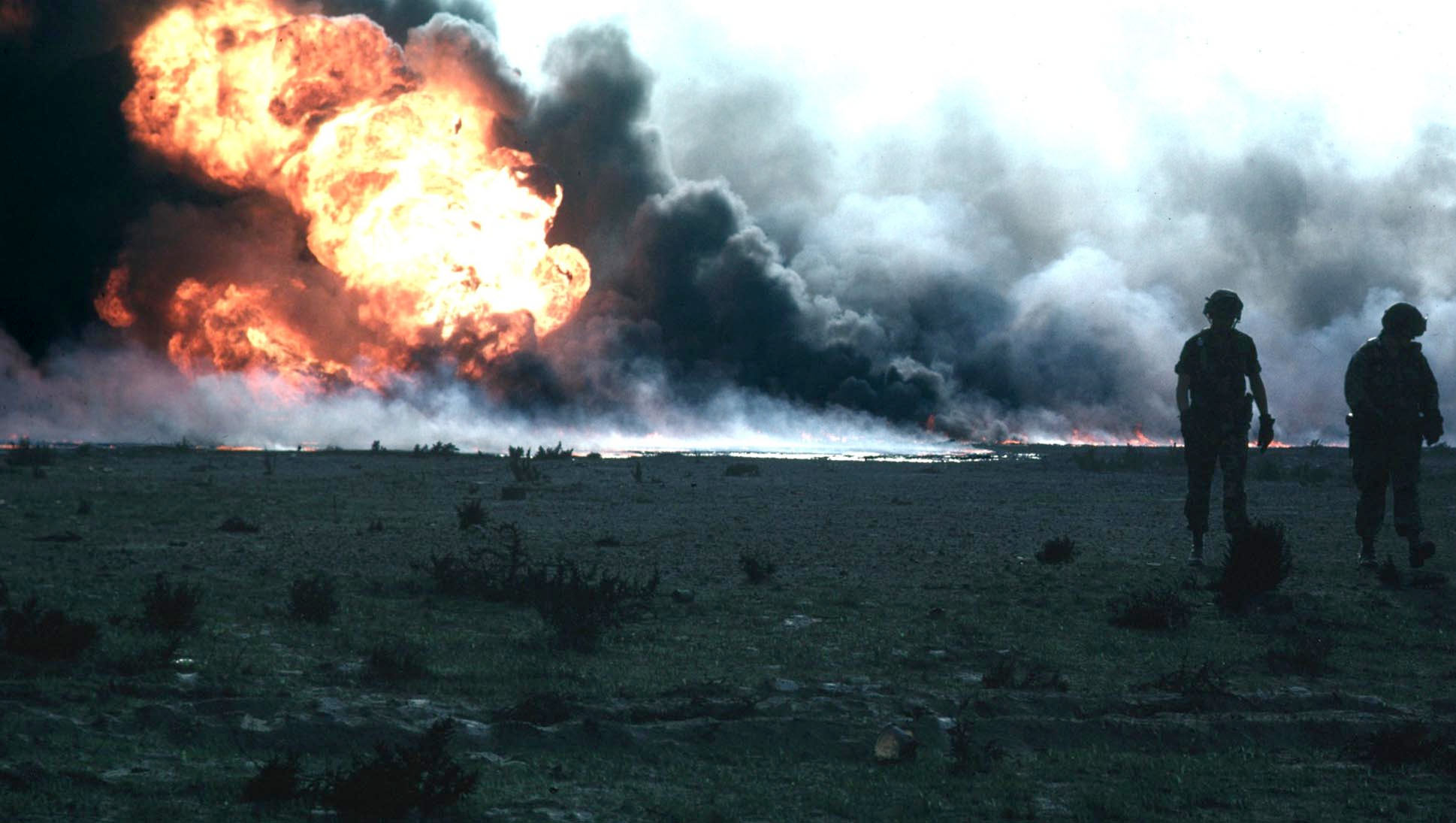
Photo credit: Burning oil fields during Operation Desert Storm, Jonas Jordan, US Army Corps of Engineers

Monday, May 04, 2009

BBC Persian television - PTV - launches

By Paul Cochrane, Arab Media and Society

On January 14, the BBC launched its Persian-language satellite television network, BBC Persian, with a £15 million ($21 million) annual budget, the
British broadcaster’s latest foray into a foreign language channel after BBC Arabic went on air in 2008.(1)
As has been the case for most foreign language channels linked to Western governments, a cloud of suspicion has hung over BBC Persian, much like how the U.S.-government funded al-Hurra and Voice of America (VOA) are viewed in the Middle East, as soft power at its most blatant and spectacular.
For while the BBC is funded by the British public paying an annual television license, PTV – as it is referred to within the BBC – receives additional funding from the Foreign and Commonwealth Office.
Indeed, PTV made waves from London to Tehran before the channel was even launched, with British tabloid newspaper The Daily Mail spouting off on the ill usage of taxpayer money (2), while Tehran eyed the channel as a potential rabble rouser on par, if not actually worse, politically speaking, than the 50-odd private Persian channels that illegally broadcast into Iran from LA. – “Tehrangeles.”(3)
While VOA has been broadcasting Persian news and discussion programming into Iran by satellite since 1999, such forays by foreign powers into the Iranian television market are rare. The launch of BBC Persian TV comes some 69 years after the BBC Persian Radio Service went on air during World War II, when the news was firmly controlled by the propaganda department of Iran’s Ministry of Information.(4) Ever since, the BBC has had a complex relationship with its Iranian audience, being viewed as a credible alternative to state propaganda at times and an agent of British meddling at others.
BBC radio broadcasts were considered instrumental in turning the people against Reza Shah Pahlavi, who was forced to abdicate following the British and Russian occupation of Iran in August 1941, (5) while the service carried out a similar function during the CIA- backed overthrow of Premier Muhammad Mossadegh in 1953.(6) Conversely, in the lead up to the overthrow of Muhammad Reza Shah Pahlavi in February 1979, the Persian Service was accused of backing Ayatollah Khomeini when it ran interviews with the revolutionary leader and aired segments of his speeches.
Nearly 30 years after the Islamic Revolution and just months before PTV was to launch, the BBC was again under fire.
In late October 2008, the Iranian Ministry of Culture issued a statement that it had “reliable reports” that the BBC Persian Service had “attempted to make suspicious and unjustifiable contacts that flout the law,” and were making “an effort to attract notorious individuals and create programs about suspicious topics.”(7) Intelligence minister Gholam-Hossein Mohseni Ezhei followed up by saying “BBC activities are against the national security of Iran,” and that correspondents were under surveillance.(8)
Then in early January 2009, Culture Minister Mohammad Hossein Safar-Harandi
announced PTV was not to get a license. No PTV correspondents were to be allowed in the country and BBC News, which has a bureau in Tehran, was barred from sharing footage with the channel or face having its license revoked. “The BBC English channel will be confronted if it abuses its legal rights by producing reports for BBC Persian and we are continually on watch for that,” he said. (9)
Safar-Harandi went on to advise journalists to avoid “unconventional” and “illegal” activities, in addition to naming Iranians that had applied for jobs with PTV. (10)
So far, seemingly not so good for the fledgling channel: PTV did not have a bureau in Iran, the channel could not be viewed legally due to the ban on private satellite receivers, and the website is filtered by the Iranian government.
A change in tune?

But while the outlook for the channel did not appear overly optimistic, four months down the line PTV has garnered thousands of viewers and one of the BBC’s highest numbers of web hits, while the mood in Tehran seems to be softening in its approach to the channel. Iranians were clearly viewing PTV by satellite – an estimated 60% of all households have illegal satellite receivers – and accessing the BBC Persian website. (11)
According to Rob Beynon, Acting Manager of PTV in London, “early indications from Tehran suggest that one in five people who have access to satellite TV tuned in during the first month. We have been encouraged by the fact that BBC Persian received 300,000 blog articles and mentions and around half a million searches for “BBC Persian Television” on Google Farsi – all in the first month after launch.”(12)
PTV was also being watched in the Persian speaking countries of Tajikistan and
Afghanistan, a reason for the channel’s title rather than ‘BBC Iran TV’, in the hope of appealing to the estimated 100 million Persian speakers worldwide.(13)
“If we have 10 million viewers in a few years we would be very happy,” said a source at PTV who wished to remain anonymous. “I often ask people who have just been to Iran if people watch PTV, and they say lots do,” he added.
With a staff of 100 mainly young Iranians, PTV shook off the image the Persian radio service had garnered by appealing to the country’s youth, with 70% of the country estimated to be under 30 years old.
“Old surveys found that BBC Farsi radio was mainly tuned into by men, sitting on their own having a smoke or with friends; that politics is a man’s world to the exclusion of women and young people. It had a slightly fusty, more mature audience,” said the source. “We tried to make PTV better than BBC Arabic TV, which is news driven. This is fifty-fifty, but with news on the hour, which is unusual for Iran,” he added.
Programs include Nobat-e Shoma (Your Turn), a live interactive show about everyday social and political issues; Talk Back; motor show Top Gear translated into Persiab; and Kook (Tune), presented by Behrzad Bolour, who is considered “the John Peel of Iran with lots of old records, dressed strangely in a hat, with earrings and a larger than life personality.”(14) The youth show Emruziha (Today’s People) is reportedly very popular, with the source saying the presenter is frequently recognized in Iranian-run shops in London and in airports, a clear indication people are watching the channel.
“I think what surprised many people was the range and diversity of our programming, from news through documentaries, technology, culture, through interactive to sport and pop music,” said Beynon. “Our interactive show combines webcams, emails, texts, and phone calls, and we have reunited families who have been apart for a generation, and covered topics never aired before for our audiences,” he added.
In terms of coverage, PTV has bureaus in London, Washington D.C., Istanbul, Beirut, Dushanbe, Kabul, and a correspondent in Jerusalem. “He is the first Iranian citizen to report from Israel, which is an anomaly for any Iranian channel,” said the source. There are also operations in Los Angeles and Islamabad, Pakistan.

Mohammad Manzarpour reporting from Gaza

The channel was the first in Iran to broadcast live the entire inauguration of U.S. President Barack Obama (although reportedly faced problems with security guards in DC), and had better coverage of the Israeli attack on Gaza than Iranian channels were able to muster due to having no presence on the ground. High quality production values and professionalism are also attributes that are appealing to Iranians, faced with choosing between the antiquated programming by state run channel IRIB or the U.S.- based channels that tend to be entertainment oriented and blatantly anti-government in their rhetoric.
“PTV has been very successful for the money invested and brought free media to one of the most strategic countries on earth for the price of Jonathan Ross,” said the source. (15)
As Iranian blogger Omid Habibinia commented, “The launch of BBC PTV should have a major effect on the state of television culture in Iran in general. In the absence of independent television on the one hand, and amateur-level programming from the stations abroad on the other, many will refer to the BBC for news and other information. Because the bar is so low, the BBC will not have to work hard to look good.” (16)
But while the channel appears to be going down well with Iranians, Tajikistan is
reportedly disappointed that it has been sidelined in PTV coverage, attributed to the overwhelmingly Iranian staff of PTV. “Dushanbe thought it would be a big opening to the world for Tajikistan, whereas Iranians feel they don’t need coverage of Tajikistan or Afghanistan,” said the source. Both Central Asian states are covered by IRIB, Iran’s main state broadcaster.
Describing the PTV staff, the source said “all are nationalistic and fairly patriotic, whether they like the people in charge or not, and not in favor of military action against Iran. You don’t feel the newsroom is a hot bed of anti-government sentiment.”
As PTV Iranian Affairs analyst Sadegh Saba told the executive editor of PTV, Steve Williams, in the January edition of in-house BBC publication The News Magazine, Iranians “don’t necessarily trust our motives, though they do trust our information. They can’t get their heads round us being government funded. However, they do think we’re balanced and fair.”(17)
This is the approach PTV is trying to get across. “There is the hope of showing the regime another way to interface with the world, of not being aggressive or defensive. The aim is not regime change, but bridge building,” said the source.
There is also the possibility that Tehran might start to cooperate with the channel as it builds an audience, although the test will come over the next few months in the lead-up to the summer presidential election.
“Tehran was initially worried that the channel would be against the system as a whole, but now is worried that reformists could use it as a platform as given less airtime on IRIB,” said the source. “They are very cagey about something they cannot control as they’re used to controlling everything.”
For such a fledgling channel, there are challenges ahead. “The technical configurations are fine, but in all cases the PTV bureaus are not independent of BBC Arabic or the BBC, so if a major story breaks there could be competition for satellite bookings; it is a lack of strategic forethought that may cost the station,” said the source. Furthermore, PTV will have to get correspondents in Iran for the channel to be effective in the long-term. “If within a year to 18 months there are not correspondents on the ground in Iran, it will be
a failure,” he added.
Beynon said that PTV will continue to press for a bureau in Tehran. “We have also been given permission to work on some programs inside Iran, so it’s wrong to say our correspondents are banned in Iran. One of our series had a very successful culture and cuisine theme and was broadcast in English on BBC World as well as on PTV,” he added.
There could also be competition in the offing, which negatively affected the reception of BBC Arabic when it was launched again last year. In the gap between the ill-fated BBC Arabic closing in 1996 following a fallout with Saudi partner Orbit, Iran, France, Russia and the USA have all set up Arabic language channels, while BBC Arabic was not able to re-hire the BBC trained journalists that had gone to work for the likes of al-Jazeera and al-Arabiya.
Al-Jazeera or CNN do not have Persian channels yet, but there has been talk of CNN setting up a franchise similar to CNN Turk. Equally, Gulf countries might expand into non-entertainment Persian broadcasting – there is currently a Dubai-based Persian Music Channel - while the first live FM broadcast in Farsi out of the UAE is to be launched in the coming months following an IPO. (18)
Indeed, in April, al-Hayat newspaper reported that Saudi Arabia is planning to launch a fifth state-run satellite channel that will broadcast in Persian and Turkish, “to acquaint them with Saudi society's social, economic, political, and security reality.”(19)
For the time being, PTV is at the cusp, not yet on terra firma but with a future that bodes well if the channel is granted a bureau in the country of its prime target audience.

1. BBC Arabic TV was launched March 11 2008, with an annual budget of £25 million a year, the broadcasters second attempt following a disastrous teaming up with Saudi Arabia’s Orbit channel in the mid-1990s, ending in 1996 after two years when the BBC fell out with Orbit.
2. ‘£15m a year to give Iran a BBC channel it doesn't even want,’ Paul Revoir, The Daily Mail, January 8 2009 - http://www.dailymail.co.uk/news/article-1109502/15m-year-Iran-BBC-channel-doesnt-want.html
On the other hand, British academic Timothy Garton Ash called the channel the “most unambiguously positive developments I have seen in a long time, and worth every penny of its £15m annual budget (the price of about one bolt on a Trident missile)” - ‘If Obama and Khamenei want to get along, they should
start watching TV,’ Timothy Garton Ash, The Guardian, January 15, 2009 -
http://www.guardian.co.uk/commentisfree/2009/jan/15/bbc-persian-television-iran
3. There are an estimated 50 satellite channels beaming into Iran from Los Angles – Tehrangeles – where there is a sizeable Iranian community. The majority of the channel’s are against the Iranian government, while some want to see the return of the Pahlavi dynasty. Despite satellite being banned in Iran, satellites are widespread and the channels are watched. The exception is during elections when the government blocks non-governmental channels through magnetic wave frequencies.
4. BBC Persian Radio was launched 28 November 1940.
5. “The BBC Persian Service, 1940-1953, and the Nationalisation of Iranian Oil,” Hossein Shahidi, Journal of Iranian Research and Analysis, Volume 17, No. 1, April 2001
6. “The BBC Persian Service was seen by most listeners as putting across the point of view of the British Government and of the Anglo-Iranian Oil Company, the fore-runner of today's British Petroleum, or BP. Listeners were particularly enraged by commentaries which criticised Dr Mossadegh and sought to
persuade Iranians that the nationalisation of oil was illegal and would not be in Iran's interest.’ ‘Injaa landan ast: BBC Persian Service 60 Years On’, Hossein Shahidi, September 24, 2001, The Iranian - http://www.iranian.com/History/2001/September/BBC/
7. Who's Afraid of BBC Persian TV? By Amir Mansouri, February 7, 2009 -
http://www.payvand.com/news/09/feb/1080.html
8.Ibid. Such statements by the Iranian government must be taken seriously, given the recent arrest of Iranian-American freelance journalist Roxana Saberi, who has worked for the BBC, for allegedly spying for the USA - 'Iran jails US journalist Roxana Saberi as spy' Peter Beaumont, The Observer, 19 April 2009
- http://www.guardian.co.uk/world/2009/apr/19/iran-america-journalist-sentence
9. “Iran bans BBC's Farsi language TV station, journalists asked not to work for foreign media, Newswatch, January 29, 2009- http://www.newswatch.in/newsblog/3879
10. Who's Afraid of BBC Persian TV? By Amir Mansouri, February 7, 2009 -
http://www.payvand.com/news/09/feb/1080.html According to a rumor within PTV, two unsuccessful applicants for PTV that had attended a vetting and
training course in Istanbul were later arrested in Iran: One for making a fake BBC Press pass to seemingly better his situation in the country, while the other tried to claim asylum in Britain after Tehran accused him of being a spy.
11. ‘BBC Persian TV is launching!’ Omid Habibinia, September 30, 2008, -
http://2006omid.blogspot.com/2008/09/bbc-persian-tv-is-launching.html
12. GND Audience Research February 2009, provided by PTV.
13. There are an estimated 70 million Farsi speakers in Iran, 20 million in Afghanistan and 10 million in Tajikistan.
14. John Peel was a popular BBC Radio One disc jockey in the UK.
15. Jonathan Ross, a television chat show host, reportedly has a £18 million, 3 year contact with the BBC – ‘Ross and Moyles face pay cuts in new £400m BBC squeeze,’ Chris Tryhorn and John Plunkett, The Guardian, March 20 2009 - http://www.guardian.co.uk/media/2009/mar/20/bbc-ross-moyles-pay-cut
16. The Long story of my critic [sic] on BBC Persian!’ Omid Habibinia, October 31, 2008 - http://2006omid.blogspot.com/2008/10/long-story-of-my-critic-on-bbc-persian.html
17. ‘Launching Persian TV’, Steve Williams, The News Magazine, Jan-Feb 2009, Issue 24, page 21.
18. Investors sought for UAE Farsi radio station, Andy Sambidge, Arabianbusiness.com, 3 April 2009 - http://www.arabianbusiness.com/551467-investors-sought-for-uae-farsi-radio-station
19. Saudis planning to launch Turkish, Persian-language TV channel, paper', al-Hayat, April 22, 2009 –Translated www.mideastwire.com/.

Photographs courtesy BBC Persian TV

In search of a global standard, Halal sector poised for growth

By Paul Cochrane in Beirut, Executive magazine

The Halal sector, which covers food, pharmaceuticals, cosmetics, finance and tourism, is at the cusp of exponential growth in the Middle East and worldwide. Valued at $1.5 trillion globally, the sector has been growing by 10-20 percent a year, even during the financial crisis, according to Ramez Shehadi, senior partner at consultancy firm Booz and Company.

Other estimates put the sector at over $2.1 trillion, and set to rise even further as companies start cottoning on to the potential of a sector that directly appeals to some 1.5 billion Muslims.

But what has been holding back the roll out of the Halal sector is the labeling and certification of products as Halal. With no global certification body, there is minimal standardization and coordination between national certifying bodies, such as in Australia, Malaysia, the USA, Britain and Brazil. It is the same story in the Middle East, with separate bodies in every country, and further compounded by the GCC importing an estimated 80 percent of Halal food from Brazil, Argentina and Australia. The Halal food market in the GCC was estimated at $9 billion in 2007, according to Canada's Agriculture and Agri-Food Trade Service.

“Halal is one of the last industries to have a common standard that producers and governments can abide by, and also a logo that consumers can look to,” said Jamaatun Azmi, Managing Director of Kashedia in Malaysia, and the creator and founder of the World Halal Forum.

With globalization resulting in products made from ingredients from numerous sources, the need for certification is even more pressing. As a result, the non-profit International Halal Integrity Alliance was established last year to create a global Halal standard, later endorsed by the Organization of the Islamic Conference.

“The whole idea of standards are they are voluntary but of benefit to manufacturers, jut like the ISO standards,” said Azmi. “You can compared to this to the growth of the organic food sector, which has become quite established, although it took decades to achieve.”

In early May, the Fourth World Halal Forum will be held in Kuala Lumpur to thrash out a global certification. But it will not be easy given the technical and scientific issues involved, such as whether mechinal fodder is considered Halal or not.

“We have to have something 100% Halal that no one can debate. If we had waited for Muslims to come to an agreement we wouldn't be where we are now,” said Saleh Abdullah Lootah, CEO of UAE-based Al Islami, the largest producer of Halal food products in the Middle East through franchises Al Islami Foods, Al Islami Cart, Al Islami Meat Shop, and fastfood chain Al Farooj Fresh.

“We went back to the book, to the Qu'ran, and adapted to that. There is a gray area, such as machine slaughtering of animals, but for us that is not acceptable,” he said. Lootah draws a line between what some say is Halal and 'real Halal,' which is meat that is hand slaughtered without stunning, as according to Islamic Sharia law.

He added that while multinational companies and others may want to get into the Halal sector, they should go all the way, as having some operations that are Halal and others not can result in confusion for consumers.

“The new generation of Muslim consumers are very sophisticated and more demanding, like it used to be with our grandfathers,” said Lootah. “With Halal it is about trust and integrity, this doesn't take days but years; it's not easy for companies to portray the message we have.”

Indeed, part of the need for certification on products – which could be as simpe as a logo of H for Halal – is that there have been a number of causes of fraudulent claims by companies marketing their products as Halal. “We have examples of pork having Halal certification, and it's pork!” said Azmi. “We also found Halal certification on knives, so there is clearly no education among manufacturers of what is actually Halal.” Just last month (APRIL), the Indonesian Agency of Drug and Food Control warned Muslims that five of out of every 35 meat flosses sold in the country contained shredded dried pork.

But it is not just in food – whether meat, processed food or in the restaurant sector - that Halal certification has potential. Cosmetics and pharmaceuticals are multi-billion dollar industries that manufacturers can tap into as Muslim consumers start to demand Halal sourced products. For cosmetics this could be big money, with the sector in the Middle East valued at $2.1 billion a year, according to trade experts Epoc Messe Frankfurt.

Sparking such potential growth is the fact that certain cosmetics have ingredients derived from pig fat and alcohol, while in pharmaceuticals, gelatine capsules also come from swine. “It opens a Pandora's box and a wealth of opportunity for generating demand by simple awareness in the Muslim world that this is really the case,” said Shehadi.

Interestingly, while Halal certifying bodies and governments in majority Muslim countries are aware of the non-Halal ingredients of products, a Halal gelatine has not yet been developed, which poses a quandry: inform the public or keep the matter quiet as people's health could be jeopardized if they stop taking certain drugs.

“Some governments are looking at this carefully to try and not create panic or chaos, as if we know the extent of non-Halal medicine it is not going to be good,” said Azmi.

But while Malaysia is taking the lead in certifying Halal, Shehadi said the Middle East has to get its act together. “It is counter intituitive that the home of Islam is not leading in Halal. The region should be a beacon, developing Halal standards and products suitable for the world. And by investing in Halal it can generate online content, entrepeneurism, small and medium sized enterprises, tourism, education and healthcare, which will have a snowball effect for development,” said Shehadi.

Friday, April 24, 2009

Somali 'Piracy Crisis': Pirates or Coastguards?

Commentary - Executive magazine
By Paul Cochrane in Beirut

Piracy off the coast of Somalia has become another ‘global crisis.’ It took the hijacking of a US ship last month and the media hyped antics of the US Navy in ‘neutralizing’ the rogue elements – three shots, three dead pirates – to make it onto the crisis list.
Yet piracy has been a problem off Somalia for as long as this East African country has been in a state of crisis, since 1991. And it is not a clear-cut case of the good guys – merchant seamen - versus the baddies – Somali pirates.
The dire situation in Somalia is what triggered a surge in piracy that has, like the conflict itself, many regional and international players involved. As an essentially failed state there are no means for patrolling Somalia’s coastline. This has been a scourge for the Somalis as well as the 33,000 ships a year that sail either side of the Horn of Africa. With no regulation, the seas were a free-for-all and the area became a rich source for unscrupulous seafarers.
In the year following the overthrow of the Union of Islamic Courts by US-backed Ethiopian troops in Dec. 2006, there were 31 attacks on ships. As the conflict in Somalia heated up, the number of attacks spiked to 122 in 2008, while in the four months of this year there have been 79 attacks. Pirates are currently holding 280 crewmen on 14 ships for ransom.

But while pirates demand millions of dollars to release hijacked ships, Somalis and the UN have claimed that foreign ships, primarily European, have been dumping toxic and nuclear waste off the coast to avoid high waste disposal costs elsewhere. When some of this toxic waste washed ashore, over 300 people died from radiation sickness
.
Illegal fishing has also taken its toll, with an estimated $300 million worth of fish trawled every year. According to news reports, stocks are running so low Somalisare struggling to survive
. Vigilante justice ensued when local fishermen took to the seas to levy ‘taxes’ and seize ships suspected of dumping and illegal fishing, calling themselves the Volunteer Coastguard of Somalia.
It was a measure that has popular backing in Somalia, as has actual piracy. According to an editorial in Somali news site WardheerNews, 70 percent of those polled “strongly viewed the piracy as a form of crude, primitive, if you will, national defense of the country’s territorial waters.”
It is a bit of a stretch however to say a ship hijacked up to 900 nautical miles off the coast is national defense, particularly with the ransoms paid out funding militias in Somalia. But such piracy could be viewed like the folkloric hero Robin Hood, robbing the rich to feed (and arm) the poor. After all, whether someone is referred to as a pirate depends on how they are regarded, similar to the way ‘one man’s terrorist is another man’s freedom fighter.’
Take Captain Morgan of Jamaican rum fame, who was a privateer in the service of the British navy in the Caribbean in the late 1600s, attacking Spanish flotillas laden with booty. Morgan and his ilk – what we might now refer to as maritime mercenaries – served a foreign policy objective by pillaging from the Spanish, but crucially set the course for Britain to become an empire through its domination of the seas. Piracy had its uses, and for his efforts Morgan was made the Lieutenant Governor of Jamaica. The founder of New Orleans was also a pirate and during the American Revolution,George Washington, lacking a navy, paid pirates to patrol the coast.

Piracy could also be considered a policy common to the financial world, whether it’s offshore banking havens that launder dirty money or of the more cutthroat capitalist variety. There was even a recent posting on the Wall Street Journal’s blog on “Piracy vs. Private Equity: A Comparison.” Similarities were the seizing of assets and adopting a “all for one, one for all” partnership model, but where piracy demands a ransom to divide among the pirates, PE has a dividend recap, then sale or initial public offering.
And just as tighter regulations of the free market are being sought,amid the global financial crisis,amid the global financial crisis, NATO is debating whether to provide armed convoys for ships plying Somalia’s waters. But despite the 15 to 20 warships under UN auspices currently off the coast, Somalis claim navy vessels are protecting illegal trawlers that were initially scared off by its volunteer coastguard.

While some temporary measures are needed to protect shipping routes, the real solution to the crisis lies on land. With stability, Somalia would have less need to resort to piracy – defensive or offensive - and its natural resources could be better protected. If one good thing can be said of the ‘piracy crisis’, it is bringing attention to the ramifications of a failed state.

Wednesday, April 22, 2009

Auto Sector in UAE, Gulf Region Not Immune to Global Meltdown

By Paul Cochrane in Dubai
WardsAuto.com, April 13, 2009

While the economic slowdown in the UAE is being felt all over, the country’s auto sector is adopting new financial strategies and a greater focus on services as access to credit tightens.
Vehicles sales in the United Arab Emirates plunged by up to 45% in the first two months of the year compared to 2008, according to Ford, a remarkable change in fortunes from the years of double-digit growth when the $3.6 billion sector was one of the fastest growing in the world.
“
Since October, traffic has been different, the roads are noticeably quieter,” said Mike Devereux, President of GM Middle East. “And the end of the third quarter 2008 was vastly different from the fourth for manufacturers. This year we are looking at a decrease overall, with the same daily sales rates since December to now.”
But while the economic slowdown in the Emirates is being felt across the board, the automotive sector is adopting new financial strategies and a greater focus on services to shift units as access to credit tightens.
“The financial crisis has certainly affected automotive sales in the UAE, with banks applying more restrictions on financing. And since nearly 80% of the UAE's automotive sales are dependant on financing, this is more evident locally,” said Waldo Galan, Managing Director of Ford Middle East. “Overall for 2009, we expect the automotive industry to achieve minimal growth in the UAE.”
In the face of tighter lending, manufacturers and dealers are teaming up with banks to offer zero percent interest on vehicle sales and making credit more readily available to customers. The most notable change in sales strategy has been the widespread introduction of leasing, a technique dealers had formerly eschewed as vehicle prices were low and customers preferred to buy.

“Financing is a problem so schemes have to be more tactically focused. Screaming the price from the rooftops is not what it’s about, but customer issues. Lots of people want vehicles but need financing, so we’re focusing on a partnerships with the National Commercial Bank (NCB) of Saudi Arabia and in the UAE a car leasing scheme,” said Devereux.
While enticing customers into showrooms is one concern for the manufacturers, so is keeping dealerships afloat, having ordered vehicles months in advance that can now not be sold or re-exported elsewhere. Furthermore, 2009’s models are now on sale yet dealers have not shifted all of last year’s lines.

“Credit, wholesale finance, and bank loans are difficult for dealers. Stock levels for dealers means reduced working capital so less money in the inventory,” said Devereux. “We will winnow down our inventory and import much less cars.”
And while there is an excess of unsold cars, manufacturers are hesitant to offload vehicles in fleet deals and government tenders.
“We’re trying not to chase unprofitable fleet tenders that we would have done before, as there is little to no margin. Price is important, and if flooding the market with 2-3 year old vehicles, too much value at a low price,” said Devereux. “We are now focusing on the retail business, with 65% retail and 35% fleet.”
Consumer preferences are also expected to shift towards more competitive fuel efficiency, fewer SUVs and trucks, and more crossovers, such as GM’s Chevrolet Cruise.
“While demand for luxury vehicles would possibly see a reduction, quality and value would still remain on top of the consumer's list,” said Galan. “We believe that consumers will act more out of a rational mindset and look for quality and value for money rather than the emotional drive.”
Such consumer shifts were taking shape last year with Kia reporting a 60% jump in sales over 2007. Japanese brands, which have the lion’s share of the market, at 40%, are also focusing on more efficient models. European brands cater more to the luxury sector with 30% market share, while the remaining 30% is equally divided between American and Korean brands.
Some 180,000 units were sold last year in the UAE, according to Ford. Last year, Ford, Lincoln and Mercury sales grew 35%, while GM sales were up 19%, and up 30% in the Middle East, with an all time record of 144,485 units sold.
After sales is a further area manufacturers and dealers are focusing on as sales stagnate, a sector valued in the Middle East at some $11 billion, while the UAE tire trade is valued at AED 4.15 billion and slated to grow this year.

“We don't see a change in after parts as value has grown. There is a big focus now on services, which will be a stable haven in a downturn. Most dealers here are under invested in service capacity, and the number of vehicles has increased so quickly,” said Devereux. “There is a need to invest in new services as vehicles are coming into prime servicing years after 2-3 years since purchase.”
While manufacturers continue to monitor the local environment, they are optimistic that revenues will go up next year as supply and demand aligns, even though it might not be the double-digit figures of the boom years.

Wednesday, April 08, 2009

Imports up, food production down, GCC eyes arable land overseas

By Paul Cochrane in Dubai
Executive magazine

Last year, food was big news as prices soared globally by 54.9 percent and associated riots erupted in 60 countries, while in the Arab world the shortage in food sufficiency was estimated at $18 billion by the Arab Authority for Agricultural Investment and Development (AAAID). In the Gulf countries, dependent to the tune of $12 billion a year on imports and agricultural water consumption at unsustainable levels, the issue took on grave importance. State and private investors promptly started eying up arable land in Africa and Asia to secure food for a region that is expected to increase import dependency to 60 percent by 2010, according to the UN’s Food and Agriculture Organization (FAO).
But while food prices and commodities have reduced in the wake of lower oil prices and the global financial crisis, the issue of food security has not gone away. Although whether all the touted agribusiness projects will take off is not a given as Sovereign Wealth Funds (SWFs) and private investors tighten their belts in the face of the slowdown.

The big issues

The Arab world’s population ballooned 121.9 percent between 1975-2005, while over a similar period, 1980-2004, the region’s food grain and meat production increased by 93 percent.
The shortfall was not overly concerning given access to the free market and staples such as wheat and rice being fair cheap, certainly affordable enough for governments to subsidize. Additionally, countries such as Saudi Arabia, Syria and Iraq were involved in large-scale agricultural projects to boost domestic production.
Saudi Arabia, for instance, spent a staggering $85 billion on agricultural development between 1984-2000, according to estimates by Elie Elhadj in The Middle East Review of International Affairs.
But the cost of such investment has gone beyond budgetary concerns. Aside from the fact that Saudi Arabia was paying up to $500 a ton for domestically produced wheat - whereas international market rates were around $120 – to maintain local agriculture some 300 billion cubic meters of water was used between 1980-1999, two-thirds of it non-renewable, according to the Ministry of Agriculture and Water. Such a gigantic amount of water was needed to grow produce in the kingdom’s arid climate, which is two to three times more water than required in a temperate climate.


After investing an estimated $16-18.7 billion over the last 30 years on its wheat program, according to BMI, Riyadh last year decided to phase out production due to water shortages. The costs versus the benefits were no longer sustainable, having been self-sufficient in wheat since the 1980s when production reach 4 million tones per year, but now a net importer and as of 2016 totally dependent on imports. Furthermore, with Saudi Arabia joining the WTO, the kingdom has to abide by the organization’s requirement to reduce state support for agriculture to 13.3 percent over the next decade. This will have other knock on effects, such as on the 12 percent of the workforce involved in a sector that accounts for just 3.3 percent of GDP.
Saudi Arabia is not the only country re-thinking its agriculture policies, with the region losing an estimated one million hectares a year to salinity, according to Dr Shoaib Ismail, a halophyte agronomist at the International Center for Biosaline Research (ICBR) in Dubai.

Crop circles in Saudi Arabia

“Twenty years ago there was good quality water everywhere. Now there is one-third seawater concentration in the groundwater, and salinity is even higher in other places. Mismanagement has led to more salinity,” said Ismail. “Some 85 percent of water usage in the GCC is for agriculture, the highest in the world. In that sense, the question arises, how feasible is agriculture over here?”
The short answer is that it isn’t. Even producing processed foodstuffs for domestic consumption and export requires water, what has been called the “export of virtual water,” and may have to be re-thought given looming water constraints.
One solution is to use halophytes, plants that grow under high saline conditions, as opposed to glycophytes, non-salt loving plants, an alternative the ICBR is involved in. But while halophytes could be used to replace more water intensive plants and trees, such plants would not produce adequate amounts of food. It is in landscaping, which accounts for 18 percent of water use in the UAE, that plants and non-conventional grasses can be advantageous, according to Ismail.
Oman is developing a salinity plan, and has invested in a project to clean water from the oil industry, as for every barrel of oil pumped out of the ground seven barrels of water are used. The UAE has also developed a Master Development Plan to assess water usage and improve efficiency, such as changing irrigation systems, phasing out subsidies and expanding water pricing to include agriculture and industry.
Desalinization is another touted panacea for the region’s water concerns, but costing between $0.81-$1 per cubic meter, desalinated water is too expensive for agricultural usage.
“Building new desalinization plants is not the solution, as warms up the sea and affects marine life,” said Ismail. It also increases the sea’s salinity and, once entering groundwater, makes fresh water even more brackish, of little to no use to either man or beast.

Dr Ismail is not optimistic about improved use of water resources in the region

Eying pastures new

With wheat prices rising 83 percent last year and other staples doubling in price, governments started eating into their reserves to placate populations that were spending ever larger amounts of their income on food.
Over in Pakistan, the NGO Oxfam reported that due to food inflation the number of poor has risen from 60 million to 77 million since 2007, while in the Arab world the AAAID predicted some 35 million people were falling into poverty due to high food costs. With the region having an overwhelmingly young population and high population growth, food security is paramount.
For the GCC, the surge in food prices didn’t push people under the poverty line, but was a contributor to inflationary pressures. And with the population expected to double by 2038 to 60 million, demand for food will continue to grow at a rapid pace. Saudi Arabia, the Gulf’s most populated country, already imports some $5 billion a year of food and beverage items, according to BMI, and that will figure will spike in years to come.


“Food security is officially defined not just as a shortage, but also looking at availability and affordability,” said George Attala, a Principal at Booz Allen Hamilton. “There are a number of ways to ensure supply is always available. One is try and diversify sources, not all wheat from say Ukraine. Another is look at internal networks, such as imports through more than one port. A third way is storage capacity, of four to six months, while the fourth is to get into contract farming, but that is not always the best solution.”
Essentially, the Middle East is left with two choices.
“The region has to import. The question is, invest abroad or rely on the free market?” said Dr Eckart Woertz, program manager in economics at the Gulf Research Center in Dubai.
Last year, Arab states appeared to be opting for the first choice in the face of high food prices, with government missions from Saudi Arabia, the UAE, Qatar, Kuwait, Egypt and Libya visiting Pakistan, Ethiopia, Cambodia, Uganda, Angola, Kazakhstan, Ukraine, Thailand and the Philippines to discuss the possibilities of buying up arable land to cultivate. The private sector also got in on the act, with the likes of the Emirates Investment Group, Abraaj Capital, Al Qudra Holding and the Bin Laden Group reportedly acquiring land in Sudan and Pakistan.
But such policies are not always popular, and also not necessarily dependable sources in the long run. “For the GCC it is a ‘pros and cons’ situation. In the short term it is profitable to buy or lease land, but it also depends on the geopolitical situation. A country may be a friend today, but might not be tomorrow, so it is a dependency issue,” said Ismail.
Last year, the FAO warned that rich countries trying to secure land overseas risked creating a “neo-colonial” system. The concerns were related to Gulf investments in Sudan where only indigenous water and land were used, whereas fertilizer, seeds, equipment and labor came from abroad. It was a similar story in Pakistan.
As Woertz remarked, “the negative case is bribe an African official, then expel locals and pastoralists, so no benefit for the local population at all. There is political baggage.” Furthermore, he added, “the GCC doesn’t have a good track record of labor rights or the environment, and these need to be taken into consideration.”
And while the countries being courted may be interested in foreign investment, they also have to feed their own populations. Sudan for instance has an estimated 200 million acres of fertile land, yet only 20 percent is being utilized. However, despite 160 million acres of available arable land, the country is importing two millions tons of wheat per year and five million people are dependent on food aid. Similarly, Pakistan is facing problems in feeding its population, as well as losing groundwater to salinity.
But although there are many reports on plans to buy land, there has been minimal information coming forth about these projects, with “transparency limited to media accounts,” said Woertz. “They announce it - billion dollar deals - but it is unclear whether it has taken off the ground, and how the private sector has been brought in.”
An additional factor is that discussions to acquire land overseas were kicked off when oil and food prices were higher. “The urgency is not there now and there is less money to throw around,” said Woertz. “The SWFs lost money in the markets and have less revenues, so [acquiring land abroad] may not be such a widespread phenomenon as made out.”

Photographs by Paul Cochrane

Thursday, March 19, 2009

Abandoning Dubai

Commentary - Executive
By Paul Cochrane in Dubai

Dubai has been getting a lot of negative coverage in the media lately. One story stands out in particular, the frequently spouted ‘3,000 cars abandoned at Dubai airport,’ which has been used to suggest the emirate’s economy is sinking into the sand.
It is a story I’ve had recounted to me from barbers to businessmen, with figures metamorphosing like in a massive game of Chinese whispers, from hundreds of cars left a day to up to 30,000 having been abandoned.
India’s Daily News & Analysis broke the story, citing 3,000 cars had been abandoned over four months at the Dubai International Airport (DXB) and quoting the director general of airport security.
The story was soon picked up elsewhere, with websites firing off sensational headlines: ‘DXB clogged with cars abandoned by fleeing construction workers,’ and ‘Thousands of luxury cars abandoned at DXB as expats flee debts’.
The curious thing is that within a week of The Times of London carrying the 3,000 figure, and then a local newspaper quoting an anonymous airport security source that “every day more and more cars were found,” and “Christmas was the worst - we found more than two dozen on a single day,” the chief of Dubai’s police force came out with a different figure.
“Only 11 cars have been abandoned at Dubai airport in over a year,” said Lieutenant General Dhahi Khalfan Tamim, before lambasting the media for its reports on the decline of the economy as being “out of proportion.” He went on to say that Dubai still has “a smooth economy and the problems attributed to the emirate both in the local and international media were completely false.”
The original report and the government’s eventual response all happened in the first two months of the year, but I kept hearing stories about dumped cars at the airport when in Dubai in March. Either people had not read the clarification, or no one really believed the police chief’s claim.
So who to believe? We have the press reports on one hand and on the other a statement by a government spokesman that will presumably not be changed. Whether the abandoned cars story is an urban legend or not is now hard to ‘prove’.
But what the story does suggest is that if the government is not forthcoming about the gravity of the situation we are left with no choice but to fall back on what the police chief urged the media not to use: anecdotal evidence to gauge how healthy Dubai’s economy really is.
There are also economic indicators, but this requires a cross examination of numerous sectors, which is problematic given the nature and secrecy of many institutions and family businesses in Dubai, often unwilling to disclose to business journalists how their business is faring. This is compounded by a dearth of collaborative data amongst players as well as official statistics on economic sectors.
As one industrialist remarked when we talked about Dubai’s economy, “our clients don’t read the news about the sector, we get together to talk and see how we’re really doing.”
Ultimately, all we can do is piecemeal data and anecdotal indicators together. Judging from everything I’ve read, seen and heard, I’ll stick my neck out to say Dubai is in a downturn, despite the government’s spin.
In the first two months of the year the automobile sector declined 45% in the UAE, advertising is set to plunge 50% in 2009, and economic growth is projected to be between 2-4%, while real estate prices have dipped, construction projects have stopped, and banks are not lending like before.
All of this is evident from visibly fewer vehicles on the road – as observed by the head of GM Middle East – and from the huge blank billboards on Sheikh Zayed Road that previously advertised real estate projects.
Conversations with Dubai residents are a further indicator. A plywood distributor’s business was down 90% from 2008, from 100 containers a month to only nine; a taxi driver sent 35-40% less cash home than before; an import/export firm registered a 35% decline in orders; a colleague’s flat mate lost her job as a graphic designer.
I even heard of a friend’s relative abandoning his car at the airport. Given such anecdotal evidence, it would be no surprise that people are leaving their cars at DXB or in parking lots elsewhere as jobs are lost.
Denials of Dubai’s economic situation by the government are frankly disingenuous. Dubai needs to face up to this to be able to think hard about the direction it wants to take its economy. There are no easy answers, but short-term thinking has to be sidelined, as does the official reticence on the true state of the economy.
After all, stories like the abandoned cars at DXB can quickly get out of proportion and become believed, no matter claims to the contrary; it is a human fallibility we have seen time and again, yet also an understandable one given people’s desire to know what’s going on, especially during a crisis.

Photo by Paul Cochrane

Oman ups infrastructure development

Ras al Jinz, famous for nesting sea turtles, near Sur

Executive
By Paul Cochrane in Muscat

While construction workers are downing tools throughout the Gulf and the future of massive infrastructure projects are in jeopardy, the Sultanate of Oman is bucking the regional trend by investing billions of dollars to bolster its nascent tourism sector, aviation and industrial base.
Compared to its GCC neighbors that have spent lavishly over the past decade on infrastructure and real estate projects the Sultanate, the relatively poor man of the Cooperation Council, has lagged behind in infrastructure roll out.
That Oman is doing so now is not down to Muscat possessing a financial crystal ball that foresaw the cost of raw materials plunging from record highs and that contract bidding would become more competitive. For Oman, the projects are out of necessity, to catch up with regional developments and be viewed as more of a GCC player than merely the better half of the lower Arabian Peninsula.
The Sultanate has always had to be prudent with its revenues, and never so much as the present with energy accounting for some 75% of national revenues yet oil prices having tumbled. The last two immediate budgets, which ran a $1.04 billion deficit in 2008 with revenues of $14.06 billion, were both based on $45 a barrel. Conservative thinking 16 months ago when oil hovered around the $100 mark, but roughly on par for this year.
If prices drop, some projects could be frozen, but Oman also has new oil and gas fields coming online, and is aiming to average out production at 550,000 barrels of oil per day.
Furthermore, Oman has not been hit to the same degree by the financial crisis as the more service-based economies of the rest of the Gulf, in addition to only relaxing property laws as late as 2006, which had previously prevented foreigners from owning property and restricted GCC citizens to just three plots of land. As a result, the real estate sector has only started to flourish over the last few years, further compounded by the entrance of international realtors that have changed the face of the sector as well as driving up rents.
But the path the Sultanate wants to tread doesn’t differ much from that of other GCC countries: investing heavily in airports, roads, ports, industrial zones and high-end tourism projects. Oman is just the last member of the GCC to board the ‘speed-development’ train.

The Corniche in Mutrah, Muscat

Infrastructure roll out

Talking of trains, Oman is mulling the idea of its first railway, a goods carrier that would run 200 kilometers between the industrial city of Sohar and Barka. Reportedly in its consultancy phase, the line would eventually cater to passengers.
But where Oman is really placing its transport infrastructural emphasis is on roads and airports. In such a large country with populated areas confined to Muscat and the cities of the northeast, and a vast, relatively empty expanse of 1000 kilometers to the second major city, Salalah in the south, a developed road network has been vital. Some $1.9 billion was earmarked in the 2008 budget for highway and road development, in addition to improving traffic flow in Muscat, according to Gulf Construction.

With only airports in Muscat and Salalah 1,000 km away, the bus network is the only way to get around

The impacts are already being felt, with the newly opened Muscat-Sur highway – so new the tollbooths are still not operational - slashing two hours off drive time.
But with tens of billions to be spent on industrial projects, ports and tourism projects, roads alone are not enough to connect areas like Duqm, Salalah and Sohar.
“To speed up access to Duqm, as four to five hours by road from Muscat, an airport is ‘essential’ infrastructure,” said George Bellew, Chief Executive Officer of Oman Airports Management Company.
Airports are where the big money is being invested, to the tune of $3 billion for the expansion of Muscat International Airport and billions on six other airports.
“Like everywhere else, there has been an increase in travelers, tourism and commercial trade in Oman. Six airports are to be built, maybe more,” said H.E. Sheikh Mohamed Bin Sakhar Al-Amry, Under Secretary for Civil Aviation Affairs. “We will build airports as needs dictate,” he added. Some $43.86 million has been earmarked for consultancy studies, design and supervision of the airports.
All airports are to be located in areas of industrial activity and/or tourism, a potential major currency earner given Oman’s nature, history, 2,700 kilometers of coastline, and two months in the summer – known as Al Khareef – when the area surrounding Salalah is uniquely endowed with monsoon rains that transform the landscape into a lush green oasis.
“There is a determination by the Omani government to diversify non-oil revenues, and an aspect of that is clearly tourism and air travel,” said Bellew.
Numerous multi-billion dollar tourism projects are underway in Oman, including the $7 billion Blue City, the $2.5 billion Wave Muscat, the $2 billion Salam Yiti, the $1.6 Omagine, and the $400 million Muscat Gulf Course.
In Salalah, the Dhofar Tourism Company is developing the $2.85 billion Mirbat project, consisting of residencies and hotel resorts, while the Muriya Tourism Development Company, a JV between Oman’s Ministry of Tourism and Egypt’s Orascom Development Holding, is developing Salalah Beach. Covering 15.6 million square meters, the project will have 3,000 residences, a marina, PGA golf course and hotels from the major chains, Club Med, Rotana, and Movenpick.

Herons and waders on Salalah beach

To meet the expected surge in tourism when such projects are finished, Salalah’s airport is being expanded from the current needs of 300,000 passengers per year to two million in phase one, and eventually four million.

Domestic links

Three domestic airports are to be built in the southern towns of Haima and Shaleem, as well as in Adam, a gateway city to Oman’s interior region some 300 km south of Muscat.
Duqm is to be the country’s third international airport with a capacity for 500,000 passengers per year, and is the site of a $1.8 billion port project, refinery, shipyard and tourism resorts. Firms are currently bidding for a $200 million contract for the construction of the airfield and infrastructure projects.
Further airports are to be built in Ras al Hadd and Sohar, located 200 kilometers from Muscat on the way to Dubai. “Ras Al Hadd is being progressively developed as a tourist area, where turtles nest [at Ras al Jinz], and covers the local area of the city of Sur. There also is the expectation of eco-tourism developing along the Eastern coastline,” said Bellew.

An archaeological dig at a 3BC site in Ras al Jinz

Sohar has risen as the country’s foremost industrial hub, driven by over $12 billion of investment in the city’s port, a joint venture between the government and the Port of Rotterdam. The Sohar Special Economic Zone is also under development, primarily catering to downstream petrochemicals and the steel industry as well as logistics at a 500-hectare site. The SSEZ will compliment the 220-hectare Sohar Industrial Estate, and Oman International Container Terminal, which the country is banking on to bolster trade due to Sohar’s proximity to Muscat and the nearby Emirates.
The Sohar airport is slated for completion by 2013, although a $300 million tender for the passenger terminal has not yet been appointed.
The biggest airport development is at Muscat International Airport (MIA). “MIA is a gateway airport with one main runway, two in both directions. The plan is to build a standalone midfield terminal,” said Bellew.
The first expansion phase will allow for 12 million passengers a year, with a new passenger terminal control tower, 32 air bridges, VIP building, air traffic management centre, 6,000 car parking spaces, and a cargo terminal to handle some 200,000 tons per year. The second terminal will be connected to the rest of the airport via an underground metro system, with the design brief making it possible to expand to 48 million passengers per year by 2050. “In six months we will finish the planning and award contracts,” said Bellew.
There was a need however to open a new pier in March to increase capacity to 7 million per year. Indeed, last year MIA saw air traffic rise 18% on 2007, to 4.5 million passengers. In January, passenger numbers were up by 19%, largely due to Oman hosting the Gulf Football Cup.
“January figures are an anomaly to the global figures, where there has been a lot of negative results, largely due to the underdeveloped nature of the market here,” said Bellew.
The Sultanate will no doubt be hoping that Oman is an anomaly in weathering the financial storm as so many projects get off the ground. Economic growth, however, is expected to slow from 7% in 2008 to 3% this year, but major projects are nonetheless still years off completion.
“We budgeted for this a long time ago, so I don’t think we will change plans,” said Al-Amry.

Photos by Paul Cochrane

Tuesday, March 10, 2009

The Near Death of a Star

Executive - Commentary

In late January I was asked to look into the closure of The Daily Star, Lebanon’s only English language daily. But discussions to financially prop up the paper were going on behind closed doors, so without a shareholder to quote, the story, as they say, was dead in the water. It also looked as if ‘the DS’ could be as well, and that this commentary might have been a eulogy of sorts.
For on January 14, the DS was ordered to cease operations following a court order requested by Standard Chartered Bank over a loan of some $700,000. The presses were at a stand still, staff were on leave until further notice, and the website frozen on the date the plug was pulled. It took until February 2, for the paper to raise the cash to get back on the newsstands.
To the hacks, editorial staff and interns that have spent time at the Gemaizeh offices (of which I am one), the closure was but another episode in the drama of the DS.
As the old hands can readily recall, the newspaper has had many ups and downs, from the deal with The International Herald Tribune that gave the DS a much needed boost in the early 2000s, to the unification of the Lebanon and Regional editions, to the downsizing of the paper’s staff in 2005, when it shrank from occupying two floors of Marine Tower to only one. Then there was the ill-fated plan to gain a bigger slice of the regional market by moving to Dubai – I was even asked if I would be willing to make the move, it was seemingly that certain – and the loss of the IHT alliance in 2006.
Older staff still working at the paper were pragmatic following the shutdown, feeling the causes would be rectified as so many times before when the paper was in dire straits. Former staff were somewhat nostalgic – they certainly let each other know about the closure – but equally not surprised when recalling the financial constraints and lack of dynamism and morale in the newsroom itself.
The discontinuation of the DS did not bring about any schadenfreude though, but rather handwringing. For despite all of the paper’s shortcomings, notably reduced pagination and a heavier reliance over the years on the wire services as well as interns to churn out content, readers bemoaned the loss.
There was talk of what news options were left to English-speakers in Lebanon and for readers abroad interested in this perpetually problematic country. For Lebanon is extremely limited when it comes to daily news coverage in English, confined to a handful of mostly partisan websites, such as nowlebanon.com, which is linked to March 14, naharnet.com, equally pro-March 14, and almanar.com.lb, linked to Hizbullah.
Although no details were forthcoming about the re-financing of the DS, the fact that it is not openly sponsored by any political group and regularly has Lebanon’s two opposing camps breathing down its neck, makes the Star’s position in Beirut a much needed one.
Sure there is a need for less wire copy and more original content, as well as an overhaul of the Opinion page, which more often than not reflects the ideas of those outside the region than in it – running counter to what anecdotal evidence suggests, that people want another perspective on Middle Eastern issues than what the Western mainstream media offers. The website also needs to be seriously revamped in keeping with the shifts in the media environment.
But these constraints appear to be acknowledged by the DS, as stated in a ‘We’re back’ announcement: ‘Expect to see some changes in format and style over the coming months as this newspaper tries to revitalize.’ That has, however, been heard before, so let’s hope some real change is afoot to boost readership and not lose the DS, again.
Media coverage of Lebanon aside, the loss of the DS would have deprived the world of a journalistic incubator for the numerous reporters, editorial staff, photographers and graphic designers that have passed through the Star since it was re-launched in 1996. From my time there and before, former DS staff have gone on to work for Britain’s The Financial Times, The Economist, The Guardian, The Independent, and for Reuters; The Los Angeles Times, The Washington Post, The New York Times, Christian Science Monitor, Newsweek and Time; Germany’s Frankfurter Allgemeine Zeitung; Belgium’s De Standaard; Canada’s Globe and Mail; the UAE’s The National and The Gulf Times; Australia’s The Age; and on television Al Arabiya, Al Jazeera, Future, and ABC.
The aforementioned are clearly some of the biggest names in global media, and a fact the Star’s management can take pride in. It is another good reason why it’s good news to have The Daily Star back in print.

PAUL COCHRANE is a Beirut-based journalist. He worked at The Daily Star from 2002-2005