The Central Bank of Yemen (CBY) is struggling to operate amid the conflict that has been wracking the country for the past seven years. The institution’s base, but not all its the staff, were moved from the capital Sana’a - currently not under the control of the internationally-recognised government - to Aden, while much of the country is off-limits to regulators. Paul Cochrane managed to talk with a senior CBY official, who offered rare insight on combating financial crime in a war zone.
To read more go to Money Laundering Bulletin
StatCounter
Tuesday, October 31, 2017


Tuesday, October 03, 2017
Accounting for NGOs in conflict areas
This article was first published in the October 2017 international edition of Accounting and Business magazine.
To read more go to: http://www.accaglobal.com/uk/en/member/member/accounting-business/2017/10/insights/ngo-conflict.html
Vetting of local staff and suppliers is a further complication. Vetting is required by donors, particularly government bodies such as USAID.
Non-governmental organisations (NGOs), international aid agencies and charities are under increased pressure to abide by international and domestic regulations to demonstrate their financial probity. But while there is often effective oversight in their home countries, in the field, NGOs can struggle to adapt and navigate local rules to ensure appropriate procedures are in place.
To read more go to: http://www.accaglobal.com/uk/en/member/member/accounting-business/2017/10/insights/ngo-conflict.html
Thursday, September 28, 2017
China and Counter-terrorism
International Link (Hong Kong)
October 2014
“Terrorism
in China is starting to look more like what is seen elsewhere in
Southeast Asia and the Middle East,” said Andrew Small, a
Transatlantic Fellow at the
German
Marshall Fund of the United States.
Such
a statement would have been unheard of a decade ago, even a year ago,
especially outside of Chinese officialdom. But over the past year
the frequency of terrorist attacks, albeit low level, has increased
in the country, particularly in Xinjiang province in the far West.
Police stations have been attacked, officials stabbed, and there was
a double-suicide bombing at the Urumqi railway station on the final
day of President Xi Jingping's visit to Xinjiang – where he was
focusing, ironically, on counter-terrorism – in April, 2014. There
have also been attacks in cities around the country, with one of the
most high profile in Tiananmen Square in October, 2013.
Such
attacks have a commonality – they have been carried out by Uighers,
the ethnic, predominantly Sunni Muslim minority from Xinjiang. As a
result, Beijing has stepped up its counter-terrorism, or
counter-insurgency (COIN), policies in Xinjiang, with President Xi
calling for “nets spread from the earth to the sky” as part of a
year-long crackdown to curb terrorism.
“(The
situation) has turned from a local threat to a more State stability
threat over the last year, which is what has been so significant. It
is raising a lot of fundamental questions on Chinese foreign policy
and counter terrorism strategies. There is a lot that was taken for
granted about how they did these things, and these are up for grabs
now,” said Small, who is also a contributor to the European Union
Institute for Security Studies. “China wants to import
counter-terrorism experts from elsewhere to re-think approaches, as
they see they are dealing with a different problem (from the past),
and have not figured out yet if it is a regular low-level insurgency
campaign, or a subset of Uighers connected to a wider (Sunni) Jihadi
network and a qualitatively different threat to the last few
decades.”
Until
this past year, external observers and Western states downplayed
attacks by Uighers, being almost dismissive of China facing terrorism
threats, evidenced by the stance of the US, which has not blacklisted
organizations deemed terrorist groups by China, and provided minimal
cooperation despite the overarching international support for
Washington's “global war on terrorism.”
As
the attacks have increased, it has become apparent that China is
facing an issue not confined to Xinjiang alone, perhaps reflecting
what is happening
globally. As Raffaelo Pantucci, a senior researcher on
counter-terrorism and Chinese diplomacy at Britain's Royal United
Services Institute (RUSI), has observed, China faces “a dual track
problem.” There is disenfranchisement within Xinjiang towards
Beijing that erupts in occasional violence on one hand, notes
Pantucci, and on the other external Uigher communities that are
pursuing a radical Sunni Jihadist agenda. The fear is that such
elements have already carried out terrorist activities within China,
and that external support will push the Uigher issue, or elements of
the Uigher community, into becoming a Jihadist one.
“I
think Uigher grievances are the regular ones: the loss of identity,
homeland, and to elevate Uigher Islam identity over Chinese communist
identity. However, militant operations have been less about these
grievances but people from outside providing the ideology and the
means to attack,” said Jacob Zenn, an
analyst of Eurasian affairs at the Jamestown Foundation and an expert
on Islamic terrorism.
It
is the uncertainty as to whether external factors were directly
involved in attacks that the West has not labeled them as terrorism,
Islamic terrorism in specific, implying solely domestic Chinese
issues.
China
itself shoulders some of the blame for this. “If
the Chinese do a better job to distinguish between legitimate
political activities and terrorist activities, there would be greater
scope of cooperation with the United States, the United Kingdom and
the EU on these issues. Because China blurs the lines so much, it
creates a problem for countries that might be more helpful on the
issue,” said Small.
That
said, while Western states have reportedly had a high degree of
success at preventing terrorism domestically, further afield COIN
efforts have not been as successful, notably in Afghanistan and
particularly in Iraq, as seen with the rise of the Islamic State in
Iraq and the Levant (ISIL) in the wake of the US withdrawal in 2011,
and in Syria, where Western states and Gulf allies backed “moderate”
rebels against Damascus that morphed into the militant Jihadist
variety. The same can be said of Libya following Western intervention
to overthrow the regime of Muammar Gaddafi.
Indeed,
it is predominantly countries with significant Muslim populations in
the Middle East, Africa, Central and Southeast Asia that have
cumulatively been the main targets and victims of radical Islamic
terrorism, rather than the West itself. As such, Beijing would do
well to look at the successes and failures of states that are dealing
with terrorism on a more regular basis with similar circumstances,
such as Pakistan, India, Indonesia and Arab states.
External
support?
While
China is ramping up its domestic COIN strategies, it is also focusing
on external influences, such as cracking down on Uigher language
websites to prevent Uighers from
being ideologically radicalized and recruited online.
“What
has shifted in thinking has been more of a focus on propaganda
support and the ideological influence of the Jihadi groups. Chinese
counter-terrorism experts are now placing more weight on the
international dimension, to squash some of the external support that
is actually accessible, such as the Turkistan Islamic Party (TIP) in
Pakistan,” said Small.
Beijing
pressured ally Islamabad to ban certain Central Asian Jihadist
groups, such as the Islamic
Movement
of Uzbekistan (IMU), the Islamic Jihad Union, the East Turkestan
Islamic Movement and TIP. According
to reports from Reuters, there are an estimated 400 Uigher fighters
in Pakistan and 250 in Afghanistan. In May, the Pakistani military
struck targets connected to the Uigher-led TIP.
Preventing
neighboring Central Asia from providing safe areas for Uigher
militants to operate from is slated to become a top priority for
Beijing. “Pakistan
and Afghanistan are hell holes right now, and these extremists thrive
in such basket cases. China needs to do more outreach to Central Asia
to not let it become a sanctuary for these guys. The other thing, if
it doesn't want to help the US, China needs to do something about
shoring up Afghanistan and Pakistan,” said Ahmed Salah Hashim,
Associate Professor at the military studies program at the Rajaratnam
School of International Studies in Singapore.
The
Pakistani 'badlands' of the Federally Administered Tribal Areas
(FATA) and North Waziristan have been the refuge for TIP and other
Uigher-linked groups. But it is not just Uigher Jihadists that
consider China a target. The TIP is linked to the IMU, which is
pushing for the jihad to go beyond Pakistan and Afghanistan into
China, and its mufti, Abu Zar al-Burmi, has reportedly become a
prominent Jihadi leader in Pakistan with an anti-China message that
is gaining in popularity, according to Zenn.
Last
year, in a speech
called “A Lost Nation”, al-Burmi said the “mujahideen should
know that the coming enemy of the Ummah
(the Islamic community) is China, which is developing its weapons day
after day to fight the Muslims.” In the speech, al-Burmi stated
Muslims should kidnap and kill Chinese people and target Chinese
companies, and blasted the Pakistani-Chinese relationship.
Who
is funding the Uighers in Central Asia is not clear. “External
support is a very sensitive topic, but it is clear that several
hundred militants in Pakistan and Afghanistan are receiving funding
from Saudi Arabia, or whoever funds the Taliban, which is trickling
down to Uighur militants, and they have an increasing sophisticated
internet presence to recruit. There are some seriously anti-Chinese
organizations in Turkey that don't avow militancy, but know about who
the militants are in Pakistan,” said Zenn.
China
and the Islamic State
In
many ways, China is starting to reap what was sown by the West and
its Gulf Arab allies in Central Asia and the Middle East. Islamic
terrorism has become a Trojan horse on China's periphery that is
being steadily assembled like a gigantic Lego statue, brick by small
brick, to be rolled into the mainland.
While
contemporary radical Islam has developed over the past 50 years, and
gained traction over the past 30 years following US-backed support
for the Afghan Mujahideen against the Soviet Union, Syria and Iraq
have become the new centers for radical, militant Islam, and have
attracted Uigher and Chinese Muslim fighters to their ranks.
“Chinese
Muslims and Uighers have shown up in videos in Syria, although it is
unclear where they come from, from China or from the Uigher diaspora,
which lives in Turkey, while Syria is a huge magnet for Muslims
across the ethnic divide,” said Pantucci.
The
rise of ISIL, or the Islamic State, over the past two years, in
particular this year as the group gained international notoriety
through taking huge swathes of Northern Iraq and North-West Syria, is
fueling a global Jihadist resurgence.
“ISIL
has really caught the attention of a lot of young, angry, unemployed
types, what I call 'Boutique Jihad',” said Hashim. “Although ISIL
is supplanting Al Qaeda, they haven't said much on the Uigher
situation. Given their ambitions, and the map of the Islamic State
caliphate from Andalusia to beyond the Persian empire, to China, they
may say something about this. And given their successes, if
maintained, this will gain traction with Uighers; that is a potential
scenario. The Uigher situation has become more center stage for
Jihadists.”
While
analysts consider the risks to the Chinese mainland from Uigher
Jihadists minimal, in part due to the difficulties of getting back
into China, it is the ideology of ISIL and other Jihadist groups that
is of concern at both the internal and external level.
“The
most
dangerous thing for China from ISIL is the ideology, which is
breaking down borders and identity by religion and not nationality.
That idea is already catching on in West Africa, with militants going
to Boko Haram to destroy colonial era boundaries and create a new
political system based on Islam as a common denominator. In Central
Asia this idea has not caught on, but could, especially if ISIL is
rich and starts funding militants in Central Asia or proxies in
Pakistan or Afghanistan,” said Zenn.
COIN
approaches
At
the domestic level, Beijing does not want to give impetus to Uigher
grievances by enabling the uprising to turn towards radical Islam,
slight though this risk may currently be. It is worth bearing in mind
that the initially peaceful uprisings in secular Syria in 2011 for
instance became more militant and Islamic - it was co-opted - as did
the militant opposition to the US occupation of formerly secular
Iraq. Significantly, this did not require huge numbers of Jihadists,
with ISIL for example having an estimated 30,000 fighters.
China
would do well to study COIN strategies in countries that have
struggled to contain insurgencies that were supported internally and
externally, such as in India. India is similar in population size to
China and also has diverse minorities.
India's
COIN approach was characterized by Sameer Lalwani in West Point's CTC
Sentinel,
as “a strategy of attrition with the deployment
of 'raw state coercion' and 'enemy-centric' campaigns to suffocate an
insurgency through a 'saturation of forces.'”
In
Indian Kashmir this heavy-handed approach has not worked, and neither
for other ongoing insurgencies, such as the Naxalites, given that
both are decades old conflicts. In part this is due to the lack of a
soft policy approach alongside economic development, with brutal
crackdowns keeping the conflict going. China should not imitate
India's approach.
“China
has a lot of resources to deal with the outbreak of terrorism, but it
has not been particularly subtle in its approach. A problem is that
China does not send crack units to Xinjiang, which cannot provide
order without a brutal approach, so keeps the area quiet for a while
but feeds into the rage. An effective counter-terrorism approach
requires both a soft policy as well as a hard policy approach, and
China has not calibrated that properly. A learning process, and the
issue is if China can learn faster than the Uighers can,” said
Hashim.
Furthermore,
there needs to be a strong understanding of what causes terrorism and
adjust soft policy accordingly. So far, Beijing has focused on
economic development over other issues.
“I
think that while a key focus is on heavy economic investment, in
reality there is a third way, which is people's sense of alienation.
It is not monetary, but cultural, about a sense of belonging, and a
lot of people feel they don't have a stake in modern China. They are
not going to be swayed by houses, cars and jobs. Look at the UK's
four pillar counter-terrorism strategy: Pursue, Prevent, Protect and
Prepare, and they've not figured out the preventative side - the
social disenfranchisement - and that is what China has also not
addressed, the cultural aspect of it, and why people are drawn to
these ideas,” said Pantucci.
Ultimately,
Beijing needs to develop approaches to its dual track problem of
domestic grievances and external Jihadists, and not add fuel to the
fire through the two becoming increasingly connected. It is
essential, therefore, that Beijing works closer with Central Asian
states to contain the problem in these countries, but also pressure
the West and Arab Gulf states on counter terrorism issues, including
counter terrorism financing.
“By
themselves the Uighers cannot cause mayhem; they can cause problems
like they've been doing lately - episodic hit and run incidents which
are a nuisance rather than a security problem. Right now, China's
capacity in Xinjiang is very strong. If (militant) Uighers have a
chance of anything, they will have to rely on external sanctuary and
support,” said Hashim. “But
if
relations with China and the West go down hill there is the
possibility of using the Trojan horse phenomenon to cause trouble.”
Tuesday, September 26, 2017
Hard as diamond - Money Laundering
Money Laundering Bulletin
The diamond trade remains one of the launderers’ best friends, write Paul Cochrane (Beirut) and Ed Zwirn (New York), the precious stone’s high value to mass ratio, akin to the highest value banknotes obtainable. Indeed, it is harder to trace diamonds than numbered banknotes - there is no reliable means by which the point of origin of a particular gem can be ascertained just by examining it.
The diamond trade remains one of the launderers’ best friends, write Paul Cochrane (Beirut) and Ed Zwirn (New York), the precious stone’s high value to mass ratio, akin to the highest value banknotes obtainable. Indeed, it is harder to trace diamonds than numbered banknotes - there is no reliable means by which the point of origin of a particular gem can be ascertained just by examining it.
To read the rest of this article go to:
Monday, July 31, 2017
The big Lebanese thirst
Fierce competition among bottlers
Executive Magazine

Not many consumer product segments have steady year-on-year growth regardless of the economic environment. Nor are there many products that are the same price as they were a decade ago. But as the marketing saying goes, water is life, and there is plenty of competition for consumers of bottled water.
"You can consider bottled water in Lebanon
as a basic good. You don’t have any alternative for drinking water, so
we’ve never really been affected by the political situation, nor the
economic situation,” says Merched S. Baaklini, deputy general manager of
Bev Holding, producer of Rim.
According to a 2016 Blominvest Bank
report, the sector grew in volume by 2 percent in 2013 and 2014, and 5
percent in 2015. In value terms, it averaged 6 percent growth in 2013,
10 percent in 2014, and 6 percent in 2015.
Sector players attribute the rising
demand for bottled water to both the healthy lifestyle trend, with
consumers increasingly opting for water over soft drinks, and government
mismanagement of the water sector. This ranges from health scares
related to the lack of oversight of water companies — especially
unlicensed bottlers, — to shortages in government supply. When the taps
run dry, consumers are left unsure about the quality of water delivered
by truck to their apartments.
The trash crisis of summer 2015 caused
another spur in business according to bottlers, fueled by mounting
public concern about the government’s inability to deal with waste and
environmental degradation. Tests carried out by the Lebanese Agriculture
Research Institute (LARI) showed that, in March 2016 — nine months
after the trash crisis started — leachate from dumpsites across the
country entered the groundwater, with bacteria levels reaching 2,000
trillion per milliliter (ml) the accepted norm being less than 200 per
ml.
The Class A bottlers — established brands licensed by the
Ministry of Public Health (MoH) — account for an estimated 30 percent of
the market, according to industry insiders, valued at around $160
million a year. The remaining 70 percent are more localized in
distribution terms and unregulated, with just 42 out of some 1,000
bottlers licensed.
The surge in bottlers is most evident in the supply of 10
liter containers, which, other than the water stores typically found in
the suburbs and countryside that fill up 10 and 20 liter jerry cans, are
the most economical, costing from LL1,000 to LL1,750. “The big
companies never had the 10 liter bottles as part of their portfolio,
typically having the 330ml, 500ml, and the 1, 1.5 and 2 liter bottles,
then jumping to the 18.9-22 liter size [known as the ‘gallon’]. Today,
these companies are tackling the 10 liter market, as it’s an attractive
and growing market,” says Roy Hage, manager of Petform, one of the
country’s top three manufacturers of consumer grade plastic bottles.
Petform produces some 70,000 bottles per hour, and Hage estimates that
there are over 250,000 10 liter bottles produced in Lebanon each day.


Minimal plastic is recycled in Lebanon, ending up in garbage dumps and on beaches, like here in Costa Brava, south of Beirut.
The water knife
While bottlers have largely dismissed concerns about
depleting water tables and the unreliability of snow melt (the source of
over 50 percent of the country’s water) Roland Riachi, visiting
assistant professor at the Political Studies and Public Administration
department at AUB, says that demand will rise due to the depletion of
water resources, and that the number of wells has risen from 3,000 in
1970 to 80,000 today, or eight wells per square kilometer. “This will
lead to a drop in tap water supply, so there’ll be more demand for water
delivery, for drinking, and domestic use,” he adds. LARI estimates that
the average depth of groundwater across the whole country has dropped
on average by 70 to 80 meters, and projects it will fall further.
The problem is the lack of regulation in the water sector,
be it from agricultural use, to tapping wells for drinking water. By
law, water companies pay the government LL1,000 for every 1,000 liters
extracted, and are limited to withdrawing 100,000 cubed meters a day
from a depth of less than 150 meters. Most water companies stated that
they pay according to a metered system, but others, such as Tannourine,
said the water was free.
The lack of oversight of the overall sector and depleting
water resources are already causing logistical issues for companies.
Some bottlers concede that they stockpile during the winter months due
to shortages in the summer, and even buy water off other bottlers when
supplies run low.
“Most water companies are seeing a reduction in water
availability. The illegal bottlers are about to cause a catastrophic
disaster, as they’re drilling near the shorelines and emptying
aquifers,” says Marcel Hage, chairman and CEO of Talaya. “If more people
favor natural drinking water, and the supply is short, prices will
eventually go up. But if the situation continues as it is now, of ‘water
as water,’ no matter where from, prices will remain stable.”
Economics 101 teaches us that with demand outstripping supply, prices
should go up. But the theory does not yet apply to local bottlers due
to the low cost of extraction, the lack of government oversight, and
high competition. “Prices haven’t changed because the price is the cost
of the bottle, not the water inside. This is why you see different
brands with the same price,” says Reine Berbery, marketing manager at
Tannourine.
The number of new entrants into the market is difficult to
quantify due to the number of unlicensed bottlers. But, at the higher
end, there are still new entrants, such as a $7 million bottling
facility in Bekaa’s Yammouneh, announced in May.
Just as Nestle shook up the sector when it bought Sohat
and introduced Nestlé Pure Life, Pepsi’s launch of its global brand
Aquafina in July 2015 has triggered what players call a price war.
“Aquafina has made it harder for everyone, as they have the
distribution model, and gave it out for free with Pepsi when they
launched,” says Alain Tabourian, chairman and CEO of Interbrand, which
owns Sannine.
According to SMLC Pepsi-Cola’s Executive
General Manager, Bassem Ali, Aquafina has had “strong double-digit
growth” due to the “largest distribution network in
the country.” The top seller is the 500ml bottle, but the company is
mulling entering the gallon market, which industry insiders estimate at
around 25 to 30 percent of the licensed market.
Diversification
Competition to get on supermarket shelves
is fierce, as that is where consumers have the most choice, and the
best prices for licensed brands. This is down to distribution costs,
with home delivery costing more, albeit ensuring more consumer loyalty.
Industry players estimate distribution at 30 to 40 percent of operating
costs.
“As long as consumers can easily switch
brands, and can’t tell the difference between one water brand and
another, the higher the competition,” says Riwa Daou, a research analyst
at Blominvest Bank.
Such competition extends to imported and
sparkling waters. Nestlé had dominated the sparkling water segment with
brands Perrier and San Pellegrino, but Rim introduced its own sparkling
water brand in 2016, and Tannourine introduced San Benedetto earlier
this year. The brands have also ventured into glass bottles to appeal to
higher-end consumers, especially at restaurants.
“We consider selling under cost as part
of marketing. This is the competition in the market, even to give the
bottle for free (to restaurants) as it’s good for our image,” says
Tannourine’s Berbery.
Other brands have also introduced glass bottles, but only
market newcomer Talaya has glass gallons, one of only three companies
worldwide to do so. Talaya’s CEO and Chairman, Marcel Hage, says glass
gallons have reached 25 percent of their overall sales in less than six
months, with overall growth of 50 percent compared to 2016.
Glass gallons are only expected to appeal
to a small number of consumers due to the high costs, at LL7,500 for 15
liters, and a $15 deposit fee, compared to LL6,000 for 18.9 liters in
plastic gallons, and a similar deposit. Costs are high due to the cost
of glass itself, imported from Europe, with the 300,000 gallons
estimated to cost over $3 million.


Bad mouthing
Competition is so acute that nearly every
bottler had something negative to say about their competitors, ranging
from illicit practices and mislabeling, to exposing plastic bottles to
the sun, to burning trash during the 2015 crisis.
Sannine was accused of requesting the
removal of the manufacturing date on gallon bottles to not be
constrained by longevity issues. Tabourian denies this. “There’s no law
that states you have to put the date on the container, only for
production. We were asking to amend our traceability code in case
there’s a problem with a specific lot of orders. It has nothing to do
with the consumer, but was blown out of proportion,” he stated in an
interview with Joe Maalouf on LBC.
Nestlé Pure Life was accused of not being
correctly licensed, but Nestlé says that both Sohat and Nestlé are
licensed by the MoH under the name Société des Eaux Minerales
Libanaises, under Natural Mineral Water and Drinking Water respectively.
Such competition among players will
continue as consumer demand continues to rise amid ongoing mistrust and
mismanagement of public water sources. What may happen is consolidation,
whether or not the government clamps down on the several hundred
illegal bottlers. “There are enough players in the market, so there will
be consolidation. The name of the game is distribution, and moving a
lot of product at a low cost,” says Tabourian.
Photos by Paul Cochrane.
Photos by Paul Cochrane.
Tuesday, July 11, 2017
Gulf crisis and gas: Why Qatar is boosting output
Economic
power is gradually shifting away from oil to gas-rich nations, which
favours Qatar in its dispute with Saudi Arabia and UAE
Middle East Eye
Qatar may be under economic siege but it pulled an ace from up its sleeve on 4 July by announcing that it will bolster liquid natural gas production by some 30 percent.
The move will secure Doha's position for years to come as the world's top exporter of LNG.
Naser Tamimi, a Qatari energy analyst, told MEE: "It is a very significant announcement as it will put huge pressure on the LNG projects underway in countries with higher extraction costs. It is also signals that Qatar is fighting for market share."
The announcement is also seen as a shot across the bows of Saudi Arabia and the UAE, the leads in the embargo, that Qatar is not buckling under the pressure.
Roudi Baroudi, the chief executive of Energy & Environment Holding, an independent consultancy in Doha, said: "The bottom line is this was a business decision. If politics had an impact, it was in the timing: it's possible that the move was accelerated in order to signal the country's resolve and ensure that if the siege persists, more revenues will be available to help soften the blow."
To read more go to: http://www.middleeasteye.net/news/gulf-crisis-and-gas-why-qatar-boosting-output-875083485
In French, Gaz et crise du Golfe : comment le Qatar pourrait prendre le dessus: http://www.middleeasteye.net/opinions/gaz-et-crise-du-golfe-comment-le-qatar-pourrait-prendre-le-dessus-983767993
In Arabic,ضربة موجهة للمحاصرين: لماذا تعزز قطر إنتاجها من الغاز؟
: http://alasr.ws/articles/view/18788
In Spanish: Crisis del Golfo y gas: ¿Por qué Qatar aumenta la producción? http://arabia.watch/es/sept2014/geopolitica/6415/Crisis-del-Golfo-y-gas-%C2%BFPor-qu%C3%A9-Qatar-aumenta-la-producci%C3%B3n.htm
Middle East Eye
Qatar may be under economic siege but it pulled an ace from up its sleeve on 4 July by announcing that it will bolster liquid natural gas production by some 30 percent.
The move will secure Doha's position for years to come as the world's top exporter of LNG.
Naser Tamimi, a Qatari energy analyst, told MEE: "It is a very significant announcement as it will put huge pressure on the LNG projects underway in countries with higher extraction costs. It is also signals that Qatar is fighting for market share."
The announcement is also seen as a shot across the bows of Saudi Arabia and the UAE, the leads in the embargo, that Qatar is not buckling under the pressure.
Roudi Baroudi, the chief executive of Energy & Environment Holding, an independent consultancy in Doha, said: "The bottom line is this was a business decision. If politics had an impact, it was in the timing: it's possible that the move was accelerated in order to signal the country's resolve and ensure that if the siege persists, more revenues will be available to help soften the blow."
To read more go to: http://www.middleeasteye.net/news/gulf-crisis-and-gas-why-qatar-boosting-output-875083485
In French, Gaz et crise du Golfe : comment le Qatar pourrait prendre le dessus: http://www.middleeasteye.net/opinions/gaz-et-crise-du-golfe-comment-le-qatar-pourrait-prendre-le-dessus-983767993
In Arabic,ضربة موجهة للمحاصرين: لماذا تعزز قطر إنتاجها من الغاز؟
: http://alasr.ws/articles/view/18788
In Spanish: Crisis del Golfo y gas: ¿Por qué Qatar aumenta la producción? http://arabia.watch/es/sept2014/geopolitica/6415/Crisis-del-Golfo-y-gas-%C2%BFPor-qu%C3%A9-Qatar-aumenta-la-producci%C3%B3n.htm
Troubled Oasis - Jordan AML and CFT
Money Laundering Bulletin
The Hashemite Kingdom presents as a haven of calm in a region beset by conflict but all is not as financially clean as the image suggests, reports Paul Cochrane from Beirut.

WHILE Jordan usually has a reputation for reliability, security and stability, the truth is that the Hashemite Kingdom is behind the compliance curve as regards anti-money laundering (AML) and combating the financing of terrorism (CFT) compared to many of its Middle Eastern peers. Jordan’s government only upgraded outdated anti-money laundering and counter terrorist financing legislation in 2015. Better late than never but the country faces numerous problems, ranging from regional instability and economic malaise, to smuggling, money laundering and corruption. Furthermore, up to 4,000 Jordanians are fighting with the Islamic State group in neighbouring Syria and Iraq, a fact which brings serious terror financing risks in its wake.
Photo credit: Ahmed Telfah via Wikicommons
The Hashemite Kingdom presents as a haven of calm in a region beset by conflict but all is not as financially clean as the image suggests, reports Paul Cochrane from Beirut.

WHILE Jordan usually has a reputation for reliability, security and stability, the truth is that the Hashemite Kingdom is behind the compliance curve as regards anti-money laundering (AML) and combating the financing of terrorism (CFT) compared to many of its Middle Eastern peers. Jordan’s government only upgraded outdated anti-money laundering and counter terrorist financing legislation in 2015. Better late than never but the country faces numerous problems, ranging from regional instability and economic malaise, to smuggling, money laundering and corruption. Furthermore, up to 4,000 Jordanians are fighting with the Islamic State group in neighbouring Syria and Iraq, a fact which brings serious terror financing risks in its wake.
Jordan
has garnered minimal critical attention from the Financial Action
Task Force (FATF) thus far; it is not considered ‘a jurisdiction of
primary concern’ by the US, nor is it included in the US State
Department’s 2017 International Narcotics Control Strategy Report
(INCSR), despite its location in a difficult neighbourhood.(1) The
Hashemite Kingdom borders two countries in conflict, Iraq and Syria,
while its other three neighbours - Saudi Arabia, Egypt and Israel/the
Occupied Palestinian Territories - also have serious terrorism and
money laundering problems.
It
may be a surprise, therefore, that Jordan only amended its AML/CFT
law in January 2015. The last evaluation report, in 2013, by regional
FATF-style body, the Middle East and North Africa Financial Action
Task Force (MENAFATF), found the country to be non-compliant and
partially compliant with 36 of FATF’s 40 Recommendations and 9
Special Recommendations (overall 12 were non-compliant). (2)
In
part, Jordan has escaped the spotlight by virtue of not being a major
regional banking centre, unlike the Gulf countries, Lebanon or Egypt.
But it is not a minnow – the country has 16 commercial and Islamic
banks and nine foreign banks, and the financial sector is closely
tied to Saudi Arabia. The country’s leading bank, Arab Bank,
dominates the sector, with assets exceeding USD46 billion out of a
USD68.2 billion total at the end of 2016, according to Central Bank
of Jordan data. (3)
“If
you control Arab Bank, you control the [Jordanian] financial sector.
The whole banking sector is owned by Saudi interests, which runs the
public debt,” said Tariq Tell, a Jordanian professor of politics at
the American University of Beirut, in Lebanon.
Strategic
allies
Such linkages have led experts to
conclude that while Jordan is not a high risk ML/TF jurisdiction,
neither is it low risk. The 2016 Basel Anti-Money Laundering (AML)
Index ranked Jordan third in the Arab world and 35th internationally.
As such, it is a middle risk jurisdiction, but somehow, when it comes
to many global banks, Jordan still is not a particularly high concern
from a sanctions and AML perspective, noted Eric Lorber, a lawyer at
the Financial Integrity Network in Washington DC, who advises
financial institutions on US Office of Foreign Assets Control (OFAC)
matters. “It doesn’t raise that many red flags, certainly for
European or East Asian banks,” he said. “Compared to the United
Arab Emirates or other jurisdictions, Jordan presents a lower risk,
but also because Jordan is a close ally of the United States, like
being part of the coalition against the Islamic State (IS) or being
supportive of Israel, so there is a political component at play
there.”
Riad
al Khouri, director - Middle East at political risk adviser
GeoEconomica GmbH in Amman, agrees that geopolitics is one reason why
Jordan gets something of an AML pass. Jordan has no energy reserves,
with its USD38.7 billion economy dependent on mining, tourism,
services and manufacturing. To ensure its survival, Jordan has had to
rely on the political and financial support of the Arab Gulf
countries and the US, with the latter providing USD$1.25 billion in
bilateral aid in 2016.
“The
American empire inherited Jordan (from the British) and regards
Jordan as a strategic asset, in particular for the defence of Israel.
As long as Jordan is supportive, it can get away with many things,
including money laundering,” said al Khouri.
Legislation
but selective application?
The
upgraded AML law has improved compliance within banks, said Oraib
Rantawi, director of the Amman-based Al Quds Centre for Political
Studies. “There are serious restrictions now with money transfers,
and a serious verification process [of clients] under the authority
of the Central Bank of Jordan (CBJ),” he explained. The amended
legislation is designed to bring Jordanian law into line with FATF
standards, such as controls on politically exposed persons (PEPs) and
terrorist financing. It also insists that AML/CFT reporting entities
adopt a risk-based approach. The new laws also requires all civil
society, charitable and non-governmental organisations (NGOs) to make
suspicious transaction reports to Jordan’s financial intelligence
unit (FIU), the Central Bank of Jordan’s Anti Money Laundering and
Counter Terrorist Financing Unit, which operates under the authority
of a National Committee for Anti-Money Laundering and Terrorism
Funding, headed by the CBJ governor.
A
representative of the Jordan Anti-Corruption Commission now sits on
the national AML/CFT committee. The FIU is able to conduct
investigations into suspicious transactions, in cooperation with
Jordanian law enforcement. The law means that civil society
organisations “have to declare where they get money from,”
Rantawi remarked.
But
while due diligence obligations have been reinforced by the new
legislation, corruption and cronyism linked to the royal family and
its circle remains less regulated, claimed Khouri. “If, today, you
want to transfer USD5 million to a newly opened account in Amman,
you’d have questions you may not have had 20 years ago, but to send
a large amount of money to government officials, you can cross the
border with a suitcase,” said Khouri.
And
such problems have been noticed. Jordan dropped five points in
Transparency International’s 2016 Corruption Perceptions Index from
2015, ranked 57 out of 176 countries, with an overall score of 48 out
of 100 points. Tariq Tell was not surprised, commenting: “It is a
garrison state because of kleptocracy, massive corruption and 30
years of major economic crisis.”
Number
crunching
Meanwhile,
there have been few convictions for money laundering. While the
number of suspicious transaction reports (STRs) increased by 48
percent in 2015 compared to the previous year, there were no
prosecutions for money laundering in the 12 months; it is not known
if there were any in 2016. The CBJ’s Anti Money Laundering and
Counter Terrorist Finance Unit has not yet released STR filing data
for 2016.
Despite
the lack of official data, money laundering is considered to be
pervasive in Jordan: “Everyone thinks there is massive money
laundering going on as we’ve no idea where a lot of money comes
from,” said Tell. “There are a lot of secondary networks through
the Gulf and from Iraq to Jordanian banks. Jordan is a staging post
to cash in on deals.”
Indeed,
Jordan became a hub for Iraqi cash in the 1990s due to the US and
United Nations (UN) sanctions on Iraq, and the UN’s Oil-for-Food
Programme, which began in 1996. The programme ended with the US
invasion of Iraq in 2003, while a UN investigation accused nearly
half of the 4,500 companies involved of paying illegal kickbacks and
surcharges to get contracts.(5)
The
networks established during this period have remained in place,
especially with the autonomous Kurdistan Region in northern Iraq,
bolstered by the influx of Iraqi refugees from 2003 onwards.
“Since
the 1990s, money laundering has been important in financing Jordan’s
economy. I’d say the single most important source is Iraq, then
Russia. Since 2011, there is Syria,” said Khouri.
Jordan
is currently hosting some 655,399 Syrian refugees registered with the
UN. Adding in unregistered refugees, Syrians currently account for an
estimated 10% of the 8 million population. Jordan has banned its
residents and companies from using the Syrian banking sector and
applies restrictions on Syrians opening bank accounts.
Cross-border
trade
Smuggling
is also a problem, increasing Jordan’s exposure to money laundering
with smugglers utilising tribal networks with the Iraqi, Saudi and
Syrian borders, and over the Red Sea onto Egypt’s Sinai Peninsula.
“We have long borders and desert, so there’s many ways to
smuggle, but the good news is there’s limited opportunities to use
this cash at a larger scale as it draws the attention of the
authorities,” said Rantawi.
Reports
that Yemeni Houthis, which are fighting against Saudi-backed Yemeni
forces, were using Jordan in 2015 to launder money have been
dismissed by the government, however. Flights between the two
countries have stopped, said Rantawi, adding: “We have our own
security concerns”.
And
yes, despite its comparative stability, the conflicts in Iraq and
Syria have impacted Jordan, with six terrorist attacks linked to the
Islamic State in 2016. The most high-profile was in December, when 10
people were killed in a shootout with Jordanian members of an IS
affiliated cell at Kerak Castle, a crusader fortress south of Amman.
“It was the worst year for the past decade. At the end of the day
we’re in the midst of a chaotic region with Al-Nusra Front and the
Islamic State surrounding Jordan,” said Rantawi.
Foreign
fighters – return risk
Independent
Jordanian reports estimate that between 2,000 to 4,000 Jordanians
have joined the Islamic State since 2013, the second highest
participation of foreign fighters by nationality after Tunisia. (6)
With
Jordan part of the US-led coalition against IS, Amman is concerned
about repercussions within the kingdom, especially if IS fighters
return home. “There will be huge blowback. Jordan is on the front
line of the war on terror, and there’s a problem in their own
backyard,” said Tell.
And
while IS is heightening terrorism concerns, there is a long presence
of Islamic extremism in the country, which dates back to the 1980s,
while Abu Musab al-Zarqawi, a Jordanian, was the alleged founder of
Al Qaeda in Iraq. “Al-Zarqawi was a rock star of Islamic terror and
he had very strong support [here]. ISIS has complicated the picture,”
said Khouri.
There
are also concerns about terrorist financing connected to Palestinian
political parties such as Hamas. The Arab Bank was found liable in
2014 under the US Anti-Terrorist Act for knowingly providing
assistance to Hamas, which the US considers a terrorist organisation.
A full settlement is still pending.
“The
Palestinian angle makes [Jordan’s] compliance picture more
vulnerable,” added Khouri. “The overall situation is not good.
There is terrorist financing, certainly money laundering, and finally
compliance is not as strong as the US or Jordan wants.”
Footnotes
3) A consortium of Arab and
Jordanian investors acquired a 20% stake in the Arab Bank Group for
USD1.12 billion from Oger Middle East Holding, part of Lebanon’s
political-business dynasty, the Hariri family, in February 2017. The
bank has assets of more than USD46 billion and 600 branches on five
continents. -
http://www.reuters.com/article/arab-bank-jo-equity-idUSL5N1FT3TS
4)
Jordan: Background and U.S. Relations, Congressional Research
Service, January 25, 2017
Monday, July 03, 2017
New Cars Increasingly Rare as Syrian Civil War Rages
WardsAuto
Due to the tanking economy and widespread violence, more than 4 million people have left Syria, either taking their cars with them to neighboring countries or selling them. The automobile sector slowly has morphed into a used-car market.
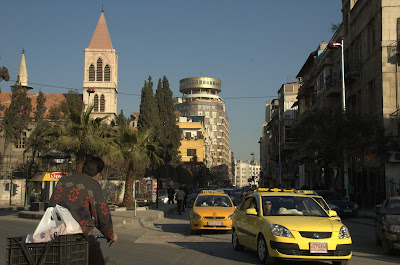
BEIRUT - The Syrian car sector has been hit hard by the country's ongoing civil conflict, now into its sixth year.
From nearly 90,000 vehicles being imported into Syria annually before the rebellion against the rule of President Bashar al-Assad started in 2011, imports have plunged to about 1,000 a year. But despite a burgeoning used-car market and rampant smuggling of stolen cars, an agreement was signed this year to locally manufacture China’s Dongfeng Motor DFM brand. Production started in February in the city of Hama, north of Homs, well within the government-controlled zone of Syria.
The country’s once-burgeoning car market had seen sales surge after the government reduced import duties in 2005, from 255% to 60% for cars above 1.6L, and from 145% to 40% for those with smaller engines. Indeed, in 2010, Syria imported some 87,000 cars, double that of neighboring Lebanon, although small on a per-capita basis, given Syria’s population of 18 million compared with Lebanon’s population of 4 million at the time.
European, Japanese, South Korean, Iranian and Chinese cars were selling well, while American models not built in the U.S. also were available in the market (Syria had imposed high customs duties on U.S.-made products).
When anti-Assad demonstrations broke out in March 2011, sales started to plunge due to political instability. “The new-car market has taken a nosedive, as no one is willing to buy a car in case the window is blown in by an explosion or it’s taken at a (military or militia) checkpoint,” says a former car dealer now living in Beirut, Lebanon, who asked to remain anonymous.
Even many bureaucrats avoid using new and official cars in the areas still under government control, instead using yellow cabs, typically Chinese or Iranian brands.
The sanctions imposed on Syria in 2011 by the European Union and the U.S. cut the country out of the Society for Interbank Worldwide Financial Telecommunication transaction network and from using U.S. dollars and euros.
With the Syrian government burning through its foreign reserves, in the fall of 2011 a ban on automobile imports was announced, with the Central Bank of Syria’s governor saying the import ban would save $4.5 billion in scarce foreign currency. The decision was overturned following pressure from car dealerships, says Jihad Yazigi, editor of the Syria Report financial newsletter.
Instead, the government raised tariffs on vehicles, duties that remain in place today – although with sales dwindling they do not raise much revenue. These are now 50% on all cars with engines of 1.6L and under; cars with engine sizes of 1.6L-3.0L, 80%; cars with engines above 3.0L, 120%; and above 4.0L, 150%.
At the same time, the Syrian pound started to depreciate, eventually reaching SYP520:$1 in 2015, from SYP47:$1 in 2011. The pound remains weak, with black-market rates being the key rate given that formal international trading in the currency largely HAS ceased, making imported cars prohibitively expensive for Syrians still earning and using the local currency.
As the conflict spread around the country, sales dropped even further. According to Syrian newspaper Al Watan, about 1,000 cars were imported each year in 2013, 2014 and 2015. Figures for 2016 are not yet available and those statistics cover government-controlled areas only, although the government does officially run the largest population centers, including most of Damascus and Aleppo.
Due to the tanking economy and widespread violence, more than 4 million Syrians have left the country, either taking their cars with them to neighboring countries or selling them.
The automobile sector slowly has morphed into a used-car market. “The used market has been growing the most, and the stolen-car market,” the dealer says. “A lot get stolen in the country and then shipped out, but many are stolen in Lebanon, Turkey and Europe that end up in Syria.”
He adds that his dealership sold just six cars in 2016, all from 2012 inventory. “There’s no way we’d spend hard currency to ship cars to Syria that would sit in a lot waiting to be sold, as anything could happen. The risk is way too high.”
The Syrian government last September banned the importation of cars until the end of the year. No reason was given, but Yazigi believes it was to further reduce imports and retain much-needed foreign currency.
Data on locally produced cars is minimal but is believed to be in the low thousands for Iranian brands Khodro and SAIPA, manufactured through Iranian-Syrian joint ventures in Damascus and Homs. In February, Syrian company Khallouf Trading announced it was starting the production and sales of two new locally assembled cars under license from China’s DFM brand: the S50 sedan, which will be priced at SYP9 million ($18,000), and the all-wheel-drive AX7, priced at SYP13 million ($26,000).
Sales of the new vehicles are expected to be driven by the import ban, bolstered by the availability of spare parts and aftersales service, as spare parts are hard to import into the country due to sanctions.
There is demand for high-end cars from a rising class of war profiteers. “There is a nouveau riche (clientele) buying supercars. It is surprising in a conflict to see a $1 million Bugatti with Syrian license plates,” the dealer says.
Photograph: Damascus, 2008, by Paul Cochrane
Due to the tanking economy and widespread violence, more than 4 million people have left Syria, either taking their cars with them to neighboring countries or selling them. The automobile sector slowly has morphed into a used-car market.

Bureaucrats avoid using official cars in the areas still under
government control, instead using yellow cabs, typically Chinese or
Iranian brands.
BEIRUT - The Syrian car sector has been hit hard by the country's ongoing civil conflict, now into its sixth year.
From nearly 90,000 vehicles being imported into Syria annually before the rebellion against the rule of President Bashar al-Assad started in 2011, imports have plunged to about 1,000 a year. But despite a burgeoning used-car market and rampant smuggling of stolen cars, an agreement was signed this year to locally manufacture China’s Dongfeng Motor DFM brand. Production started in February in the city of Hama, north of Homs, well within the government-controlled zone of Syria.
The country’s once-burgeoning car market had seen sales surge after the government reduced import duties in 2005, from 255% to 60% for cars above 1.6L, and from 145% to 40% for those with smaller engines. Indeed, in 2010, Syria imported some 87,000 cars, double that of neighboring Lebanon, although small on a per-capita basis, given Syria’s population of 18 million compared with Lebanon’s population of 4 million at the time.
European, Japanese, South Korean, Iranian and Chinese cars were selling well, while American models not built in the U.S. also were available in the market (Syria had imposed high customs duties on U.S.-made products).
When anti-Assad demonstrations broke out in March 2011, sales started to plunge due to political instability. “The new-car market has taken a nosedive, as no one is willing to buy a car in case the window is blown in by an explosion or it’s taken at a (military or militia) checkpoint,” says a former car dealer now living in Beirut, Lebanon, who asked to remain anonymous.
Even many bureaucrats avoid using new and official cars in the areas still under government control, instead using yellow cabs, typically Chinese or Iranian brands.
The sanctions imposed on Syria in 2011 by the European Union and the U.S. cut the country out of the Society for Interbank Worldwide Financial Telecommunication transaction network and from using U.S. dollars and euros.
With the Syrian government burning through its foreign reserves, in the fall of 2011 a ban on automobile imports was announced, with the Central Bank of Syria’s governor saying the import ban would save $4.5 billion in scarce foreign currency. The decision was overturned following pressure from car dealerships, says Jihad Yazigi, editor of the Syria Report financial newsletter.
Instead, the government raised tariffs on vehicles, duties that remain in place today – although with sales dwindling they do not raise much revenue. These are now 50% on all cars with engines of 1.6L and under; cars with engine sizes of 1.6L-3.0L, 80%; cars with engines above 3.0L, 120%; and above 4.0L, 150%.
At the same time, the Syrian pound started to depreciate, eventually reaching SYP520:$1 in 2015, from SYP47:$1 in 2011. The pound remains weak, with black-market rates being the key rate given that formal international trading in the currency largely HAS ceased, making imported cars prohibitively expensive for Syrians still earning and using the local currency.
As the conflict spread around the country, sales dropped even further. According to Syrian newspaper Al Watan, about 1,000 cars were imported each year in 2013, 2014 and 2015. Figures for 2016 are not yet available and those statistics cover government-controlled areas only, although the government does officially run the largest population centers, including most of Damascus and Aleppo.
Due to the tanking economy and widespread violence, more than 4 million Syrians have left the country, either taking their cars with them to neighboring countries or selling them.
The automobile sector slowly has morphed into a used-car market. “The used market has been growing the most, and the stolen-car market,” the dealer says. “A lot get stolen in the country and then shipped out, but many are stolen in Lebanon, Turkey and Europe that end up in Syria.”
He adds that his dealership sold just six cars in 2016, all from 2012 inventory. “There’s no way we’d spend hard currency to ship cars to Syria that would sit in a lot waiting to be sold, as anything could happen. The risk is way too high.”
The Syrian government last September banned the importation of cars until the end of the year. No reason was given, but Yazigi believes it was to further reduce imports and retain much-needed foreign currency.
Data on locally produced cars is minimal but is believed to be in the low thousands for Iranian brands Khodro and SAIPA, manufactured through Iranian-Syrian joint ventures in Damascus and Homs. In February, Syrian company Khallouf Trading announced it was starting the production and sales of two new locally assembled cars under license from China’s DFM brand: the S50 sedan, which will be priced at SYP9 million ($18,000), and the all-wheel-drive AX7, priced at SYP13 million ($26,000).
Sales of the new vehicles are expected to be driven by the import ban, bolstered by the availability of spare parts and aftersales service, as spare parts are hard to import into the country due to sanctions.
There is demand for high-end cars from a rising class of war profiteers. “There is a nouveau riche (clientele) buying supercars. It is surprising in a conflict to see a $1 million Bugatti with Syrian license plates,” the dealer says.
Photograph: Damascus, 2008, by Paul Cochrane
Wednesday, June 21, 2017
Gas and the Gulf crisis: How Qatar could gain the upper hand
Asian markets, military allies and a crucial pipeline all offer Doha leverage against its adversaries amid the current crisis
Middle East Eye
The blockade of Qatar, led by Saudi Arabia and the United Arab Emirates, has already had an economic impact.
Qatar, the world’s second largest producer of helium, has stopped production at its two plants as it cannot export gas by land. Qatar Airways can no longer fly to 18 destinations. Qatari banks are feeling the pinch, particularly the Qatar National Bank (QNB), the region’s largest by assets, and Doha Bank: both have extensive networks across countries which are members of the Gulf Cooperation Council (GCC).
Ratings agency Standard & Poor's (S&P) downgraded Qatar’s credit rating from AA to A- on 8 June. It could put it on credit watch negative, a sign that the crisis could impact investment and economic growth. Moody’s followed suit, placing Qatar’s AA long-term foreign and local currency Issuer Default Ratings (IDRs) on rating watch negative.
Doha is unlikely to buckle soon. It has plenty of financial muscle, not least in its sovereign wealth fund, the Qatar Investment Authority (QIA), which holds an estimated $213.7 billion, according to the Institute of International Finance. The seed capital for that fund comes from Qatar’s oil and gas exports.
Energy receipts account for half of Qatar’s GDP, 85 percent of its export earnings and 70 percent of its government revenue. The crisis may affect the emirate's medium- to long-term energy contracts, as buyers diversify their imports to be less reliant on Qatari gas.
To read the rest go to: http://www.middleeasteye.net/essays/qatar-and-gulf-crisis-who-holds-winning-card-energy-stakes-1648311614
Monday, May 29, 2017
The 'Pipelineistan' conspiracy: The war in Syria has never been about gas
The
pipeline hypotheses do not stand up to the realities of how energy is
transported through the Middle East in the 21st century
Middle East Eye
Middle East Eye
Six years into a conflict that has killed at least 400,000 people, there is a widely held belief that the bloodshed in Syria is simply another war over Middle Eastern energy resources.
The bloodshed, so the theory goes, is a proxy battle about two proposed pipelines which would run across the country and on to Turkey and Europe.
While neither pipeline has left the drawing board, or indeed was ever realistic, this has not dampened the theory's popularity as a core reason for the Syria conflict.
The first pipeline is allegedly backed by the US and runs from Qatar through Saudi Arabia and Jordan to Syria. The second is a supposedly Russia-backed pipeline that goes from Iran, via Iraq, to Syria.
Syrian President Bashar al-Assad, it is claimed, rejected the Qatari pipeline in 2009, at the request of Moscow, to ensure that European reliance on Russian gas would not be undermined.
As a result, some commentators claim, the US and its European and Gulf allies, including Qatar, decided to orchestrate a rebellion against Assad to ensure that their pipe dreams became a reality rather than the Iranian option. Russia, in turn, backed Syria to ensure its own energy interests prevailed. Iran is also an ally of the current regime in Damascus.
These claims have been promoted in several quarters: the Qatari-based Al Jazeera first floated the concept of a "Pipelineistan war" in 2012.
Even US establishment journal Foreign Affairs and the Guardian newspaper picked up on the theory, which gained further traction in 2016 in an article by Robert Kennedy Jr, and was flagged by, among others, Jill Stein of the Green Party, a former US presidential candidate.
The idea was floated again after the US bombing of Syria in April. This, it was claimed, was further "proof" of Washington's desire to oust Assad and enable Europe to diversify its gas dependency away from Russia.
While the US has been covertly working with Gulf allies against the Assad regime, controlling Syria's energy resources and pipeline networks was not a primary concern. If so, it would be a very low priority for regime change.
Why? Firstly, the timeline is wrong. Covert action against Syria started under the George W Bush administration, in 2005, well before the alleged Qatari offer to Damascus in 2009.
"We can see US action against the Syrian regime well before the notion of this pipeline came into existence," says Justin Dargin, an energy scholar at Oxford University.
Secondly, the pipeline hypotheses do not stand up to the realities of how energy is transported through the Middle East and the obstacles faced by pipeline proposals, many of which fail to come to fruition. Even the Arab Gas Pipeline, whose second phase came online in 2005, has been mired in problems.
Robin Yassin-Kassab, author of Burning Country: Syrians in Revolution and War, says the Pipelineistan theory also ignores how the conflict started and the early months of the revolution.
"Like all conspiracy theories, it thrives on the absence of content and in-depth knowledge of the country," he says.
TO READ THE REST GO TO: http://www.middleeasteye.net/essays/pipelineistan-conspiracy-why-war-syria-was-never-about-gas-144022537
Monday, April 03, 2017
The Gulf in terrorist finance control

Arab Gulf governments are repeatedly accused of aiding terrorist financing on and, more often, off the record. Calls to get tough on these states have been side-lined by political and economic expediency, while Gulf moves to curb such funding have been lacklustre, with risks in prospect, reports Paul Cochrane, from Beirut.
Terrorist
financing is continuing
in the Middle East, highlighted
by the devastating attack in
Istanbul over the new year. Radical
Islamic groups still operate
in Iraq and Syria, notably the Islamic State, or ISIL (also
known as ISIS), and their
source of funding is
a contentious issue.
Currently
the issue is tied up with the Syria conflict due to the number of
armed actors involved. On one side is the Syrian regime, backed by
Moscow and Tehran. Iran, being
a Shia Muslim republic,
supports Hezbollah, the Shia
Islamist militant group and political party based in Lebanon, which
is deeply involved in the Syrian conflict. On
the other side are the rebels, which include radical Sunni Muslim
groups such as ISIL, Jabhat al Nusra (renamed Jabhat Fatah al-Sham in
July 2016) and Al Qaeda, which are also under international
sanctions.
The
pro-regime Syria group claims Sunni
terrorist organisations are
funded by the six Gulf
Cooperation Council (GCC), especially Saudi Arabia and Qatar – the
other four being Bahrain, Kuwait, Qatar, Oman and the United Arab
Emirates (UAE) and
their allies, the United
States, the UK and Turkey.
But the
GCC states deny
any terrorism funding,
although openly supporting
rebel groups wanting to
oust Syrian President Bashar Assad: so
has the US government,
which has joined
Saudi Arabia in openly
support Syrian rebels, along
with the UK.
But
while Syria and Iran have been labelled ‘state sponsors of
terrorism’ by Washington,
countries judged by the US Secretary of State to repeatedly support
terrorist acts, with the US
Senate on 1 December 2016
extending the Iran and
Libya Sanctions Act of
1996 (ISLA) for another 10
years, the GCC states have not been rapped over the knuckles by the
US or other international bodies over terrorist financing.
In
private, however, more forthright opinions have been expressed: “We
need to use our diplomatic and more traditional intelligence assets
to bring pressure on the governments of Qatar and Saudi Arabia, which
are providing clandestine financial and logistic support to ISIL and
other radical Sunni groups in the region,” reads a leaked
email between Secretary of State Hilary Clinton and John Podesta, a
Counselor to President Barack Obama, dated 17 August 2014.
In
2009, another leaked
Clinton memo stated: “Donors
in Saudi Arabia constitute the most significant source of funding to
Sunni terrorist groups worldwide.” It
also said that the UAE was “a
strategic gap” that terrorists can exploit, Qatar was “the worst
in the region” on counterterrorism, and Kuwait “a key transit
point”.
The
US Treasury has kept quiet on
the matter, with the
emphasis on individual funders, not GCC governments. “The top US
official for terror finance said in 2015 that Arab Gulf monarchies
are the largest source of donations to Al Qaeda,” said
Dr David Andrew Weinberg,
Senior Fellow at the
Foundation for Defense of Democracies in Washington DC.
He
said the likely reasons
were “the high
concentration of millionaires and billionaires in that area, and “the
intense religious currents in the region. Putting those two together
seems a higher risk for terrorist financing incidents”.
This
position is echoed
by Dr Theodore Karasik, Senior Advisor at Dubai,
UAE-based consultancy Gulf
State Analytics (GSA).
“The (GCC) governments do an excellent job of trying to halt
(terrorist financing) activity but because of sympathies and also the
inability for 100 percent border control, there are going to be
leaks. These gaps need to be filled with more proactive action
instead of reaction,” he said.
Meanwhile,
the US Department of State’s
March 2016
International Narcotics Control Strategy Report (INCSR) cites private
individuals and charities as potential
terrorist financers.
Saudi Arabia, Qatar, Bahrain and Kuwait were
all labelled a
“Jurisdiction of Concern’, while the UAE was deemed a
‘Jurisdiction of Primary Concern’ and Oman a ‘Monitored
Jurisdiction’ (lower
risk).
Selective
vision
Cynics
say the unwillingness to act against the GCC states over terrorist
financing is due to political expediency. GCC states, while hosting
US and UK military facilities, are not only seen as long-standing
allies, there is the allure of
petrodollars (revenue from
petroleum exports). “An
important element of not seeing Gulf leaders put to task is that they
are influential... and have a great deal of money,” the
FDD’s Dr Weinberg
said.
But
ignoring GCC
activities is counter-productive,
David L. Phillips,
Director
of the Programme on Peace-building and Rights at Columbia
University’s
Institute for the Study of Human Rights, told MLB:
“When you politicise the decision around sanctions you undermine
the whole effort against terrorist financing. If it is [GCC]
government policy [to support terrorism] then the US needs to react
bilaterally,” and individual views
also need considering, said
Mr Phillips, a
former senior adviser to the US State Department in Iraq.
Questions
over US support for Syrian rebel groups finally
led to a bill,
introduced on 29
June 2016, to create
the ‘Stop Terrorist Operational Resources and Money Act’ (STORM),
aimed at “prohibit(ing) the US government from using American
taxpayer dollars to provide funding, weapons, training, and
intelligence support to groups like the Levant Front, Fursan al Ha
and other allies of Jabhat Fateh al-Sham, al-Qaeda and ISIS, or to
countries who are providing direct or indirect support to those same
groups,” said the
legislative text.
The
Act, proposed by
Democratic Senator Bob Casey (Penn.), if
adopted,
could change existing
policy. “STORM would basically create new statutory penalties for
countries in the gray zone - sins of omission. That might create new
incentives in GCC-US relations to address current issues,” said Dr
Weinberg.
Independent
will
Meanwhile,
the GCC states have certainly
acted as if they are addressing CFT
(combating the financing or terrorism)
issues. In
November 2014, they adopted the Manama
Declaration on CFT, and were
part of the 34-state Islamic coalition that signed the Jeddah
Communique to fight terrorism – on 11 September 2014.
But
critics say these
moves and anti-money laundering
(AML)
regimes over the past 16 years have not been overly proactive. “I
kept pounding the table over a decade ago to pay attention to the
Gulf but little traction was taken. Since 2001, the region started to
get its act together. The problem is, I have no sympathy any more as
the infrastructure is there but what is lacking is enforcement and
initiative. If the US or Britain goes to Saudi Arabia or Kuwait and
says, ‘look into this’, they will, but will not do so from their
own initiative,” said Board Adviser for the FDD’s Center on
Sanctions and Illicit Finance ( C SIF), John Cassara.
The
Jeddah Communique
has also not been well enforced, argue
experts: “The Gulf states pledged
to combat terrorist financing and repudiate the ideology that
underpins violent extremist groups but many have failed to follow up
on this. I don’t believe Qatar and Kuwait have convicted anyone on
the US on UN designation lists, which seems a clear violation of the
Jeddah Communique,” said Weinberg.
GSA’s
Dr Karasik points out a different mindset towards enforcing
international regulations. “You don’t see it manifested in
convictions but in a resignation or early retirement, or some action
done on their terms, not dictated by outside,” he said. “Having
said that, it does have an impact, as their continued move to
compliance and transparency helps Arab states perform their
(regulatory) transformation.”
A
further challenge is that only three GCC states - Bahrain, the UAE
and Saudi Arabia - have issued lists of terrorist organisations, Dr
Weinberg said. “That
further exacerbates the problem of identifying which groups are OK to
be funded out of these jurisdictions.”
Risk
to reputation?
The
banking sector has also fallen foul of terrorist financing. Six
Arab banks have lost their correspondent (deposit)
banking relationships with the US in recent
years, the first a Saudi Arabian bank in 2013
– the Al Raji Bank.
But this is less related to
CFT regime concerns and more to do with increased
compliance requirements on a range of
AML-CFT rules laid down by the Financial Action Task Force (FATF) and
the US government.
An Arab Monetary Fund study,
published in September 2016, found that foreign banks were de-risking
due to (in order of importance): lower overall risk appetite, legal
and regulatory changes, lack of profitability in correspondent
banking, sovereign credit risk ratings, and concerns about AML and
CFT risks in Arab countries.
“Reputational
risk was already a concern when foreign investors look at new
investment opportunities in the GCC. Because of heightened US
requirements for transparency and compliance, this type of action
helps to illuminate potential terrorist financing in the region,”
said Dr Karasik.
Moreover,
given the ongoing good relations between the West and the GCC, there
is not, at least yet, any major reputational risk concerns for
foreign institutions dealing with the Gulf. “There will be pressure
on de-risking but also ongoing pressure to seek money from GCC
institutions. After the economic shocks in the US and Europe, and
currently the refugee crisis, I don’t think de-risking is
necessarily going to happen to the extent it should,” said
Weinberg.
The
FDD’s Mr Cassara, a former US Treasury special agent, agreed:
“Right now I think there is nothing to worry about. Big banks in
the region are doing what they need to do to adhere to international
norms from FATF and the US. Could I see a shift? Yes. But nobody
knows what is going to happen with the new (Donald) Trump
administration.”
Photo by Paul Cochrane (Manama, Bahrain)
Subscribe to:
Posts (Atom)